


 Lot 373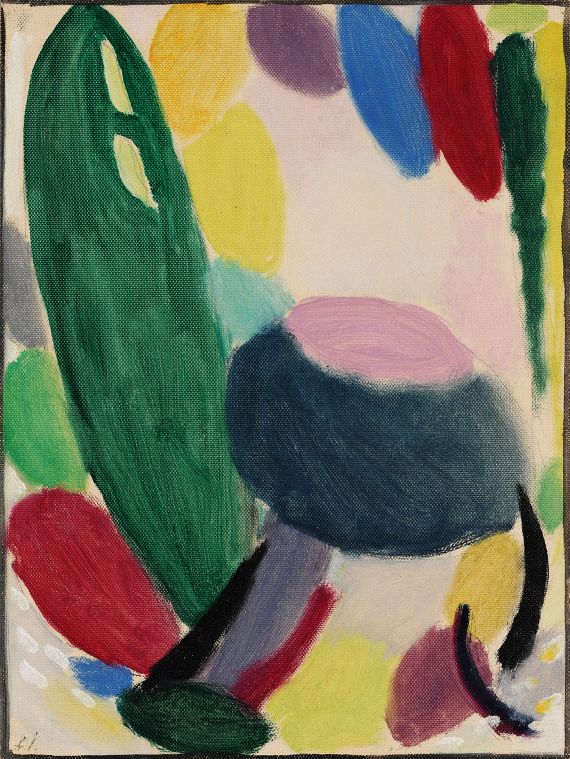
(incl. surcharge)
Variation. Um 1918.
Mit einer Echtheitsbestätigung des Alexej von Jawlensky-Archivs S.A., Locarno und des wissenschaftlichen Beirats vom 22.11.2005, dem das Werk im Original zur Begutachtung vorgelegen hat. Die Arbeit wird in das Werkverzeichnis Alexej von Jawlenskys aufgenommen
PROVENIENZ: Annie Hensler-Möhring, Wiesbaden (Geschenk des Künstlers).
Als ehemaliger Offizier der zaristischen Armee beginnt Jawlensky erst 1889 in St. Petersburg mit seiner künstlerischen Ausbildung. Er studiert bei Ilja Repin und lernt über diesen Marianne von Werefkin und Helene Nesnakomoff, seine spätere Frau, kennen. Mit beiden siedelt Jawlensky 1896 nach München über, um eine private Kunstschule zu besuchen. Hier lernt er Wassily Kandinsky kennen. Der Künstler unternimmt mehrere Reisen nach Frankreich und kann 1905 durch Vermittlung von Sergej Djagilev im Salon d'automne zehn Gemälde zeigen. Jawlensky trifft zum ersten Mal Henri Matisse. Im Sommer 1908 arbeitet er mit Kandinsky, Marianne von Werefkin und Gabriele Münter erstmals zusammen in Murnau. Hier entsteht auch die Idee zur Gründung der "Neuen Künstlervereinigung München", zu der sich die vier Maler und andere Münchner Künstler 1909 zusammenschließen. Im Dezember desselben Jahres findet in München die erste Ausstellung der Gruppe statt. Zwei Jahre später wird der "Blaue Reiter" als neue große Idee einer künstlerischen Zusammenarbeit ins Leben gerufen. 1913 nimmt der Künstler am Ersten Deutschen Herbstsalon Herwarth Waldens in Berlin teil. Als 1914 der Erste Weltkrieg beginnt, wird Jawlensky als russischer Staatsbürger aus Deutschland ausgewiesen. Er siedelt mit seiner Familie und Marianne von Werefkin nach St. Prex am Genfer See über und lebt bis 1921 in der Schweiz, wo er 1918 u.a. mit seinen abstrakten Köpfen beginnt.
In St. Prex am Genfer See in einer kleinen Wohnung wird ein Fensterausblick, den Jawlensky zunächst in angenäherter Realität festhält, zum Urtyp einer langen Reihe von Variationen, die in ihrer späteren Gestaltung kaum mehr etwas von der ursprünglichen Landschaft erahnen lassen. Die immer weiterführende Abstraktion, die Jawlenskys Suchen nach dem Urbild verdeutlicht, ist in allen drei Themengruppen - den Variationen, den konstruktiven Köpfen und den Meditationen - von ihm konsequent verfolgt worden. "Ich fing an, meine sogenannten 'Variationen über ein landschaftliches Thema', die ich vom Fenster sah, zu malen [...]. In harter Arbeit und mit größter Spannung fand ich nach und nach die richtigen Farben und Formen, um auszudrücken, was mein geistiges Ich verlangte. Jeden Tag malte ich diese farbigen Variationen, immer inspiriert von der jeweiligen Naturstimmung zusammen mit meinem Geist" (Jawlensky, Lebenserinnerungen, S. 116). Wie schon in den Lebensläufen anderer Maler zu verfolgen, ist auch bei Jawlensky die Nähe zur Musik spürbar. In kaum einem anderen Medium werden Variationen so schöpferisch verstanden, wie in der musikalischen Komposition. Jawlensky, der die einmal gefundenen Formen immer wieder versatzstückhaft in die Komposition einfügt, erreicht sein Ziel über die Farbe und das in einer so genialen Weise, dass die Variationen, obwohl formal ähnlich, sich immer neuen Interpretationen öffnen.
1922 lässt sich Jawlensky endgültig in Wiesbaden nieder, wo er vermutlich Anfang der 1920er Jahre die Malerin und Fotografin Annie Hensler-Möring und ihren Ehemann, den Bildhauer Arnold Hensler kennenlernt. Jawlensky leidet unter einer fortschreitenden Lähmung und kann nur unter Schwierigkeiten malen. 1933 wird er von den Nationalsozialisten mit Ausstellungsverbot belegt. Im Jahr darauf beginnt der Maler mit der Reihe der kleinformatigen "Meditationen". Am 15. März 1941 stirbt Alexej von Jawlensky in Wiesbaden. [KD]
Öl über Bleistift auf leinenstrukturiertem Malpapier, auf Karton aufgezogen.
Links unten monogrammiert. Verso auf dem Unterlagekarton wohl von Emmy Galka Scheyer bezeichnet "I", "A v Jawlensky", "400.000" und "150.000" (durchgestrichen). 36,3 x 27 cm ( 14,2 x 10,6 in).
Verso mit einem gedruckten Adressetikett von Annie Hensler-Möhring, Wiesbaden. Hensler-Möhring war Malerin und Fotografin. Unter den Fotodokumenten im Jawlensky-Archiv in Locarno befindet sich eine Porträtaufnahme Jawlenskys von ihrer Hand.
Privatbesitz Deutschland (Geschenk von Annie Hensler-Möhring um 1970).
Privatbesitz Deutschland (durch Erbfolge).
Privatsammlung Deutschland.

(incl. surcharge)