


Frame image
Raumbeispiel
225
Shozo Shimamoto
Ohne Titel, 1961.
Mixed media on canvas. Wood, plaster, enamel pa...
Estimate:
€ 80,000 - 120,000
$ 89,600 - 134,400
225
Shozo Shimamoto
Ohne Titel, 1961.
Mixed media on canvas. Wood, plaster, enamel pa...
Estimate:
€ 80,000 - 120,000
$ 89,600 - 134,400
Shozo Shimamoto
1928 - 2014
Ohne Titel. 1961.
Mixed media on canvas. Wood, plaster, enamel paint, and paper on canvas.
Signed in the lower right. Signed, dated, and inscribed on the reverse, partly in Japanese, and with a direction arrow. 96 x 73 cm (37.7 x 28.7 in).
[EH].
• 1954: Shozo Shimamoto founded “GUTAI” with Jiro Yoshihara.
• “GUTAI” is a globally influential group and the most significant postwar artists’ collective in Japan.
• One of the artist’s rare works from the early “GUTAI” period on the international auction market.
• Shozo Shimamoto breathes life into the materials in his works.
• In 1993, Shozo Shimamoto was represented alongside other “GUTAI” members at the Venice Biennale.
• Works from Shimamoto’s early career are at, among others, the collection of the Tate Gallery, London, and at the Ashiya City Museum of Art & History in Japan.
Accompanied by a certificate of authenticity issued by the Shozo Shimamoto Archive, Naples, dated July 4, 2004. The work is registered with the archive under number 1337.
We are grateful to the Shozo Shimamoto Archive for their kind assistance.
PROVENANCE: Galerie Sander, Darmstadt (with a label on the stretcher).
Private collection, Bavaria (acquired from the above in 1991).
Swiss collection (2015, Ketterer Kunst, from the above).
LITERATURE: Ketterer Kunst, Munich, Auction 429, Post-1War Art / Contemporary Art, Dec. 4–5, 2015, Lot 917 (with color illustration).
“There is no other artist who embodies Gutai like Shimamoto”
Michel Tapié, quoted from: Exhibition catalog Jiro Yoshihara, Shozo Shimamoto, Gutai Gallery, Osaka 1962
Called up: December 5, 2026 - ca. 15.46 h +/- 20 min.
After World War II, not only did Western art reorient itself, but artists in Japan also sought new paths of form and expression. The artists’ group “GUTAI,” founded in 1954, represents the most important and radical movement of those years in Japan. Jiro Yoshihara, Toshio Yoshida, and Shozo Shimamoto were among the founding members; the name “GUTAI” stands for “actualization of the spirit through the material” (see Dietmar Rübel et al. (eds.), Material Aesthetics: Source Texts on Art, Design, and Architecture, Berlin 2017, p. 260).
The materiality and animation of the material are thus also central to Shozo Shimamoto’s work. Even before Lucio Fontana, he worked on redefining the picture plane through holes; he rejected the conventional method of painting with a brush, instead throwing and catapulting paint onto the picture plane. As with other “GUTAI” artists, performances were the primary focus in his early years. With the opening of the GUTAI Pinacotheca in Osaka in 1962, the traditional format of the “panel painting” once again came into sharper focus.
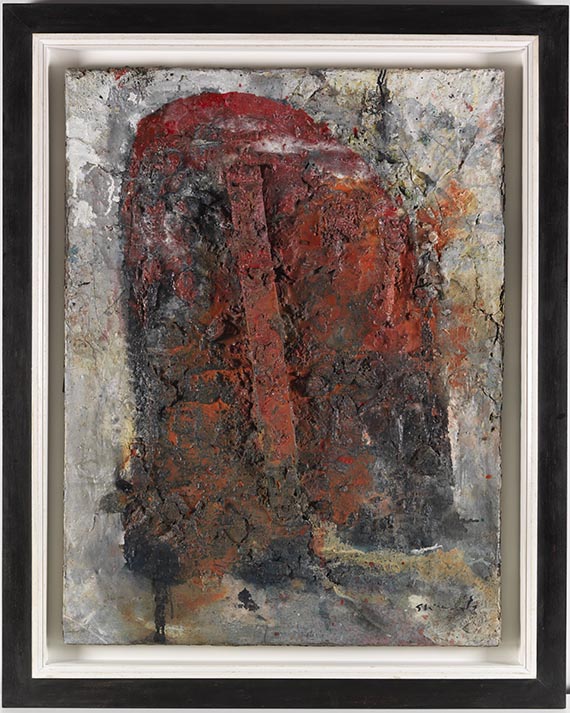
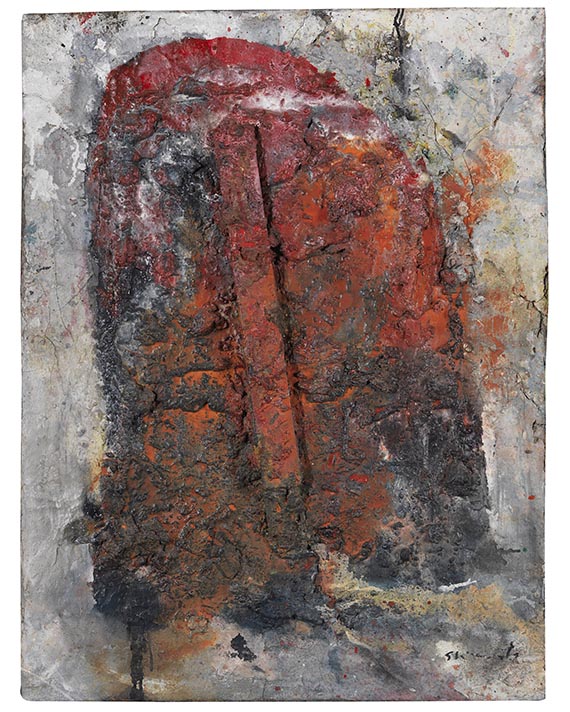
The painting offered here was created just one year earlier. Shozo Shimamoto expands the picture plane with a piece of wood set amid the crusty landscape of paint. An impressive color relief emerges with great plasticity, its solidity further enhanced by the combination of the different materials—wood and paper. Here, too, Shimamoto’s art is the result of an action-packed creative process and thus represents a prominent Japanese alternative to American Action Painting, such as that of Jackson Pollock.
