


Frame image

Raumbeispiel
12
Max Beckmann
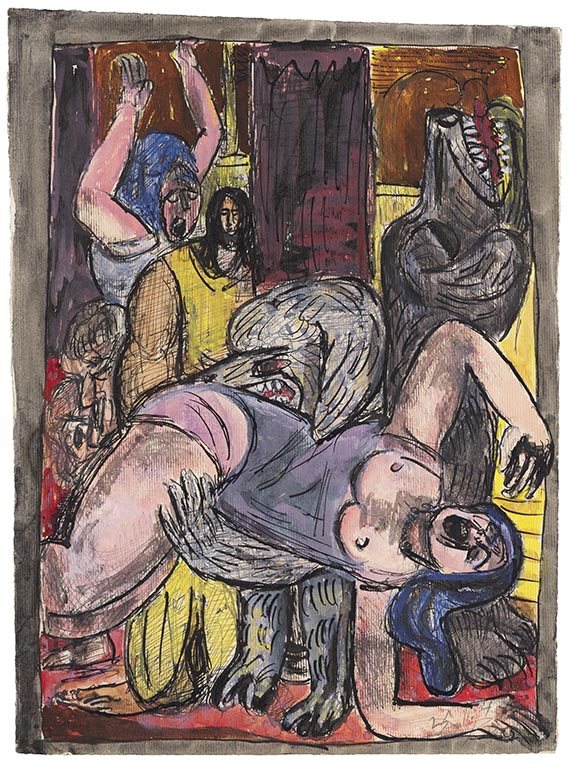
Die Hunde werden größer, 1947.
Watercolor over charcoal, pencil, and ink pen B...
Estimate:
€ 120,000 - 150,000
$ 134,400 - 168,000
12
Max Beckmann
Die Hunde werden größer, 1947.
Watercolor over charcoal, pencil, and ink pen B...
Estimate:
€ 120,000 - 150,000
$ 134,400 - 168,000
Max Beckmann
1884 - 1950
Die Hunde werden größer. 1947.
Watercolor over charcoal, pencil, and ink pen Bleistift und Tuschfeder.
Signed and dated “11/25/47 I B” in the lower right. With a hand-written note “Die Hunde werden grösser. 11/25/47. Amsterdam” (The dogs are getting bigger) on the reverse, as well as with a dedication from Quappi Beckmann to Günther Franke: ”für Günter Franke | in alter Freundschaft | und Gedenken an Max | herzlich von | Mathilde Quappi Beckmann.”. On PH-Antique laid paper. 34.5 x 25 cm (13.5 x 9.8 in), the full sheet. [JS].
More works from the Kropatscheck Collection are offered in our Day Sale on Saturday, December 5, 2026, in our Rare Books auction on Monday, November 23, 2026, and in our Online Sale from January 15 through February 15, 2027.
• MODERN MARTYRDOM Symbol of Beckmann’s tragic personal situation in 1947.
• NEW BEGINNING / NEW START Created between his exile in Amsterdam and his new beginning in America, similar to the triptych “The Beginning” (1946–49) (Metropolitan Museum, New York).
• ENIGMATIC A scene of horror serving as a condensed symbol of political threat?
• EXCELLENT PROVENANCE Quappi Beckmann dedicated this work to her friend Günther Franke.
• EXHIBITION Major solo exhibitions, notably at the Schirn, Frankfurt am Main (2006), the Van Gogh Museum, Amsterdam (2007), the Städel, Frankfurt am Main (2011–12), and the Kunsthalle Hamburg (2021–22).
PROVENANCE: Mathilde (Quappi) Beckmann, New York.
Günther Franke, Munich (Beckmann’s gallerist and art dealer; gifted by the above, inscribed on the reverse).
Sophie Franke, Munich (1977, from the above).
Private collection (1992, Kornfeld).
Fritz Eugen and Hannemarie Kropatscheck Collection, Hamburg (acquired from the above in 2006, Kornfeld).
EXHIBITION: Buchholz Gallery – Valentin Gallery, New York (listed as “anonymous loan, not for sale” in the catalog).
Max Beckmann. Frankfurter Kunstkabinett Hanna Brekker vom Rath, Frankfurt am Main 1955, cat. no. 31 (here with different dimensions).
Max Beckmann. 180 Zeichnungen und Aquarelle aus deutschem und amerikanischem Besitz, Galerie Günther Franke, Munich 1975, cat. no. 149.
Max Beckmann. Aquarelle und Zeichnungen 1903–1950. Kunsthalle Bielefeld, 1977, cat. no. 204, p. 75 (with illu.).
Der Zeichner und Grafiker Max Beckmann, Kunstverein Hamburg 1979, cat. no. 140, p. 139 (with illu. on p. 129).
Hommage à Günther Franke. Barlach, Baumeister, Beckmann, Bembé, Blumenthal.., Villa Stuck, Munich 1983, cat. no. 19, p. 37 (with illu., here with different dimensions).
Max Beckmann. Retrospective, Haus der Kunst, Munich 1984, cat. no. 196, p. 369 (with ill.).
Max Beckmann. Die Aquarelle und Pastelle, Schirn Kunsthalle, Frankfurt am Main 2006.
Max Beckmann. Exile in Amsterdam, Van Gogh Museum, Amsterdam, April 6, 2007–August 19, 2007; Pinakothek der Moderne, Munich, September 13, 2007–January 6, 2008, p. 342 (with illu. on p. 343).
Beckmann & Amerika, Städel Museum, Frankfurt am Main, 2011/12, cat. no. 52, p. 132 (with illu. on p. 133).
Dix / Beckmann: Mythos der Welt, Kunsthalle Mannheim, Mannheim, 2013/14, cat. no. 89, p. 240 (with illu. on p. 209).
Max Beckmann: weiblich - männlich, Kunsthalle Hamburg 2020/21, cat. no. 75 (with illu. on p. 152).
LITERATURE: Anja Tiedemann, Kaldewei Cultural Foundation (ed.), Max Beckmann: Catalogue Raisonné of Paintings, Frankfurt am Main, Online CR no. MB-AP 134 (with illu.), Source: https://max-beckmann.org/mb/ap/134 [last accessed: Oct. 10, 2026].
Mayen Beckmann and Siegfried Gohr, Max Beckmann. The Watercolors and Pastels. Catalogue Raisonné of Color Works on Paper, Cologne 2006, CR no. 134, pp. 296–297 (with illu.).
- -
Max Beckmann, diary entry from December 27, 1947.
Stadtnächte. Der Zeichner und Grafiker Max Beckmann, exhibition catalog, Kunstverein Hamburg, 1980, p. 141 (with illu. on p. 133).
Erhard Göpel (ed.), Max Beckmann. Tagebücher 1940–1950, Munich 1984, p. 240.
Max Beckmann. Retrospective, exhibition catalog, St. Louis Art Museum, 1984, p. 369.
Galerie Kornfeld, Bern, Modern Art, Part I, Auction June 26, 1992, cat. no. 5 (with illu.).
Klaus Gallwitz, Uwe M. Schneede, Stephan von Wiese (eds.), Max Beckmann Briefe, 1937–1950, Vol. III, Munich/Zurich 1996, p. 12.
Helmut G. Schütz, Sphinx Beckmann. Exemplarische Annäherung an Max Beckmanns Kunst, Munich 1997, p. 123.
Siegfried Gohr, Selbstgespräche. Watercolors and Pastels by Max Beckmann, in: Exhibition catalog, Sinclaire-Haus, Bad Homburg 2001, pp. 30 and 38.
Galerie Kornfeld, Bern, Art of the 19th and 20th Centuries, Part I, June 16, 2006, cat. no. 32 (with illu.).
Called up: December 4, 2026 - ca. 17.22 h +/- 20 min.
“Die Hunde werden größer” (The Dogs Are Getting Bigger) is the enigmatic title Max Beckmann chose for this scene—disturbing in all its directness and brutality—from his famous “Welttheater" (World Theater). According to the inscription on the back, Beckmann probably began this work while still in exile in Amsterdam, shortly before he voyaged to New York (August 29 through September 9, 1947). He completed it toward the end of that same year, and, on December 27, 1947—a few months after finally arriving in the U.S.—he wrote in his diary in St. Louis: “Beautiful in the winter sun at Delmar. Infinitely cheerful. […] Corrected new and old watercolors. Finally, ‘The Dogs Are Getting Bigger.’” A bizarre scene unfolds in a confined and crowded space: A gigantic, vaguely outlined dog has its arms wrapped around a half-naked woman screaming in agony and is just about to sink its teeth into her flesh. With its head thrown back, an equally monstrous dog at the right edge of the picture howls at the sky, while—separated by a dark purple curtain—figures in the left half of the picture, some wailing, some clinging tightly to one another, and some watching indifferently, bear witness to this sinister spectacle. But what is Beckmann trying to express in this scene? What deeper meaning does this artistic excess convey, created between Amsterdam and New York, between Europe and America?
Christiane Zeiller attempted to decipher the enigmatic scene in the exhibition catalog “Max Beckmann. Exil in Amsterdam” (Van Gogh Museum, Amsterdam / Pinakothek der Moderne, Munich 2007), drawing on earlier Beckmann research: “Whether the theme can be ‘unequivocally interpreted as a male sexual fantasy’ (J. Weiss in: Munich et al. 1984, no. 196, p. 369), cannot be determined with absolute certainty; however, eroticism and violence—especially in this combination—have been an important theme in Beckmann’s oeuvre since his major work "Die Nacht" (1918/19 [..]). The title may allude to the fast pace of life in the U.S. [...], but even more so to the loud, garish nature of the depiction. During his brief three-month stay in the U.S. [...], Beckmann attended a series of cocktail parties and celebrations and participated in the vibrant life of New York.”

However, the reason for the enormous, nightmarish violence and brutality of this scene remains unclear. Did Beckmann leave us a complex political allegory with this enigmatic work—one that, in all its unsettling directness and brutality, resembles a modern martyrdom and thus vaguely recalls his painting “Hölle der Vögel” (1937–38), Beckmann’s famous and unsettling allegory of National Socialism? Given Beckmann’s personal circumstances and the political climate in 1947, this idea seems unlikely only at first glance. For even though World War II had officially ended with Germany's unconditional surrender in May 1945, the horror was far from over even after Dutch Liberation Day—which Beckmann euphorically celebrated as such in his diary entry on May 5, 1947. The Dutch government launched “Operation Black Tulip”, which aimed to deport all ethnic Germans residing in the Netherlands as “enemy subjects”. Beckmann himself likely escaped deportation solely because he assisted a Dutch resistance fighter and was officially classified as a “non-enemy” in 1946. But even Germans who were already in the United States were stigmatized as “enemy aliens”, and, in some cases, were interned until 1948. Beckmann’s situation in 1947 was thus that of a man unwelcome everywhere: in Germany, he had until recently been branded a “degenerate artist” by the Nazis; in the Netherlands, he was still living in daily fear of being declared an “enemy subject” and, until his long-awaited journey to the U.S., exposed to the threat of deportation. He wasn't even truly welcomed in the U.S.A. either, as entry requirements for foreigners remained strict: Beckmann's first application for an entry permit had already been rejected in 1939; in 1947 he finally applied for a visitor’s visa as a “non-enemy” alien, which initially allowed him to accept an invitation to serve as a visiting professor at Washington University in St. Louis, where he completed this challenging masterpiece. However, to change his status from visitor to immigrant, Beckmann ultimately had to leave the U.S. again for a few months in 1948 and return to the Netherlands before he was finally allowed to enter America as an officially recognized immigrant in September 1948. In 1947, Beckmann was like a modern-day Ulysses on an endless, agonizing journey, trapped and beset on all sides by looming dangers. So are they Beckmann’s worries and fears, his deep psychological torments of 1947, that have flowed into “The Dogs Are Getting Bigger” in all their menace, brutality, and harshness? Anyone familiar with Max Beckmann’s highly condensed "World Theatre“ can—or rather, should—assume so. [JS]
On Max Beckmann's painting “Blick von der Terrasse in Monte Carlo” (1935) and the watercolor “Die Hunde werden größer” (1947) – by Dr. Christiane Zeiller, Max Beckmann Archive, Munich
The painting “Blick von der Terrasse in Monte Carlo” (presented in the Ketterer Kunst Evening Sale on December 4, 2026) was created in Beckmann’s Berlin studio, yet it depicts a view of the Côte d’Azur—a fact we will discuss in more detail later. The painting shows the view from a terrace in Monte Carlo, with the so-called “Tir aux Pigeons”—a pigeon house that allowed spa and resort guests to pass the time by shooting pigeons—visible below. Beckmann and his second wife, Mathilde “Quappi,” had been visiting the French Riviera regularly since 1930, staying in Bandol, Menton, Cap Martin, and, of course, Monaco. Like many others, they were enchanted by the light, the mild climate, and the luxurious amenities that attracted visitors: elegant hotels and splendid casinos, beach promenades, and champagne bars—the setting the painter sought and where he found inspiration for his works.
At the same time, the political situation in Germany grew increasingly dire, and by the time Hitler was appointed Reich Chancellor in 1933, power having been seized by the National Socialists, the climate had become precarious for Beckmann as well; his dismissal from the Städelschule and his move to Berlin bear witness to this, as does the fact that, for financial reasons, he had already given up his “pied-à-terre” in Paris the previous year—a place he had maintained since 1929. Even before the propaganda “Degenerate Art” exhibition opened in Munich, the Beckmanns had already decided to leave Germany. (See Christiane Zeiller, Die Beckmanns in Berlin, 1933 bis 1937. Quellen aus dem Max-Beckmann-Archiv, in: Legende und Realität. Max Beckmann im Nationalsozialismus, Berlin 2025, pp. 31ff.
When Max Beckmann created this painting in 1935, he was also working on his first triptych, “Departure,” which contrasts the horror and violence depicted on the side panels with the departing boat on the peaceful, light-blue sea as an expression of hope. “Blick von der Terrasse in Monte Carlo” (View from the Terrace in Monte Carlo) was created precisely within this field of tension between anticipation and departure; it was not painted on site in the spirit of leisure, but in Beckmann’s Berlin studio based on a postcard. It is the first work in an entire series of Riviera paintings for which a postcard as a direct reference can be verified. At the same time, it marks the beginning of his “Landscapes of Longing,” many of which were created in exile and which were inspired by postcards from his beloved region on the Mediterranean. For the painter, they served as small escapes—windows into the cheerful, peaceful world of the Côte d’Azur, which he visited for the last time in 1939, just before the outbreak of war.
Just a few months after Beckmann’s first trip to the United States, he created the watercolor “Die Hunde werden größer.” Shortly after Christmas 1947, Max Beckmann revisited some watercolors he had believed were finished, “corrected” them, and completed “The Dogs Are Getting Bigger,” which he had begun a month earlier (diary entry from December 27, 1947). Both the title and the depiction remain enigmatic; the work shows a screaming female figure at the center who is attacked by a huge dog baring its teeth. Behind her, at the right edge of the picture, a second large dog raises its head, mouth open. In the background, other people can be seen reacting in very different ways to the immediate threat, yet they do not intervene. The depiction is clearly marked by sexual allusions: the screaming woman’s exposed breast and the dogs, with their masculine connotations, driven by “animalistic” instincts. The title may thus also allude to the painter himself, who frequently used an “X” in his diary entries as a code for various types of sexual experiences.
The diaries also reveal that a dog lived in the building where the Beckmanns resided in St. Louis; it was often left alone and terrorized the couple with its incessant howling. It is possible that such a circumstance inspired Beckmann to create this watercolor—not least because the presence of this dog must have reminded him of his own beloved Pekingese, Butchy, who had to stay with acquaintances in Amsterdam during the couple’s first trip to the U.S. and was only allowed to accompany them to their new home the following year.
When he painted this watercolor, Max Beckmann had already been living in the United States for three months. His first impressions upon arriving in New York and his walks through downtown St. Louis had evidently already influenced the color palette of his works: it was increasingly characterized by bright “pop” colors, similar to those typical of the new Technicolor films, which Max Beckmann—a passionate moviegoer—watched in large numbers in the New World. What is unusual is that a variant of this watercolor was created almost simultaneously, the whereabouts of which are unknown (see MB-A/P 134a).
The painting “Blick von der Terrasse in Monte Carlo” (1935) by Max Beckmann from the important Fritz Eugen and Hannemarie Kropatscheck Collection, Hamburg, is also offered in our Evening Sale on Friday, December 4, 2026.
Christiane Zeiller attempted to decipher the enigmatic scene in the exhibition catalog “Max Beckmann. Exil in Amsterdam” (Van Gogh Museum, Amsterdam / Pinakothek der Moderne, Munich 2007), drawing on earlier Beckmann research: “Whether the theme can be ‘unequivocally interpreted as a male sexual fantasy’ (J. Weiss in: Munich et al. 1984, no. 196, p. 369), cannot be determined with absolute certainty; however, eroticism and violence—especially in this combination—have been an important theme in Beckmann’s oeuvre since his major work "Die Nacht" (1918/19 [..]). The title may allude to the fast pace of life in the U.S. [...], but even more so to the loud, garish nature of the depiction. During his brief three-month stay in the U.S. [...], Beckmann attended a series of cocktail parties and celebrations and participated in the vibrant life of New York.”
Max Beckmann, Hölle der Vögel (Hell of the Birds), 1938, oil on canvas, private collection.
However, the reason for the enormous, nightmarish violence and brutality of this scene remains unclear. Did Beckmann leave us a complex political allegory with this enigmatic work—one that, in all its unsettling directness and brutality, resembles a modern martyrdom and thus vaguely recalls his painting “Hölle der Vögel” (1937–38), Beckmann’s famous and unsettling allegory of National Socialism? Given Beckmann’s personal circumstances and the political climate in 1947, this idea seems unlikely only at first glance. For even though World War II had officially ended with Germany's unconditional surrender in May 1945, the horror was far from over even after Dutch Liberation Day—which Beckmann euphorically celebrated as such in his diary entry on May 5, 1947. The Dutch government launched “Operation Black Tulip”, which aimed to deport all ethnic Germans residing in the Netherlands as “enemy subjects”. Beckmann himself likely escaped deportation solely because he assisted a Dutch resistance fighter and was officially classified as a “non-enemy” in 1946. But even Germans who were already in the United States were stigmatized as “enemy aliens”, and, in some cases, were interned until 1948. Beckmann’s situation in 1947 was thus that of a man unwelcome everywhere: in Germany, he had until recently been branded a “degenerate artist” by the Nazis; in the Netherlands, he was still living in daily fear of being declared an “enemy subject” and, until his long-awaited journey to the U.S., exposed to the threat of deportation. He wasn't even truly welcomed in the U.S.A. either, as entry requirements for foreigners remained strict: Beckmann's first application for an entry permit had already been rejected in 1939; in 1947 he finally applied for a visitor’s visa as a “non-enemy” alien, which initially allowed him to accept an invitation to serve as a visiting professor at Washington University in St. Louis, where he completed this challenging masterpiece. However, to change his status from visitor to immigrant, Beckmann ultimately had to leave the U.S. again for a few months in 1948 and return to the Netherlands before he was finally allowed to enter America as an officially recognized immigrant in September 1948. In 1947, Beckmann was like a modern-day Ulysses on an endless, agonizing journey, trapped and beset on all sides by looming dangers. So are they Beckmann’s worries and fears, his deep psychological torments of 1947, that have flowed into “The Dogs Are Getting Bigger” in all their menace, brutality, and harshness? Anyone familiar with Max Beckmann’s highly condensed "World Theatre“ can—or rather, should—assume so. [JS]
On Max Beckmann's painting “Blick von der Terrasse in Monte Carlo” (1935) and the watercolor “Die Hunde werden größer” (1947) – by Dr. Christiane Zeiller, Max Beckmann Archive, Munich
The painting “Blick von der Terrasse in Monte Carlo” (presented in the Ketterer Kunst Evening Sale on December 4, 2026) was created in Beckmann’s Berlin studio, yet it depicts a view of the Côte d’Azur—a fact we will discuss in more detail later. The painting shows the view from a terrace in Monte Carlo, with the so-called “Tir aux Pigeons”—a pigeon house that allowed spa and resort guests to pass the time by shooting pigeons—visible below. Beckmann and his second wife, Mathilde “Quappi,” had been visiting the French Riviera regularly since 1930, staying in Bandol, Menton, Cap Martin, and, of course, Monaco. Like many others, they were enchanted by the light, the mild climate, and the luxurious amenities that attracted visitors: elegant hotels and splendid casinos, beach promenades, and champagne bars—the setting the painter sought and where he found inspiration for his works.
At the same time, the political situation in Germany grew increasingly dire, and by the time Hitler was appointed Reich Chancellor in 1933, power having been seized by the National Socialists, the climate had become precarious for Beckmann as well; his dismissal from the Städelschule and his move to Berlin bear witness to this, as does the fact that, for financial reasons, he had already given up his “pied-à-terre” in Paris the previous year—a place he had maintained since 1929. Even before the propaganda “Degenerate Art” exhibition opened in Munich, the Beckmanns had already decided to leave Germany. (See Christiane Zeiller, Die Beckmanns in Berlin, 1933 bis 1937. Quellen aus dem Max-Beckmann-Archiv, in: Legende und Realität. Max Beckmann im Nationalsozialismus, Berlin 2025, pp. 31ff.
When Max Beckmann created this painting in 1935, he was also working on his first triptych, “Departure,” which contrasts the horror and violence depicted on the side panels with the departing boat on the peaceful, light-blue sea as an expression of hope. “Blick von der Terrasse in Monte Carlo” (View from the Terrace in Monte Carlo) was created precisely within this field of tension between anticipation and departure; it was not painted on site in the spirit of leisure, but in Beckmann’s Berlin studio based on a postcard. It is the first work in an entire series of Riviera paintings for which a postcard as a direct reference can be verified. At the same time, it marks the beginning of his “Landscapes of Longing,” many of which were created in exile and which were inspired by postcards from his beloved region on the Mediterranean. For the painter, they served as small escapes—windows into the cheerful, peaceful world of the Côte d’Azur, which he visited for the last time in 1939, just before the outbreak of war.
Just a few months after Beckmann’s first trip to the United States, he created the watercolor “Die Hunde werden größer.” Shortly after Christmas 1947, Max Beckmann revisited some watercolors he had believed were finished, “corrected” them, and completed “The Dogs Are Getting Bigger,” which he had begun a month earlier (diary entry from December 27, 1947). Both the title and the depiction remain enigmatic; the work shows a screaming female figure at the center who is attacked by a huge dog baring its teeth. Behind her, at the right edge of the picture, a second large dog raises its head, mouth open. In the background, other people can be seen reacting in very different ways to the immediate threat, yet they do not intervene. The depiction is clearly marked by sexual allusions: the screaming woman’s exposed breast and the dogs, with their masculine connotations, driven by “animalistic” instincts. The title may thus also allude to the painter himself, who frequently used an “X” in his diary entries as a code for various types of sexual experiences.
The diaries also reveal that a dog lived in the building where the Beckmanns resided in St. Louis; it was often left alone and terrorized the couple with its incessant howling. It is possible that such a circumstance inspired Beckmann to create this watercolor—not least because the presence of this dog must have reminded him of his own beloved Pekingese, Butchy, who had to stay with acquaintances in Amsterdam during the couple’s first trip to the U.S. and was only allowed to accompany them to their new home the following year.
When he painted this watercolor, Max Beckmann had already been living in the United States for three months. His first impressions upon arriving in New York and his walks through downtown St. Louis had evidently already influenced the color palette of his works: it was increasingly characterized by bright “pop” colors, similar to those typical of the new Technicolor films, which Max Beckmann—a passionate moviegoer—watched in large numbers in the New World. What is unusual is that a variant of this watercolor was created almost simultaneously, the whereabouts of which are unknown (see MB-A/P 134a).
The painting “Blick von der Terrasse in Monte Carlo” (1935) by Max Beckmann from the important Fritz Eugen and Hannemarie Kropatscheck Collection, Hamburg, is also offered in our Evening Sale on Friday, December 4, 2026.


Buyer's premium and taxation for Max Beckmann "Die Hunde werden größer"
This lot can be purchased subject to differential or regular taxation.
Differential taxation:
Hammer price up to 2,000,000 €: herefrom 34 % premium.
The share of the hammer price exceeding 2,000,000 € is subject to a premium of 29 % and is added to the premium of the share of the hammer price up to 2,000,000 €.
The share of the hammer price exceeding 4,000,000 € is subject to a premium of 22 % and is added to the premium of the share of the hammer price up to 4,000,000 €.
The buyer's premium contains VAT, however, it is not shown.
Regular taxation:
Hammer price up to 2,000,000 €: herefrom 29 % premium.
The share of the hammer price exceeding 2,000,000 € is subject to a premium of 23% and is added to the premium of the share of the hammer price up to 2,000,000 €.
The share of the hammer price exceeding 4,000,000 € is subject to a premium of 15% and is added to the premium of the share of the hammer price up to 4,000,000 €.
The statutory VAT of currently 7 % is levied to the sum of hammer price and premium.
We kindly ask you to notify us before invoicing if you wish to be subject to regular taxation.
Headquarters
Joseph-Wild-Str. 18
81829 Munich
Phone: +49 89 55 244-0
Fax: +49 89 55 244-177
info@kettererkunst.de
Louisa von Saucken / Undine Schleifer
Holstenwall 5
20355 Hamburg
Phone: +49 40 37 49 61-0
Fax: +49 40 37 49 61-66
infohamburg@kettererkunst.de
Dr. Simone Wiechers
Fasanenstr. 70
10719 Berlin
Phone: +49 30 88 67 53-63
Fax: +49 30 88 67 56-43
infoberlin@kettererkunst.de
Cordula Lichtenberg
Gertrudenstraße 24-28
50667 Cologne
Phone: +49 221 510 908-15
infokoeln@kettererkunst.de
Hessen
Rhineland-Palatinate
Miriam Heß
Phone: +49 62 21 58 80-038
Fax: +49 62 21 58 80-595
infoheidelberg@kettererkunst.de
We will inform you in time.