


Sale: 612 / Evening Sale, Dec. 04. 2026 in Munich → Lot 126000565
Raumbeispiel
126000565
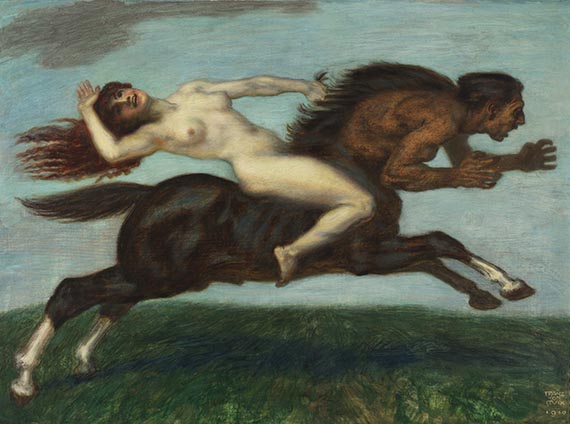
Franz von Stuck
Kentaurenritt, 1910.
Oil on panel
Estimate:
€ 100,000 - 150,000
$ 116,000 - 174,000
Information on buyer's premium, taxation and resale right compensation will be available four weeks before the auction.
126000565
Franz von Stuck
Kentaurenritt, 1910.
Oil on panel
Estimate:
€ 100,000 - 150,000
$ 116,000 - 174,000
Information on buyer's premium, taxation and resale right compensation will be available four weeks before the auction.
Franz von Stuck
1863 - 1928
Kentaurenritt. 1910.
Oil on panel.
Signed and dated in the lower right. 60.5 x 82 cm (23.8 x 32.2 in), in the original frame.
On the development of the theme of the Centaur Ride , see also Voss 251/172 “Lustiger Ritt” (1903) and Voss 376/175 “Prestissimo”. [JS].
• Eros, Pathos, Antiquity: The “Ride of the Centaur”—an outstanding example of Stuck’s captivating Symbolist fin-de-siècle painting.
• Stuck, Klimt, Schiele: The best compositions by the leading figure of the Munich Secession and driving force behind Viennese Modernism were created around the turn of the century.
• “Sünde” (Sin, 1891) – “Kentaurenritt” (Ride of the Centaur, 1910): Scenes of unbridled sensuality and eroticism inspired by mythology and the Bible.
• Stuck & Picasso: The hybrid creatures—the faun, the centaur, and the Minotaur—as the artists' alter egos.
• Early exhibition history: Selected by Stuck for the International Art Exhibition in Rome as early as 1911 and exhibited at Paul Cassirer’s gallery in Berlin in 1916.
• Excellent provenance: From the Schmeil Collection in Dresden, which includes works by Courbet, Böcklin, Liebermann, and Hodler.
• Museum-quality: Stuck’s works are part of major collections, including the Metropolitan Museum in New York, the Musée d’Orsay in Paris, and the Hermitage in St. Petersburg.
We are grateful to Margot Th. Brandlhuber of the Museum Villa Stuck in Munich for her expert advice.
PROVENANCE: From the artist’s studio (until 1911: International Art Exhibition, Rome).
Collection of Carl Hugo Schmeil (1852–1923), Dresden (1911–1916: with a fragmentarily preserved label from the auction of the collection at Paul Cassirer/Hugo Helbing, Berlin, on the reverse).
Melchior Voitländer Collection (1858–1934), Kronach (acquired from the above, in the family’s possession until 1968: Weinmüller/Neumeister).
Private collection, Southern Germany (until 2001: Neumeister).
Private collection, Southern Germany (acquired from the previous owner in 2001; in the family’s possession ever since).
EXHIBITION: International Art Exhibition, Rome, 1911 (see the review in: Kunst für Alle, no. 26, 1910/11, p. 534).
Galerie Hugo Helbig, Munich, Sept. 8–25, 1916, no. 125 (as part of the auction of the Schmeil Collection at Paul Cassirer).
Galerie Paul Cassirer, Berlin, Oct. 3–16, 1916, no. 125 (as part of the auction of the Schmeil Collection at Paul Cassirer).
LITERATURE: Heinrich Voss, Franz von Stuck 1863–1928, Catalogue Raisonné of Paintings, Munich 1973, CR no. 375/174.
-
Burkhard Meier, Deutschland auf der Internationalen Kunstausstellung in Rom 1911, in: Kunst für Alle, no. 26, 1910/11, p. 534 (with double-page black-and-white illustration preceding p. 529 [based on the contemporary mezzotint reproduction by Bruckmann]).
Galerie Paul Cassirer, Berlin, auction of the Schmeil Collection, Dresden, Berlin 1916, cat. no. 125 (with black-and-white illustration).
Weinmüller, Rudolf Neumeister Art Auction House, Munich, Modern Art, 112th Auction, May 21, 1968, lot 325 (with illustration).
Neumeister’s Modern Art, Munich, auction 30, November 15, 2001, lot 933 (with illustration).
Galerie Paul Cassirer, Berlin, auction of the Schmeil Collection, Dresden, Berlin 1916, p. XI.
Galerie Paul Cassirer, Berlin, Versteigerung der Sammlung Schmeil, Dresden, Berlin 1916, S. XI.
Seduction, Lust, and Passion: Stuck’s “Ride of the Centaurs” and the Bliss of an Intense Life
The captivating fin-de-siècle paintings of Munich’s painter-prince Franz von Stuck are dominated by a profound fascination with an intense, sensual life. Eros and death are central themes that permeate his outstanding body of work. Since the early 1890s, his spellbinding creations have been filled with figures like cupids, fauns, and nudes, set in scenes with an eroticism inspired by antiquity—scenes that, when embedded in a bucolic setting, have an almost playful quality at their core. But then it was Stuck’s iconic painting “Sünde” (Sin, 1893, Neue Pinakothek, Munich)—depicting a naked femme fatale entwined by a serpent—that sparked a public scandal at the first exhibition of the Munich Secession in 1893 and would henceforth ensure Stuck’s growing national and international fame. Mysterious, self-assured, and gazing directly at the viewer, this figure, bathed in dreamlike light, captivated audiences. As a founding member of the Munich Secession, Stuck spearheaded the breakaway of progressive artists from the conservative Munich Artists’ Cooperative and developed “Sin” from the biblical theme of temptation. The altar-like presentation in his famous artist’s villa on Prinzregentenstraße in Munich also references a famous model from Christian iconography: Stuck staged his “Sin” in the tradition of a Renaissance Madonna, yet in doing so he created a decidedly provocative counter-image of femininity. Inspired not only by the Bible but also by ancient mythology, Stuck has left us masterfully composed scenes of unbridled sensuality and eroticism. Stuck, the leading figure of the Munich Secession, thus made the rich facets of eroticism socially acceptable and, in doing so, drew on the art-historical tradition of depicting the amorous affairs of the ancient gods (Amori degli Dei) in Italian printmaking. The centaur, half-human, half-beast, has been regarded as a symbol of unbridled male desire since antiquity and was therefore, in the second half of the 20th century, ultimately portrayed by Pablo Picasso—alongside the other hybrid beings, the faun and, above all, the horned Minotaur—as the alter ego of the love-hungry, ecstatically passionate artist. In Stuck’s work, the nymph riding naked on the centaur’s back seeks to tame his powerful force and, through the dynamic counter-movement of their bodies, merges with the creature into a sensually unleashed unity.
Stuck, Klimt, Schiele: Facets of Femininity in the Munich and Vienna Secession
Dressed as a mythological equestrian figure, Stuck created a fascinating symbol of the subconscious with his “Ride of the Centaur.” Stuck transformed a complex emotion into an image. At the heart of this work are the depths of the human subconscious—scientifically explored by Sigmund Freud—the inner turmoil and the ongoing internal struggle between passion and reason, desire and intellect, sin and morality. Stuck’s significance as a source of inspiration—both in style and content—for the Vienna Secession, for Gustav Klimt, and for Egon Schiele, who belonged to the next generation, can hardly be overestimated. This was highlighted, among other things, by the 2016 exhibition “Sünde und Secession. Franz von Stuck in Wien” at the Unteres Belvedere. When “The Ride of the Centaur” was created, Stuck's career was at its absolute peak: he had celebrated his artistic breakthrough after presenting the painting “Sünde” at the Munich Secession exhibition in 1893. He was subsequently appointed to the Royal Academy of Fine Arts in Munich in 1895, where his students included, among others, Wassily Kandinsky and Paul Klee. In 1897, he married the wealthy American singer Mary Lindpainter and, in the following years, commenced construction of his stately artist’s villa on Prinzregentenstraße in ancient Roman style, which was later expanded to include a prestigious studio building in the early 1910s. Franz von Stuck, who was born in Lower Bavaria in 1863 as the son of a miller and was eventually ennobled by Prince Regent Luitpold of Bavaria in 1906, had established himself in Munich’s affluent society shortly after the turn of the century. His outstanding body of work as a painter and his villa became the center of Munich Art Nouveau, which initially inspired the founding of the Vienna Secession and, after numerous exhibitions in Vienna, also served as a stylistic model for painters in the Vienna Art Nouveau movement. In 1909, a year before the creation of “The Ride of the Centaur,” Stuck finally achieved his international breakthrough with his own exhibition room at the International Art Exhibition in Venice, which was enthusiastically celebrated by critics. Franz von Stuck was 46 years old and at the height of his artistic and social fame. His marriage to Mary had become a successful social constant; as his muse and model, however, she was increasingly replaced by young women who gave the painter new inspiration. Like Picasso—who, a few decades later, would embrace love with almost intoxicating passion—Stuck devoted his life and work entirely to his fascination with living life to the fullest until his death. Stuck was fascinated by the facets of femininity—caught between the ancient goddess, girlish innocence, and the femme fatale—and he masterfully contrasts them with the male psyche's internal conflict between reason and passion in “The Ride of the Centaur.” Franz von Stuck himself must have recognized the special quality of this consummate composition, as he selected it for the International Art Exhibition in Rome in 1911, where it was praised by visitors and critics alike and ultimately acquired that same year by Commercial Councilor Schmeil of Dresden for his prestigious art collection. [JS]

Headquarters
Joseph-Wild-Str. 18
81829 Munich
Phone: +49 89 55 244-0
Fax: +49 89 55 244-177
info@kettererkunst.de
Louisa von Saucken / Undine Schleifer
Holstenwall 5
20355 Hamburg
Phone: +49 40 37 49 61-0
Fax: +49 40 37 49 61-66
infohamburg@kettererkunst.de
Dr. Simone Wiechers / Nane Schlage
Fasanenstr. 70
10719 Berlin
Phone: +49 30 88 67 53-63
Fax: +49 30 88 67 56-43
infoberlin@kettererkunst.de
Cordula Lichtenberg
Gertrudenstraße 24-28
50667 Cologne
Phone: +49 221 510 908-15
infokoeln@kettererkunst.de
Hessen
Rhineland-Palatinate
Miriam Heß
Phone: +49 62 21 58 80-038
Fax: +49 62 21 58 80-595
infoheidelberg@kettererkunst.de
We will inform you in time.