


Sale: 611 / Day Sale, Dec. 05. 2026 in Munich → Lot 126000552
Frame image
Raumbeispiel
126000552
Carl Spitzweg
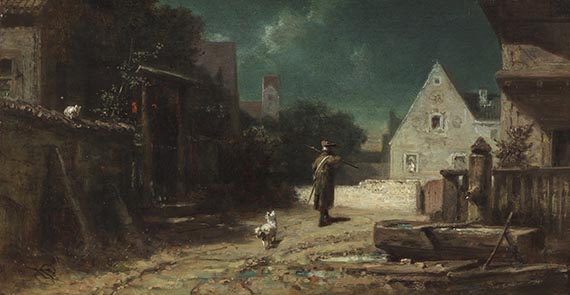
Nachtwächter bei Mondschein, Hund und Katze, Ca. 1870.
Oil on cardboard on a backing cardboard
Estimate:
€ 50,000 - 70,000
$ 58,000 - 81,200
Information on buyer's premium, taxation and resale right compensation will be available four weeks before the auction.
126000552
Carl Spitzweg
Nachtwächter bei Mondschein, Hund und Katze, Ca. 1870.
Oil on cardboard on a backing cardboard
Estimate:
€ 50,000 - 70,000
$ 58,000 - 81,200
Information on buyer's premium, taxation and resale right compensation will be available four weeks before the auction.
Carl Spitzweg
1808 - 1885
Nachtwächter bei Mondschein, Hund und Katze. Ca. 1870.
Oil on cardboard on a backing cardboard.
Signed with initials in the lower left. 15 x 28.3 cm (5.9 x 11.1 in).
• A work of museum quality.
• The Night Watchman is one of the most iconic figures in Carl Spitzweg’s oeuvre.
• A refined and detailed work in a landscape format that is rare for this motif.
• A distinctive “Night Watchman” scene, to which Spitzweg lends an additional narrative dimension with the humorous detail of the dog and cat.
PROVENANCE: H. Kirchmair (according to the sales catalog, lot no. 419).
Private collection, Northern Germany.
Private collection, Sweden (2020, Ketterer Kunst; inherited by the current owner.
EXHIBITION: 23. Sonderausstellung, Nationalgalerie, Berlin, Nov./Dec. 1886, No. 78 (from the collection of Th. Kirchmair, Munich).
Galerie Kessler, New York, 1916, p. 36.
Carl Spitzweg. Reisen und Wandern in Europa und der Glückliche Winkel, Haus der Kunst, Munich, Jan. 24–May 18, 2003, p. 289, no. 172 (with color illustration).
LITERATURE: Günther Roennefahrt, Carl Spitzweg. Beschreibendes Verzeichnis seiner Gemälde, Ölstudien und Aquarelle, Munich 1960, CR no. 734 (illu. on p. 64).
Siegfried Wichmann, Carl Spitzweg. Verzeiichnis der Werke. Gemälde und Aquarelle, Stuttgart 2002, CR no. 1302 (with color illustration).
- -
Hermann Uhde-Bernays, Spitzweg. Reime und Bilder, Munich 1915, illu. 24.
Hermann Uhde-Bernays, Carl Spitzweg: Des Meisters Leben und Werk, 5th ed., Munich 1919, ill. 127.
Hyacinth Holland, Karl Spitzweg, Munich 1916, p. 22, illu. 32.
Fritz von Ostini, Aus Carl Spitzwegs Welt, Barmen 1924, p. 45.
Max von Boehn, Carl Spitzweg, 4th ed., Bielefeld/Leipzig 1937, illu. p. 20.
Alois Elsen, Carl Spitzweg, Vienna 1948, p. 134, plate 79.
Siegfried Wichmann, Carl Spitzweg: Der Nachtwächter. Dokumentation, Starnberg-Munich, R.f.v.u.a.K., 1986, p. 26 (with color illustration), Bavarian State Library, Munich, inventory no. Ana 656 SW 26.
Siegfried Wichmann, Carl Spitzweg: Kunst, Kosten und Konflikte, Frankfurt/Berlin, 1991, p. 314, no. 419.
Im Kinsky, Vienna, Auction 93, 19th-Century Paintings, Nov. 13, 2012, lot 152 (with color illustration).
Ketterer Kunst, Munich, Auction 508, 19th-Century Art, Dec. 12, 2020, lot 304 (with color illustration).
Beginning in the 1860s, Spitzweg began painting nocturnal scenes, studying the effects of light in small towns bathed in soft moonlight, often under a starry sky. Various motifs and figures populate the nocturnal setting: the secrecy of dark alleys provides the backdrop for rendezvous and moonlit serenades beneath the beloved's balcony, while roaming night guards clatter through the streets; the scenes also include a few fantastical moments, such as the witches’ ride or the castle ghost. Spitzweg thus offers the viewer a glimpse into a world that is otherwise hidden—a world of furtive activity, stealth, and longing in the dark corners of the towns. A recurring figure in these scenes is the night watchman, who roams the deserted alleys alone. When reading Spitzweg’s letters—often written late in the evening to his brother Eduard—the night watchman’s shouts repeatedly emerge as a disruptive and comical element. Thus, in 1838, Spitzweg—who was apparently somewhat sensitive to this unnecessary nocturnal noise—bid farewell to Nuremberg: “Well then, good night—it’s 10 o’clock here; the night watchman is shouting, I swear, right under my window” (quoted from: Siegfried Wichmann, Carl Spitzweg, Stuttgart 2002, p. 26).
In Romantic literature, the figure appears in Bonaventura’s satirical tales from 1805, in which the protagonist encounters all sorts of curious characters in his “Night Watches.” Wandering alone, armed with his halberd and lantern, he observes these scenes while everyone else sleeps. In Spitzweg’s work, too, he is one of the eccentric figures that follow a different rhythm than the ordinary, respectable citizen. Most of the time, however, he is left to his own boredom and fatigue, since his actual task—to ensure peace and order—seems relatively useless in the staid tranquility of small towns. At times, Spitzweg even depicts him asleep, meaning the shouted announcement of the hour—which would otherwise disturb the sleepers’ peace—is absent. Unlike in previous depictions of this theme, our scene is not set in a small German town but in a rural setting. Even during his stay in the small town of Schliersee in 1855, Spitzweg was not spared the nightly clamor, as he cannot help but mention. In the small village square, surrounded by farmhouses, the simple wooden fountain ripples quietly away. In the little village, everything seems to be bathed in peaceful tranquility—the only two potential troublemakers are the dog and cat, who pause briefly to look at one another but will likely decide in the next second to ignore each other deliberately; so deeply does the scene—bathed in milky moonlight against the cloudy sky—radiate calm and peace. Barely disturbing the harmonious play of light in the painting because of its tiny size, a red lantern glows, hidden from view; in the distance, twilight is already gently setting in, signaling the end of the night watchman’s shift. Spitzweg’s finely woven narrative talent is especially evident in this nocturnal scene; it speaks through barely perceptible hints and connections, rendered with artistic refinement, well-placed effects, and subtle, highly nuanced expressiveness. [KT]
In Romantic literature, the figure appears in Bonaventura’s satirical tales from 1805, in which the protagonist encounters all sorts of curious characters in his “Night Watches.” Wandering alone, armed with his halberd and lantern, he observes these scenes while everyone else sleeps. In Spitzweg’s work, too, he is one of the eccentric figures that follow a different rhythm than the ordinary, respectable citizen. Most of the time, however, he is left to his own boredom and fatigue, since his actual task—to ensure peace and order—seems relatively useless in the staid tranquility of small towns. At times, Spitzweg even depicts him asleep, meaning the shouted announcement of the hour—which would otherwise disturb the sleepers’ peace—is absent. Unlike in previous depictions of this theme, our scene is not set in a small German town but in a rural setting. Even during his stay in the small town of Schliersee in 1855, Spitzweg was not spared the nightly clamor, as he cannot help but mention. In the small village square, surrounded by farmhouses, the simple wooden fountain ripples quietly away. In the little village, everything seems to be bathed in peaceful tranquility—the only two potential troublemakers are the dog and cat, who pause briefly to look at one another but will likely decide in the next second to ignore each other deliberately; so deeply does the scene—bathed in milky moonlight against the cloudy sky—radiate calm and peace. Barely disturbing the harmonious play of light in the painting because of its tiny size, a red lantern glows, hidden from view; in the distance, twilight is already gently setting in, signaling the end of the night watchman’s shift. Spitzweg’s finely woven narrative talent is especially evident in this nocturnal scene; it speaks through barely perceptible hints and connections, rendered with artistic refinement, well-placed effects, and subtle, highly nuanced expressiveness. [KT]

Headquarters
Joseph-Wild-Str. 18
81829 Munich
Phone: +49 89 55 244-0
Fax: +49 89 55 244-177
info@kettererkunst.de
Louisa von Saucken / Undine Schleifer
Holstenwall 5
20355 Hamburg
Phone: +49 40 37 49 61-0
Fax: +49 40 37 49 61-66
infohamburg@kettererkunst.de
Dr. Simone Wiechers / Nane Schlage
Fasanenstr. 70
10719 Berlin
Phone: +49 30 88 67 53-63
Fax: +49 30 88 67 56-43
infoberlin@kettererkunst.de
Cordula Lichtenberg
Gertrudenstraße 24-28
50667 Cologne
Phone: +49 221 510 908-15
infokoeln@kettererkunst.de
Hessen
Rhineland-Palatinate
Miriam Heß
Phone: +49 62 21 58 80-038
Fax: +49 62 21 58 80-595
infoheidelberg@kettererkunst.de
We will inform you in time.