


Frame image

Raumbeispiel
113
Carl Spitzweg
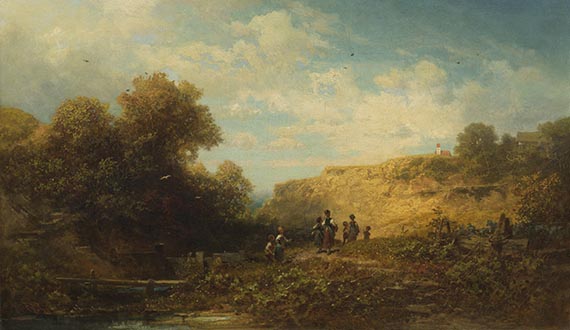
Schulkinder auf dem Heimweg, Um 1860.
Oil on canvas
Estimate:
€ 50,000 - 70,000
$ 56,000 - 78,400
113
Carl Spitzweg
Schulkinder auf dem Heimweg, Um 1860.
Oil on canvas
Estimate:
€ 50,000 - 70,000
$ 56,000 - 78,400
Carl Spitzweg
1808 - 1885
Schulkinder auf dem Heimweg. Um 1860.
Oil on canvas.
Signed and with the initials in the lower left. 32 x 54 cm (12.5 x 21.2 in). [AW].
• Spitzweg’s skills become evident in the unique interplay between atmospheric landscape and anecdotal figure depiction.
• He masterfully uses light and shadow to create a transparent atmospheric perspective.
• The self-taught artist Carl Spitzweg developed his unmistakable style between Biedermeier and Late Romanticism.
• Works by Spitzweg are in renowned museums such as the Neue Pinakothek in Munich, the Staatsgalerie in Stuttgart, and the Alte Nationalgalerie in Berlin.
PROVENANCE: Private collection, Southern Germany.
LITERATURE: Günther Roennefahrt, Carl Spitzweg. Beschreibendes Verzeichnis seiner Gemälde, Ölstudien und Aquarelle, Munich 1960, CR no. 484 (with black-and-white illustration on p. 187).
Siegfried Wichmann, Carl Spitzweg. Verzeichnis der Werke. Gemälde und Aquarelle, Stuttgart 2002, CR no. 1038 (with b&w ill. on p. 424; measurements incorrectly stated).
- -
Eugen Kalkschmidt, Carl Spitzweg und seine Welt, 4th ed., Munich 1966, p. 98 (with ill. 67).
Called up: December 5, 2026 - ca. 13.17 h +/- 20 min.
Carl Spitzweg is considered one of the most significant German painters and draftsmen of the Biedermeier and Late Romantic periods. His artistic talent emerged early, but he initially followed his father’s wishes and studied pharmacy. He graduated with honors. While working at the Löwenapotheke in Straubing, he lived among actors and painters who fueled his enthusiasm for art. In 1833, he decided to pursue painting and, just two years later, became a member of the Munich Art Association. He never attended an art academy—Spitzweg was entirely self-taught. His extensive body of work comprises more than 1,500 paintings and drawings.
His style is unmistakable, blending the detailed draftsmanship of the Biedermeier period with the poetic atmosphere of late Romanticism. With subtle humor and great empathy, Spitzweg depicts human quirks, everyday encounters, and whimsical or tragic situations. His extraordinary figures often come across as both comical and touching. They speak to emotions and life circumstances that remain relatable even today.
Spitzweg’s focus, however, is not limited to people and urban scenes. He was well-read, traveled extensively, and frequently visited the lake regions of Upper Bavaria. Impressions from the Chiemgau, the Alpine foothills, South Tyrol, Italy, and Switzerland appear in his paintings. In 1836, he climbed the Watzmann and enjoyed the mountain views. In the middle of the century, he traveled to Paris, where he became acquainted with the Barbizon School's landscape painting. Their plein air style depicts nature under the open sky, using natural light and vivid colors. These experiences encouraged Spitzweg to depict expansive landscapes more often in panoramic horizontal formats.
In the painting shown here, he combines his precise observation of everyday life with a romantic depiction of nature. A small group of schoolchildren heads home, adding a human element to the panorama. The figures remain small, while untouched greenery, winding paths, and a bright blue sky dominate the pictorial space. Spitzweg masterfully guides the viewer’s gaze from the small wooded area with a stream on the left, past the children, toward a view whose full extent appears to the children as they descend, yet remains mysteriously hidden from us as viewers. Drawing and color, everyday life and poetry, subtle wit and quiet beauty merge into an idyllic scene. In this way, Spitzweg reveals his unique sense of color and nature, transforming a simple walk home into a fairy-tale moment. [AW]

Buyer's premium and taxation for Carl Spitzweg "Schulkinder auf dem Heimweg"
This lot can be purchased subject to differential or regular taxation.
Differential taxation:
Hammer price up to 2,000,000 €: herefrom 34 % premium.
The share of the hammer price exceeding 2,000,000 € is subject to a premium of 29 % and is added to the premium of the share of the hammer price up to 2,000,000 €.
The share of the hammer price exceeding 4,000,000 € is subject to a premium of 22 % and is added to the premium of the share of the hammer price up to 4,000,000 €.
The buyer's premium contains VAT, however, it is not shown.
Regular taxation:
Hammer price up to 2,000,000 €: herefrom 29 % premium.
The share of the hammer price exceeding 2,000,000 € is subject to a premium of 23% and is added to the premium of the share of the hammer price up to 2,000,000 €.
The share of the hammer price exceeding 4,000,000 € is subject to a premium of 15% and is added to the premium of the share of the hammer price up to 4,000,000 €.
The statutory VAT of currently 7 % is levied to the sum of hammer price and premium.
We kindly ask you to notify us before invoicing if you wish to be subject to regular taxation.
Headquarters
Joseph-Wild-Str. 18
81829 Munich
Phone: +49 89 55 244-0
Fax: +49 89 55 244-177
info@kettererkunst.de
Louisa von Saucken / Undine Schleifer
Holstenwall 5
20355 Hamburg
Phone: +49 40 37 49 61-0
Fax: +49 40 37 49 61-66
infohamburg@kettererkunst.de
Dr. Simone Wiechers
Fasanenstr. 70
10719 Berlin
Phone: +49 30 88 67 53-63
Fax: +49 30 88 67 56-43
infoberlin@kettererkunst.de
Cordula Lichtenberg
Gertrudenstraße 24-28
50667 Cologne
Phone: +49 221 510 908-15
infokoeln@kettererkunst.de
Hessen
Rhineland-Palatinate
Miriam Heß
Phone: +49 62 21 58 80-038
Fax: +49 62 21 58 80-595
infoheidelberg@kettererkunst.de
We will inform you in time.