


Sale: 612 / Evening Sale, Dec. 04. 2026 in Munich → Lot 126000876
Frame image
Raumbeispiel
126000876
Alexej von Jawlensky
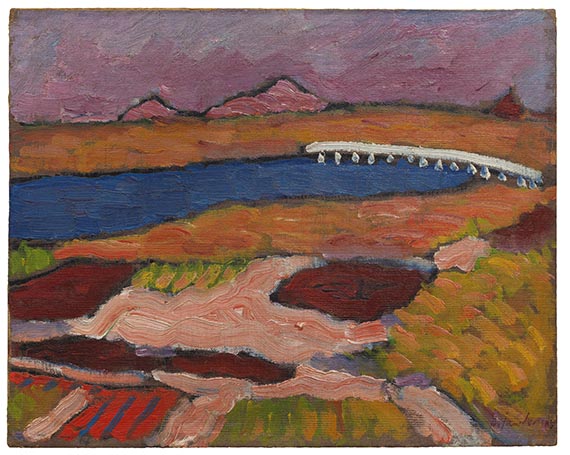
Prerow (Darß) Pommern, 1911.
Oil on canvas, originally mounted on cardboard
Estimate:
€ 100,000 - 150,000
$ 116,000 - 174,000
Information on buyer's premium, taxation and resale right compensation will be available four weeks before the auction.
126000876
Alexej von Jawlensky
Prerow (Darß) Pommern, 1911.
Oil on canvas, originally mounted on cardboard
Estimate:
€ 100,000 - 150,000
$ 116,000 - 174,000
Information on buyer's premium, taxation and resale right compensation will be available four weeks before the auction.
Alexej von Jawlensky
1864 - 1941
Prerow (Darß) Pommern. 1911.
Oil on canvas, originally mounted on cardboard.
Signed in the lower right. Titled and barely legibly inscribed “Fluss + Brücke” (River + Bridge) on the reverse. 32.4 x 40.8 cm (12.7 x 16 in). [AW].
• Rare early expressionist landscape from the “Blauer Reiter” period.
• Jawlensky considered the landscapes that he had painted in Prerow in 1911 to be his best.
• At the height of his creativity: painting that is maximally detached from nature, with free use of color and form.
• Works from this period in Prerow on the Baltic Sea are held in renowned museum collections, including the National Museum, Cardiff, the Museum Wiesbaden, and the Kunstmuseum Basel.
Accompanied by a written certificate of authenticity issued by Angelica Jawlensky Bianconi, Alexej von Jawlensky-Archive S.A., Muralto, dated September 3, 2018. The work is included in Alexej von Jawlensky’s catalogue raisonné.
PROVENANCE: Galerie Beyeler, Basel.
Private collection, USA (acquired from the above in 1957).
Dietmar Manke Collection, Schleswig-Holstein (acquired from the above).
EXHIBITION: Alexej von Jawlensky 1864–1941, Galerie Beyeler, Basel, Jan./Feb. 1957, cat. no. 21 (“Prerow (Fluß mit weißer Brücke)”; on the reverse, two gallery labels, incorrectly labeled with cat. no. 20).
Alexej von Jawlensky and Marianne von Werefkin spent the summer of 1911 in Prerow on the Darß peninsula in the Baltic Sea. After spending time with Wassily Kandinsky and Gabriele Münter in Murnau, Jawlensky sought new inspiration on the Baltic coast. In his memoirs, he describes this period as pivotal to his artistic development:
“That summer marked a major development in my art. I painted my best landscapes there, as well as large figurative works in strong, vibrant colors—absolutely not naturalistic or textural. I used a great deal of red, blue, orange, cadmium yellow, and chrome oxide green. The forms were sharply contoured with Prussian blue and emerged from an intense inner ecstasy. […] This was a pivotal moment in my art. And up until 1914, just before the war, I painted my most powerful works […] in those years.” (Alexej von Jawlensky, Lebenserinnerungen [Memoirs], quoted from: Clemens Weiler, Jawlensky. Köpfe – Gesichte – Meditationen [Heads – Faces – Meditations], Hanau 1970, p. 112)
Our work is a striking testimony to this “turning point” toward an autonomous, expressive use of color. It shows the hinterland of the coastal town with the Prerow River, which once connected the Baltic Sea and the lagoon. Jawlensky does not depict the landscape with precise topographical detail: sandy beaches, narrow paths, and what might be fishermen’s cottages remain only vaguely recognizable. The decisive aspect is how color and contour organize the motif while also bringing it to life. The palette intensifies with high-contrast tones: ochre and burnt sienna meet salmon pink and deep blue. The result is a landscape that describes less a specific place than it conveys its sensual and emotional quality. Sky and foreground seem to engage in a dynamic interplay. Although no figures are depicted, the brushwork lends the scene palpable vitality.
Simplified forms and color detached from representational reality point toward abstraction. At the same time, echoes of Jawlensky’s engagement with Vincent van Gogh are still discernible. The clear composition, focused on the pictorial surface, shows how Jawlensky developed his visual language independently. While the portrait gained increasing importance in his work during this period, the 1911 landscape proved a key part of this renewal. In this work, the impressions from his stay on the Baltic Sea coalesce into a multi-layered exploration of color, form, and sensation—one of his “best landscapes,” as Jawlensky himself wrote. [AW]

Headquarters
Joseph-Wild-Str. 18
81829 Munich
Phone: +49 89 55 244-0
Fax: +49 89 55 244-177
info@kettererkunst.de
Louisa von Saucken / Undine Schleifer
Holstenwall 5
20355 Hamburg
Phone: +49 40 37 49 61-0
Fax: +49 40 37 49 61-66
infohamburg@kettererkunst.de
Dr. Simone Wiechers / Nane Schlage
Fasanenstr. 70
10719 Berlin
Phone: +49 30 88 67 53-63
Fax: +49 30 88 67 56-43
infoberlin@kettererkunst.de
Cordula Lichtenberg
Gertrudenstraße 24-28
50667 Cologne
Phone: +49 221 510 908-15
infokoeln@kettererkunst.de
Hessen
Rhineland-Palatinate
Miriam Heß
Phone: +49 62 21 58 80-038
Fax: +49 62 21 58 80-595
infoheidelberg@kettererkunst.de
We will inform you in time.