


Frame image
Raumbeispiel
152
Max Slevogt
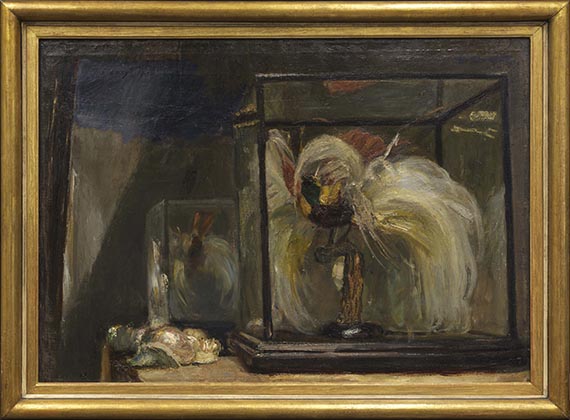
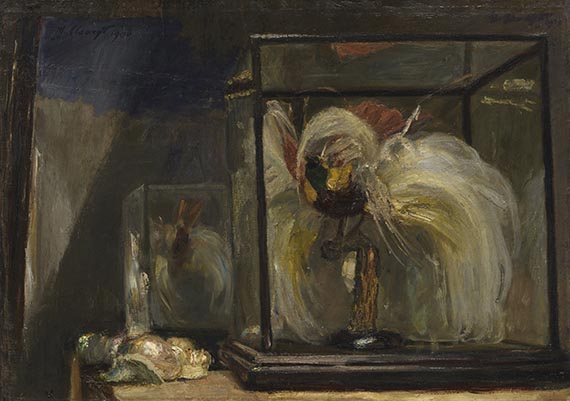
Paradiesvögel, 1900.
Oil on canvas
Estimate:
€ 40,000 - 60,000
$ 44,800 - 67,200
152
Max Slevogt
Paradiesvögel, 1900.
Oil on canvas
Estimate:
€ 40,000 - 60,000
$ 44,800 - 67,200
Max Slevogt
1868 - 1932
Paradiesvögel. 1900.
Oil on canvas.
Signed and dated in the upper left. 71 x 100.5 cm (27.9 x 39.5 in). [EB].
• Impressionist mastery around 1900: shimmering plumage in the finest shades of white.
• The unusual subject of the “birds of paradise” unfolds in a captivating interplay of light and shadow.
• Max Slevogt: Alongside Max Liebermann and Lovis Corinth, one of the most important representatives of German Impressionism.
• From the Eduard Fuchs Collection, Berlin: A “jewel” among Slevogt’s finest works (W. von Alten, 1926).
• Museum-quality: Owned by the Von der Heydt Museum in Wuppertal for nearly two decades and part of an impressive exhibition history.
• The provenance bears witness to Germany’s turbulent history and finds its completion in this amicable restitution.
The authenticity of this work was confirmed verbally by Bernhard Geil.
PROVENANCE: Collection of Eduard Fuchs (1870–1940), Berlin (by 1909 at the latest, likely acquired directly from the artist; until 1937, confiscated by the Gestapo in the intervening period: 1933-1935).
Rudolph Lepke’s Kunst-Auctions-Haus, Berlin (on consignment from the above mentioned-property, until June 16–17, 1937).
Hildebrand Gurlitt, Hamburg (acquired from the above 1937).
Fritz Slevogt Collection, Hamburg (acquired from the above in 1939)
Von der Heydt Museum, Wuppertal (Inv. No. G 1827, acquired in 2006, Kunsthaus Lempertz).
Restitution to the heirs of Eduard Fuchs (2026).
The work is free of restitution claims.
EXHIBITION: Max Slevogt. Ausstellung zum 50. Geburtstag des Künstlers, Freie Secession and Paul Cassirer, Berlin, Nov./Dec. 1918, cat. no. 33, p. 17.
Max Slevogt. Die Berliner Jahre, Von der Heydt Museum, Wuppertal, March 6–May 22, 2005; Max Liebermann House, Berlin, June 4–September 4, 2005, cat. no. 4, pp. 34ff. (with color ill.).
Slevogt und Frankreich, Saarlandmuseum – Moderne Galerie, September 1, 2018–January 13, 2019, pp. 184–185 (color illustration), p. 276.
LITERATURE: Hans-Jürgen Imiela, Max Slevogt: Eine Monographie, Karlsruhe 1968, p. 363, note 37.
- -
Josef Anton Bondy, Eine Berliner Privatsammlung, in: Neue Revue, May 29, 1909, p. 769.
Paul Westheim, Das Haus eines Sammlers. Die Sammlung Eduard Fuchs, Zehlendorf, in: Das Kunstblatt 10 (1926), p. 111.
Wilken von Alten, Max Slevogt, Bielefeld 1926, p. 16, ill. 20.
Rudolph Lepke’s Art Auction House, Berlin, Catalog 2114, F. Art Collection—Berlin. Paintings by Modern Masters, Sculptures and Furniture, Porcelain, Faience, June 16–17, 1937, Lot 92.
Ulrich Weitz, Salonkultur und Proletariat. Eduard Fuchs: Sammler, Sittengeschichtler, Sozialist, Stuttgart 1991, Slevogt Catalogue Raisonné no. 8, p. 321.
Ulrich Weitz, Der Mann im Schatten—Eduard Fuchs, Berlin 2014, p. 185 (color illustration).
Kunsthaus Lempertz, Cologne, 867th “Modern Art” Auction, December 4, 2004, lot 1334 (lot description).
Juliane Rückert, Blumen, Früchte und tote Tiere—Slevogts Faszination am Stillleben, in: Max Slevogt. Eine Retrospektive zum 150. Geburtstag, Hanover 2018, pp. 114ff. (color illustration).
Ulrich Weitz, Eduard Fuchs: Ein Pionier als Sammler und Schriftsteller, in: transfer—Journal of Provenance Research and Collection History, vol. 3 (2024), p. 44, color ill. 9.
Called up: December 5, 2026 - ca. 14.09 h +/- 20 min.
Max Slevogt holds a special place in Eduard Fuchs’s collection: 44 paintings bear witness to a deep friendship that continued through collecting. Two of these works are now for sale and allow viewers to recognize both the collector and the Impressionist: “Birds of Paradise” (1900) and “Don Quixote and the Flock of Sheep” (1907). Both paintings have an impressive exhibition and publication history dating back to the artist’s lifetime.
“Birds of Paradise” belongs to Slevogt’s major Impressionist phase around 1900. Color and light are integral to the motif. The plumage glows in shimmering, subtly graded shades of white, echoed in the pearlescent luster of the adjacent shells, further enhancing their luminosity. The conception of space is distinctly modern: eschewing detailed depiction, the artist lets the objects emerge from the darkness of a room reminiscent of an attic, illuminated by a random beam of light. The motif is arranged like a still life, yet is brought to life and effectively staged through the dynamic brushwork. W. von Alten calls this work “a jewel in the impressive series of Slevogt’s finest works owned by the Fuchs Collection” (W. von Alten 1926, p. 19).
Slevogt’s oeuvre is shaped by Impressionism but also incorporates elements of older painting styles, Symbolism, and Art Nouveau. His early work is dominated by dramatized themes that deliberately turn away from traditional history painting. In the despair of the individual, Slevogt finds a subject that would accompany him for years. Alongside Samson, Don Quixote becomes a central figure through whom the limits of human self-determination manifest themselves for him. “Don Quixote and the Flock of Sheep” (1907) is one of the earliest examples of this. He returned to the Cervantes hero time and again thereafter, in 1912 and 1923.
The provenance of the two paintings bears witness to Germany’s turbulent history. As a staunch Social Democrat and Communist, Fuchs faced immediate threats after the National Socialists’ “seizure of power”; following the Reichstag fire in 1933, he fled with his wife to Paris. His collection, left behind in Berlin, was confiscated and sold in 1937–38 at several auctions held by Rudolph Lepke in Berlin and by C. G. Boerner in Leipzig. Decades later, the “Birds of Paradise” entered the collection of the Von der Heydt Museum in Wuppertal, which is now returning them after nearly twenty years in the museum’s possession. The sale of the two works is taking place on the basis of an amicable agreement with the heirs of Eduard Fuchs. Slevogt’s triptych “The Prodigal Son,” which marked the artist’s breakthrough at the first exhibition of the Berlin Secession in 1899 and was part of the Fuchs collection from 1911 to 1938, is also being returned to the heirs after nearly seventy years at the Staatsgalerie Stuttgart and achieved an outstanding result at Ketterer Kunst in December 2024. [EB]

Buyer's premium and taxation for Max Slevogt "Paradiesvögel"
This lot can be purchased subject to differential or regular taxation.
Differential taxation:
Hammer price up to 2,000,000 €: herefrom 34 % premium.
The share of the hammer price exceeding 2,000,000 € is subject to a premium of 29 % and is added to the premium of the share of the hammer price up to 2,000,000 €.
The share of the hammer price exceeding 4,000,000 € is subject to a premium of 22 % and is added to the premium of the share of the hammer price up to 4,000,000 €.
The buyer's premium contains VAT, however, it is not shown.
Regular taxation:
Hammer price up to 2,000,000 €: herefrom 29 % premium.
The share of the hammer price exceeding 2,000,000 € is subject to a premium of 23% and is added to the premium of the share of the hammer price up to 2,000,000 €.
The share of the hammer price exceeding 4,000,000 € is subject to a premium of 15% and is added to the premium of the share of the hammer price up to 4,000,000 €.
The statutory VAT of currently 7 % is levied to the sum of hammer price and premium.
We kindly ask you to notify us before invoicing if you wish to be subject to regular taxation.
Headquarters
Joseph-Wild-Str. 18
81829 Munich
Phone: +49 89 55 244-0
Fax: +49 89 55 244-177
info@kettererkunst.de
Louisa von Saucken / Undine Schleifer
Holstenwall 5
20355 Hamburg
Phone: +49 40 37 49 61-0
Fax: +49 40 37 49 61-66
infohamburg@kettererkunst.de
Dr. Simone Wiechers
Fasanenstr. 70
10719 Berlin
Phone: +49 30 88 67 53-63
Fax: +49 30 88 67 56-43
infoberlin@kettererkunst.de
Cordula Lichtenberg
Gertrudenstraße 24-28
50667 Cologne
Phone: +49 221 510 908-15
infokoeln@kettererkunst.de
Hessen
Rhineland-Palatinate
Miriam Heß
Phone: +49 62 21 58 80-038
Fax: +49 62 21 58 80-595
infoheidelberg@kettererkunst.de
We will inform you in time.