


Sale: 612 / Evening Sale, Dec. 04. 2026 in Munich → Lot 126000877
Raumbeispiel
126000877
Alexej von Jawlensky
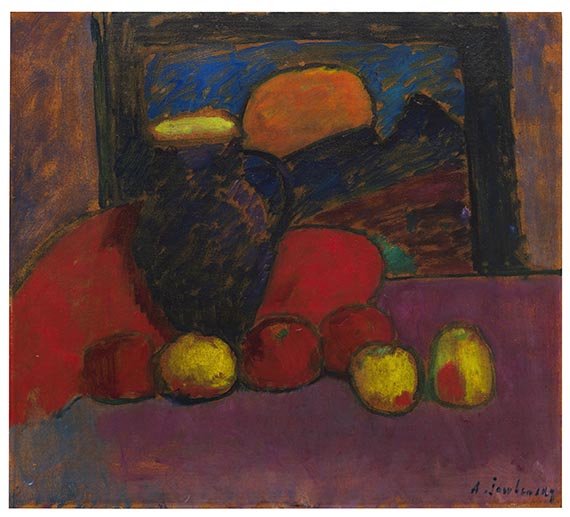
Stillleben, 1910.
Oil on cardboard
Estimate:
€ 250,000 - 350,000
$ 290,000 - 406,000
Information on buyer's premium, taxation and resale right compensation will be available four weeks before the auction.
126000877
Alexej von Jawlensky
Stillleben, 1910.
Oil on cardboard
Estimate:
€ 250,000 - 350,000
$ 290,000 - 406,000
Information on buyer's premium, taxation and resale right compensation will be available four weeks before the auction.
Alexej von Jawlensky
1864 - 1941
Stillleben. 1910.
Oil on cardboard.
Jawlensky/Pieroni-Jawlensky/Jawlensky 2230. Signed in the lower right, dated on the reverse. Titled, signed and inscribed “n 9” by the artist on a label on the reverse. Inscribed “A. J. Eddy” and “8” by a hand other than the artist’s. 49.5 x 53 cm (19.4 x 20.8 in).
The work depicted in the background of the painting is Jawlensky’s “Murnau—Landschaft mit orangener Wolke” from 1909. [EH].
• An exceptional work of museum quality.
• Jawlensky painted this “still life” during his important years in Murnau.
• Jawlensky references his 1909 painting “Murnau – Landschaft mit orangener Wolke” in this work.
• Using pure hues in large swaths, outlined by colored contours, Jawlensky achieves a sense of unity in his composition: color, pictorial harmony, and ingenuity.
• Impressive ownership history: 1. Arthur Jerome Eddy, who met Jawlensky in 1912 and authored the first American book on Modern Art; 2. Katharina Kuh, gallery owner and later the first curator of European Art at the Art Institute of Chicago.
PROVENANCE: Private collection of Arthur Jerome Eddy, Chicago, USA (acquired from the above around 1913; inscribed in pencil on the artist's label on the reverse).
Jerome O. Eddy, Chicago & Skull Valley, Arizona (inherited from the above, 1920–1937; Williams, Barker & Severn Co.).
Private collection of Katharina Kuh, Chicago, USA (acquired from the above in 1937).
Private collection of Peter and Katinka de Vries, Westport, CT, USA (acquired from the above around 1938; until 1992: Christie’s, New York, April 13, 1992).
Private collection, Canada (acquired in 1992 from the aforementioned).
Dietmar Manke Collection, Schleswig-Holstein.
EXHIBITION: Lebensmenschen. Alexej von Jawlensky und Marianne von Werefkin, Lenbachhaus Munich, Ocotber 22, 2019 - February 16, 2020; Museum Wiesbaden, March 13 - August 23, 2020, cat. no. 76, illustrated on p. 143.
LITERATURE: Maria Jawlensky, Lucia Pieroni-Jawlensky, Angelica Jawlensky, Alexej von Jawlensky. Catalogue Raisonné of the Oil Paintings, vol. 3: 1890–1914, Munich 1991, p. 407 with black-and-white illustration and p. 435, CR no. 2230.
- -
Williams, Barker & Severn Co., Chicago, The Late Arthur J. Eddy, Extraordinary Collection of One Hundred and Ten Modernistic Paintings and Antique Oriental Rugs, January 20, 1937, Lot 48.
Christie’s, New York, auction April 13, 1992, lot 221 (with color illustration).
Alexej von Jawlensky. Catalogue Raisonné of the Oil Paintings. Volume Three 1934–1937, ed. by Maria Jawlensky, Lucia Pieroni-Jawlensky, and Angelica Jawlensky, Munich 1993, no. 2230, p. 407.
Alexej von Jawlensky, Lebenserinnerungen (Memoirs), 1937, quoted from: Exhibition catalog Alexej Jawlensky. Vom Abbild zum Urbild (From Image to Archetype), Galerie im Ganserhaus, Wasserburg am Inn, Sept. 15–Oct. 28, 1979, p. 55.
Alexej von Jawlensky, Lebenserinnerungen, 1937, quoted from: Exhibition catalog Alexej Jawlensky. Vom Abbild zum Urbild, Galerie im Ganserhaus, Wasserburg am Inn, September 15 - October 28, 1979, p. 55.
Color, surface and line
Alexej von Jawlensky changed his painting style in the autumn of 1908, when he worked with Marianne von Werefkin, Gabriele Münter, and Wassily Kandinsky in rural Murnau. While the impact of van Gogh's painting on the four artists is still latent in their minds, the examination of Paul Gauguin and subsequently the Fauves, in particular with Henri Matisse and André Derain, became increasingly dominant: it is the clear assignment of color, surface, and line. In addition to traditional subjects like portraits and landscapes, the still life genre was also central to the Fauves' attention and drew the interest of Gabriele Münter and Alexej von Jawlensky, who used the French artists' work as a template for their own artistic expression. In many cases, this led to strikingly similar motifs in the still lifes Jawlensky and Münter painted after 1908.
Expressionism as synthesis
The knowledge of the painting of the "Fauves" - Matisse, Derain, Vlaminck -, who caused a stir with their first presentation at the Salon d'Automne in Paris in 1905, would also change Jawlensky's palette at the end of the trip to Provence in autumn/winter 1906. Jawlensky sent six pictures to the Salon d'Automne in 1905 - mostly still lifes - but he was not in Paris himself, nor was he in France at all. A year later, Jawlensky had planned to travel to Brittany, the artistic home of Gauguin and his successors, the "Nabis". Whether Jawlensky and Werefkin also visited Pont-Aven and Le Pouldu in the south of the peninsula, where Gauguin temporarily lived, is likely, but unknown. In any case, the Atlantic landscape had a lasting impact on Jawlensky: “For the first time I understood to paint not what I saw, but what I felt.] And I knew how to translate nature into colors according to my glowing soul. I painted many landscapes there, from the window bushes and Breton heads. The colors were glowing. And I felt happy deep inside back then,” recalled the artist in his memoirs in elation (quoted from: Alexej von Jawlensky, Reisen, Freunde, Wandlungen, ex. cat. Dortmund 1998, p. 42).
Jawlensky's friend Willibrod Verkade, an ardent student of Gauguin, encouraged him to simplify colors and shapes. In Jawlensky's still lifes, contour also appears as an equal, image-organizing element alongside color, surface, and form. Through them, the painter detached the color surfaces from mere images of reality and made them subject to the order immanent in the picture as independent elements. With staccato-like brushstrokes on the image surface, Jawlensky created additional suggestive forces, whose dynamics he transferred to the entire composition.
In this “Still Life” from 1910, Jawlensky focuses on the contrast between bright red tones and avoids too clear a contouring of the loosely arranged fruits in front of a dark blue jug, which reads as a strong violet surface. As for the setting, the artist keeps the observer in the dark. Not only is the jug in front of a bright red shape, a blanket (?) dominates the arrangement, but also the framed painting by the artist behind it: "Murnau - Landschaft mit orangener Wolke" from 1909. (Fig. ** ). With great confidence, Jawlensky quotes himself here. With the network of various elements such as ornaments, patterns, shapes, surfaces, and colors he presents here, he delivers proof of his extensive knowledge of the still life painting of Cézanne or Gauguin, both of which form a great ensemble in this painting. Jawlensky found unity in his composition in the concept of cloisonnism coined by Gauguin, a painting aesthetic in which large surfaces of pure color are framed by a black or colored line: color, harmony, and invention; Gabriele Münster was impressed by what Jawlensky explains to her as “Synthesis”. In the founding circular of the “Neue Künstlervereinigung München” from 1909, Kandinsky took up the term “artistic synthesis” and described it as a “solution that currently unites more and more artists spiritually (..)”. Many years later, in 1951, Henri Matisse spoke about the idea of the Fauves' style of painting, to which he had made decisive contributions: “I examined each constructional element individually: the drawing, the color, the values and the composition. I tried to find out how these elements could be combined into a synthesis without the expressiveness of one component being diminished by the presence of another. I tried to find out how one could unite the individual pictorial elements into a whole in which an innate quality of each individual could be fully expressed. (Henri Matisse, La chapelle du Rosaire, 1951)
Impressive ownership history
The still life left the artist's studio and soon became part of the important collection of Arthur Jerome Eddy (1859-1920). The lawyer, with a strong interest in art, belonged to the first generation of American modern art collectors. In 1913, he bought a Brancusi sculpture at the Armory Show; he also acquired other works by Marcel Duchamp, Pablo Picasso, Franz Marc, and four abstract paintings by Kandinsky. While traveling to Europe, he met many of the artists in person. Among them was Jawlensky, whom he liked so much that he purchased four works: "Portrait Marie Castell", 1906 (Catalog Raisonné 124), "Wegkreuzung- Murnau", 1910 (Catalog Raisonné 360), and "Ägypterin", 1913 (Catalog Raisonné 599). By the end of his life, Arthur Jerome Eddy's collection included over 100 avant-garde works, some of which were transferred to the Art Institute of Chicago in the 1930s. Our "Still Life" then entered the collection of Katharina Kuh (1904-1994). She first studied with Alfred H. Barr, co-founder and first director of the Museum of Modern Art in New York, and opened an important modern art gallery in Chicago in 1935. Between 1954 and 1959, she was the first female curator at the Art Institute of Chicago.

Headquarters
Joseph-Wild-Str. 18
81829 Munich
Phone: +49 89 55 244-0
Fax: +49 89 55 244-177
info@kettererkunst.de
Louisa von Saucken / Undine Schleifer
Holstenwall 5
20355 Hamburg
Phone: +49 40 37 49 61-0
Fax: +49 40 37 49 61-66
infohamburg@kettererkunst.de
Dr. Simone Wiechers / Nane Schlage
Fasanenstr. 70
10719 Berlin
Phone: +49 30 88 67 53-63
Fax: +49 30 88 67 56-43
infoberlin@kettererkunst.de
Cordula Lichtenberg
Gertrudenstraße 24-28
50667 Cologne
Phone: +49 221 510 908-15
infokoeln@kettererkunst.de
Hessen
Rhineland-Palatinate
Miriam Heß
Phone: +49 62 21 58 80-038
Fax: +49 62 21 58 80-595
infoheidelberg@kettererkunst.de
We will inform you in time.