


Raumbeispiel
56
Wassily Kandinsky
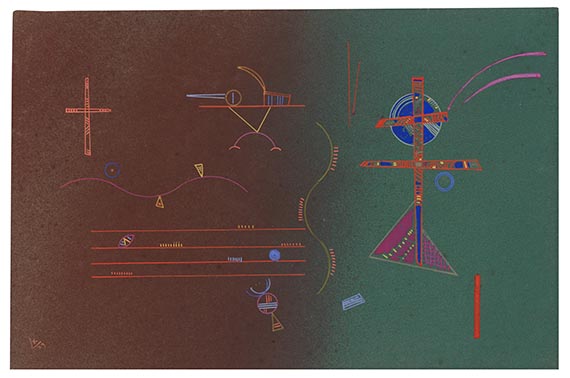
Sachte, 1929.
Watercolor and gouache on paper, originally lam...
Estimate:
€ 150,000 - 250,000
$ 168,000 - 280,000
56
Wassily Kandinsky
Sachte, 1929.
Watercolor and gouache on paper, originally lam...
Estimate:
€ 150,000 - 250,000
$ 168,000 - 280,000
Wassily Kandinsky
1866 - 1944
Sachte. 1929.
Watercolor and gouache on paper, originally laminated on cardboard.
Monogrammed and dated “K/29” in the lower left corner. Inscribed “no340 / 1929 / ‘Sachte’” on the reverse. 26.4 x 40.1 cm (10.3 x 15.7 in).
In the artist’s handwritten list, the work is recorded among the watercolors for March 1929 as “iii 1929, 340, Sachte”. [JS].
• BAUHAUS Kandinsky’s strictly geometric compositions from the 1920s are considered the highlights of his oeuvre.
• PROGRAMMATIC “Sachte” (1929) exemplifies Kandinsky’s famous abstract art theory “Point and Line to Plane” (1926).
• VISUALIZING SOUND Like a painted musical score, “Sachte” is a unique reflection of Kandinsky’s aim to express moods and tonalities through his art.
• MUSEUM QUALITY Watercolors from this period are at, among others, the Museum of Modern Art and the Guggenheim Museum in New York, as well as at the Centre Pompidou in Paris.
• PROVENANCE Part of a German private collection for nearly 60 years.
PROVENANCE: Rudolf Probst, Mannheim (according to a note in the artist’s handwritten list, presumbaly on consignment).
Nina Kandinsky Collection, Paris.
Karl Flinker, Paris (1962).
Heinz Berggruen, Paris (1962).
Roman Norbert Ketterer, Campione d’Italia (1968).
Private collection, North Rhine-Westphalia (acquired from the above in 1968).
In the family’s possession ever since.
EXHIBITION: Wassily Kandinsky, November Exhibition, Kunsthaus Zürich, Nov. 5–Dec. 9, 1931, no. 69.
Wassily Kandinsky. Ausstelung mit Werken von 1918 bis 1933, Galerie Otto Stangl, July 25–September 4, 1962 (illustrated, no p.).
LITERATURE: Vivian Endicott Barnett, Kandinsky: Catalogue Raisonné of Watercolors, vol. 2: 1922–1944, Munich 1994, cat. no. 931 (with b/w ill.).
- -
Roman Norbert Ketterer, Modern Art V, Campione d'Italia, 1968, no. 63.
“Music, which for centuries has been the art form that uses its means not to depict the phenomena of nature, but to express the artist's inner life and to create a unique realm of sounds, is currently the most envied teacher of painting.”
Wassily Kandinsky, On the Spiritual in Art, Munich 1912, p. 41
Called up: December 4, 2026 - ca. 18.50 h +/- 20 min.
A visit to a concert by Arnold Schoenberg, the renowned proponent of free atonality, in January 1911 is considered a pivotal moment in Wassily Kandinsky’s path to abstract painting. The program at Munich’s Jahreszeitensaal featured two compositions by the experimental Austrian composer. Kandinsky attended the concert with his young artist colleague Franz Marc, with whom he would later resign from the Neue Künstlervereinigung München that same year to found the legendary Expressionist artists’ group “Der Blaue Reiter”. Franz Marc also became an international legend; equally talented and, like Kandinsky, imbued with a visionary spirit, he produced a body of work of immense art-historical significance in the few years before his early death in World War I. In stark contrast to Kandinsky, however, Marc, whose famous “Blue Horses” are still considered icons of Expressionism today, never intended to abandon figuration completely. Of all the progressive artists of the “Blue Rider,” only Kandinsky dared to take this radical step, akin to an art-historical revelation, starting with the painting “Impression III (Concert)” (1911, Städtische Galerie im Lenbachhaus, Munich), created in 1911 following the Schoenberg concert. This endeavor culminated that year in the nearly three-meter-wide “Composition V” (1911), which, because of its radical abstract style, the jury of the New Artists’ Association rejected, ultimately leading to the secession of the “Blue Rider” artists. With this piece, Kandinsky approaches what he defined as the goal of his artistic aspirations in a letter he wrote to Schoenberg immediately after the concert: “The independent life of the individual voices in your compositions is exactly what I am seeking to find in painterly form.” (W. Kandinsky to A. Schoenberg, in: Briefe, Bilder und Dokumente einer außergewöhnlichen Begegnung, Salzburg/Vienna 1980, p. 19). And while Kandinsky’s early abstract compositions from those years—albeit abstracted to the point of being mere pictorial symbols—still contained representational elements such as mountains, church steeples, boats, figures, and horsemen, his pictorial language gradually began to crystallize around 1920, influenced by Russian Constructivism, moving toward a strictly geometric abstraction. This process ultimately reached its peak during his years at the Bauhaus. In 1921, Kandinsky began teaching analytical drawing at the Bauhaus in Weimar, then was appointed head of the Department of Form and Color Theory in 1925 after the Bauhaus relocated to Dessau. In Dessau, where the artist lived in one of the Masters’ Houses together with Paul Klee, he created the present, masterfully balanced composition “Sachte” (Gently) in March 1929. Through the gentle color gradation of the picture's two halves, as well as the delicate, almost lyrical interplay of lines and basic geometric forms, which function on the pictorial surface like musical accents and voices, Kandinsky comes remarkably close to his central artistic aim of achieving an expression in painting that is comparable to music. Even if Kandinsky had not titled the sheet “Sachte” and included it in his handwritten list, “Sachte” would still be precisely the tone the viewer perceives in this extremely lyrical and gently composed work. [JS]

Buyer's premium and taxation for Wassily Kandinsky "Sachte"
This lot can be purchased subject to differential or regular taxation.
Differential taxation:
Hammer price up to 2,000,000 €: herefrom 34 % premium.
The share of the hammer price exceeding 2,000,000 € is subject to a premium of 29 % and is added to the premium of the share of the hammer price up to 2,000,000 €.
The share of the hammer price exceeding 4,000,000 € is subject to a premium of 22 % and is added to the premium of the share of the hammer price up to 4,000,000 €.
The buyer's premium contains VAT, however, it is not shown.
Regular taxation:
Hammer price up to 2,000,000 €: herefrom 29 % premium.
The share of the hammer price exceeding 2,000,000 € is subject to a premium of 23% and is added to the premium of the share of the hammer price up to 2,000,000 €.
The share of the hammer price exceeding 4,000,000 € is subject to a premium of 15% and is added to the premium of the share of the hammer price up to 4,000,000 €.
The statutory VAT of currently 7 % is levied to the sum of hammer price and premium.
We kindly ask you to notify us before invoicing if you wish to be subject to regular taxation.
Headquarters
Joseph-Wild-Str. 18
81829 Munich
Phone: +49 89 55 244-0
Fax: +49 89 55 244-177
info@kettererkunst.de
Louisa von Saucken / Undine Schleifer
Holstenwall 5
20355 Hamburg
Phone: +49 40 37 49 61-0
Fax: +49 40 37 49 61-66
infohamburg@kettererkunst.de
Dr. Simone Wiechers / Nane Schlage
Fasanenstr. 70
10719 Berlin
Phone: +49 30 88 67 53-63
Fax: +49 30 88 67 56-43
infoberlin@kettererkunst.de
Cordula Lichtenberg
Gertrudenstraße 24-28
50667 Cologne
Phone: +49 221 510 908-15
infokoeln@kettererkunst.de
Hessen
Rhineland-Palatinate
Miriam Heß
Phone: +49 62 21 58 80-038
Fax: +49 62 21 58 80-595
infoheidelberg@kettererkunst.de
We will inform you in time.