


Frame image
Raumbeispiel
36
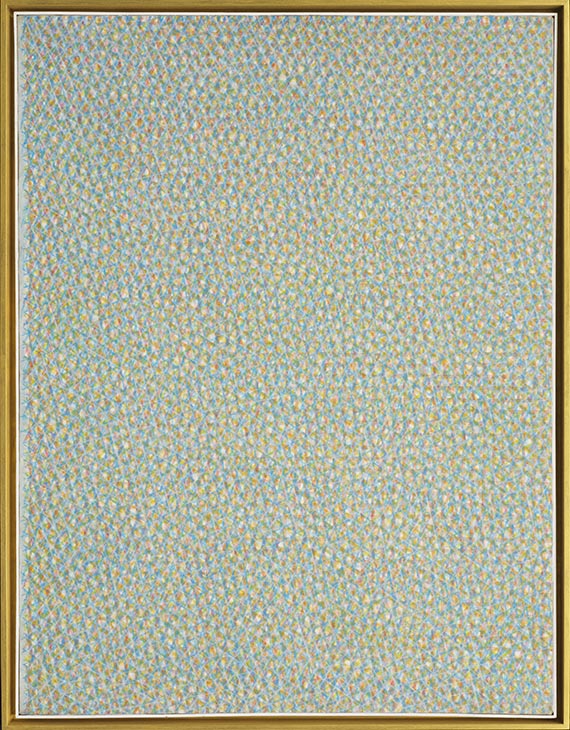
Piero Dorazio
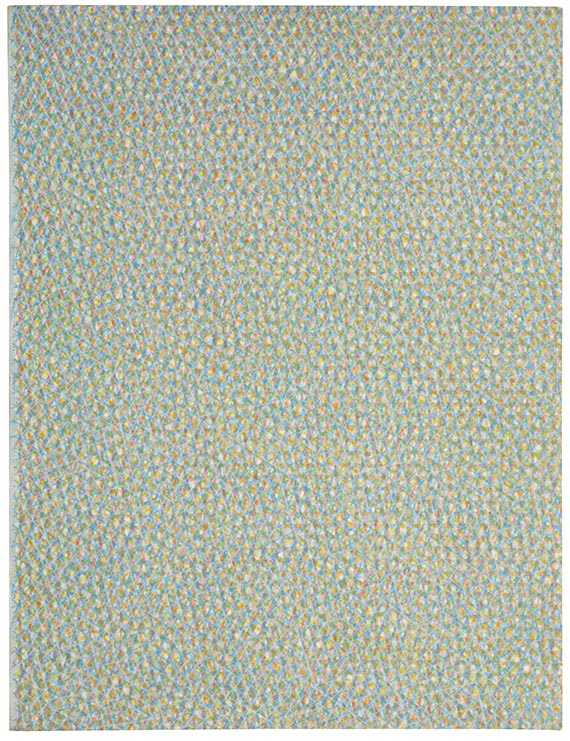
Jeux d’air, 1962.
Oil on canvas
Estimate:
€ 250,000 - 350,000
$ 280,000 - 392,000
36
Piero Dorazio
Jeux d’air, 1962.
Oil on canvas
Estimate:
€ 250,000 - 350,000
$ 280,000 - 392,000
Piero Dorazio
1927 - 2005
Jeux d’air. 1962.
Oil on canvas.
Signed, dated, and titled on the reverse of the canvas. 117 x 89.5 cm (46 x 35.2 in).
In the original frame.
• PURE ABSTRACTION A masterful, oscillating grid composition (“Reticolo”) from Dorazio’s most sought-after creative period.
• CALEDOSCOPE Captivating visual depth and luminous presence.
• BREAKTHROUGH In 1960, Dorazio exhibited similar works at the Venice Biennale, and the São Paulo Biennial in 1963.
• INTERNATIONAL Extensive provenance and exhibition history.
• MUSEUM-QUALITY Comparable key pieces by are in major international collections such as the Museum of Modern Art, New York; the Centre Pompidou, Paris; and the Galleria Nazionale d’Arte Moderna e Contemporanea, Rome.
Accompanied by a photo certificate issued by the Archivio Piero Dorazio, Milan. The work is documented in the Archivio Piero Dorazio, Milan.
PROVENANCE: Galleria dell’Ariete, Milan (with a label and stamp on the reverse of the stretcher).
Galleria La Bertesca, Genoa (with two labels and two stamps on the reverse of the stretcher).
Marlborough Galleria d’Arte, Rome (with a label on the reverse of the stretcher).
Marlborough Fine Art, London (with a label on the reverse of the stretcher).
Galerie im Erker, St. Gallen (stamped twice on the reverse of the stretcher).
Galleria Finarte, Milan (circa 1977/1978).
Franco Stefanoni Collection, Lecco (circa 1991, on a label on the reverse of the stretcher).
Private collection, Milan (since 2008, Sotheby’s).
Private collection (acquired from the above).
Private collection, Southern Germany (acquired from the above).
EXHIBITION: Piero Dorazio, Marlborough Fine Art, London, January 1966, cat. no. 10, no illustration
Piero Dorazio, Galerie Im Erker, St. Gallen, May 28–July 16, 1966, cat. no. 8, with b&w illustration on p. 10 (with a label on the back of the stretcher).
Piero Dorazio, Galleria Peccolo, Livorno, February 27–March 31, 1971.
Città di Lecco per l’arte, Villa Manzoni, Musei Civici, Lecco, April 20–May 26, 1991 (with a label on the back of the stretcher).
LITERATURE: Marisa Volpi Orlandini, Jacques Lassaigne, and Giorgio Crisafi, Dorazio, Milan 1977 / Stuttgart 1978, CR no. 530 (with illustration and plate 69)
- -
Sotheby’s, Milan, Modern & Contemporary Art, May 27, 2008, lot 289 (with illustration).
"The surface of a canvas is a two-dimensional plane, and from this plane we create an optical phenomenon; we create an image that evokes sensation, an emotion in the viewer, from which, in turn, a question, a reflection, a thought, an idea gradually emerges—let’s say, essentially, a way of thinking and a state of mind; if we succeed in this, we find ourselves in the presence of art."
Piero Dorazio in a conversation with Giulio Turcato, quoted from: Conversazione sull’arte oggi e su cose interessanti in occasione della trentatreesima Biennale di Venezia, in: Metro, Milan, no. 11, June 1966, p. 45.
Called up: December 4, 2026 - ca. 18.10 h +/- 20 min.
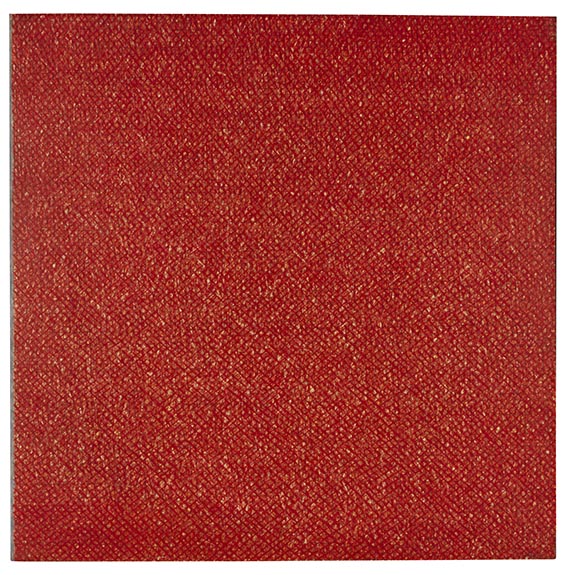
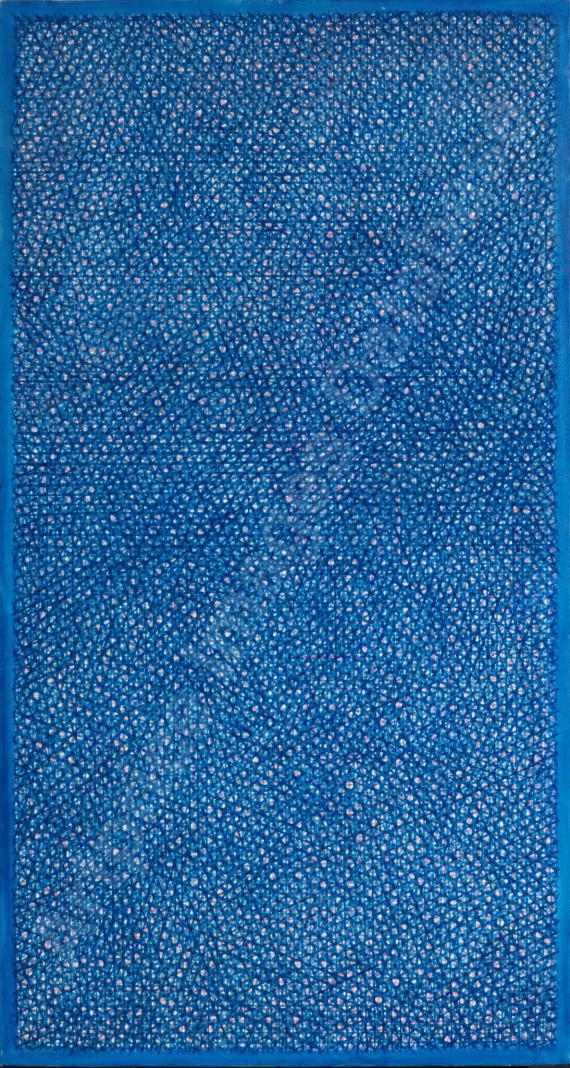
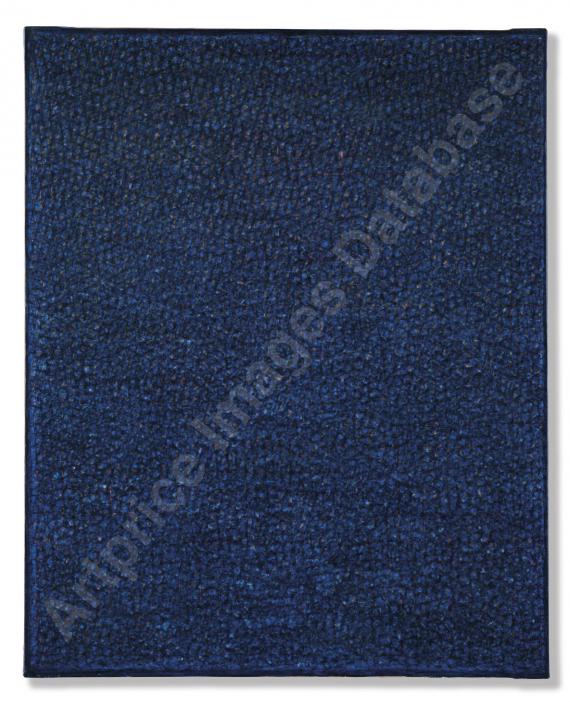
The painting “Jeux d'air,” created in 1962, marks the pinnacle of Piero Dorazio’s famous “Reticoli” or grid paintings (1958–1963), a series of works that ranks among the most influential contributions to postwar abstraction in Europe. Dorazio built the composition from a dense network of linear brushstrokes that slightly vary in angle, thickness, and transparency. These subtle nuances breathe life into the entire pictorial space: a visual impression of depth and constant vibration emerges where the lines intersect and overlap. As the eye wanders across the surface, the colors seem to come forth, recede, and merge. The painting comes alive, as it constantly changes shape in the very act of viewing.
Architecture, Space, and Color
This dynamic of perception is central to Dorazio’s work. The pictorial surface never appears static; it is constantly refreshed through the active experience of viewing. Dorazio’s distinctive approach to the canvas is significantly shaped by his studies in architecture at the University of Rome in the mid-1940s. This background explains his enduring fascination with supporting structures, spatial dynamics, and the way light animates an environment. Dorazio does not conceive of space as a void that must be filled, but as a fabric that takes shape through structural rhythm and chromatic energy. He writes: “I believe that one cannot imagine the relationship between humans and space—neither visually nor conceptually—without color—but one can do so through painting.” (Piero Dorazio, quoted in: Exhibition catalog “Piero Dorazio,” Galerie im Erker, St. Gallen 1966, p. 21). In the “Reticoli”, this architectural impulse is directly transferred to the two-dimensional pictorial surface. The linear grid does not serve as a rigid framework, but as an open, modulating light lattice in which space is measured, constructed, and made perceptible through the interplay of colors.
Transatlantic Dialogue
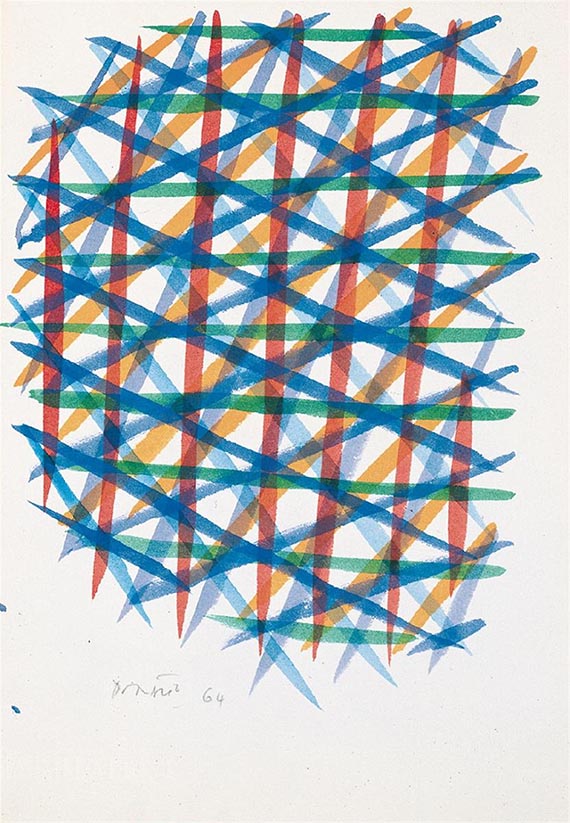
Dorazio’s artistic journey was also shaped by the atmosphere of reconstruction following World War II. In 1947, he traveled to Paris to study the historical avant-garde at the École des Beaux-Arts, and that same year he co-founded the group “Forma I” in Rome. Beginning in 1953, extended stays in New York brought him into direct contact with the American avant-garde, including Barnett Newman and Robert Motherwell. These encounters gave him a distinctly international perspective and anchored his work in the dialogue between European traditions of color and light and the aspirations of the new American painting. By the late 1950s, this exploration culminated in the “Reticoli”. While movements such as the European Informel and American Action Painting relied on thick layers of paint and gestural drama, Dorazio opted for clarity, structure, and visual discipline. Instead of applying paint in broad swaths or with dramatic gestures, he shaped it from hundreds of fine, intersecting lines. The result balances calculation and openness. The composition is organized with mathematical precision, yet the surface remains light, porous, and atmospheric.
The International Breakthrough
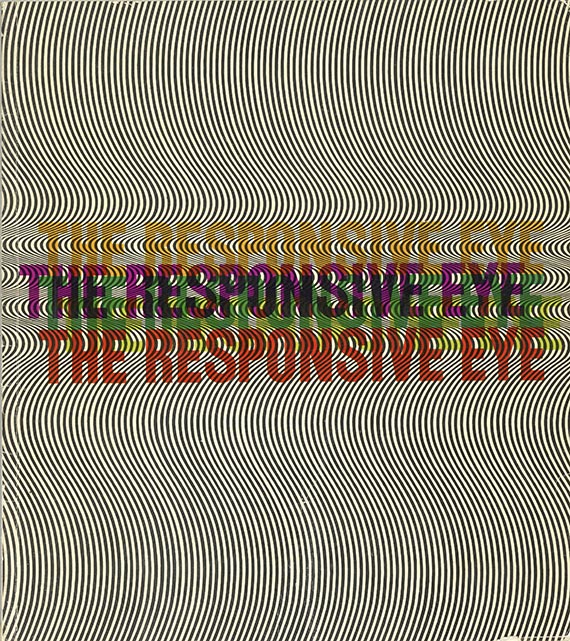
The year 1960 marked his international breakthrough. At the Venice Biennale, he exhibited his grid paintings in a highly acclaimed solo exhibition space. He was appointed to the University of Pennsylvania to establish its Graduate Painting Program, where he taught for nearly a decade. “Jeux d’air” was created during this fruitful transatlantic phase and exemplifies the broad interest in visual perception that characterized the 1960s. This interest peaked in 1965 with the groundbreaking exhibition “The Responsive Eye” at the Museum of Modern Art in New York, which also included works by Dorazio. “Jeux d’air” shows Dorazio at the height of his creative powers. The grid does not form a closed boundary, but rather an open field of light and air. Its measured rhythm guides the viewer’s gaze, while the iridescent, shimmering colors keep the picture plane in motion. Thus, the painting combines discipline, dynamism, and luminosity into a consummate visual whole. [KA]
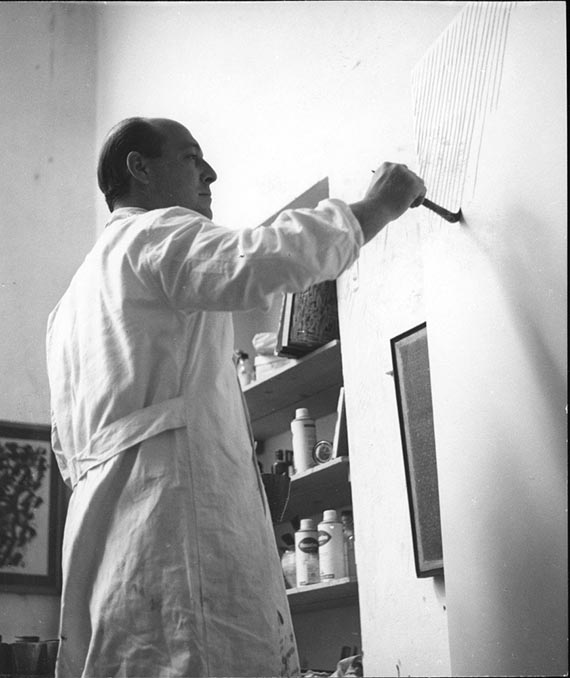
Piero Dorazio in his studio, 1959, photo: Werner Schloske. © VG Bild-Kunst, Bonn 2026
Architecture, Space, and Color
This dynamic of perception is central to Dorazio’s work. The pictorial surface never appears static; it is constantly refreshed through the active experience of viewing. Dorazio’s distinctive approach to the canvas is significantly shaped by his studies in architecture at the University of Rome in the mid-1940s. This background explains his enduring fascination with supporting structures, spatial dynamics, and the way light animates an environment. Dorazio does not conceive of space as a void that must be filled, but as a fabric that takes shape through structural rhythm and chromatic energy. He writes: “I believe that one cannot imagine the relationship between humans and space—neither visually nor conceptually—without color—but one can do so through painting.” (Piero Dorazio, quoted in: Exhibition catalog “Piero Dorazio,” Galerie im Erker, St. Gallen 1966, p. 21). In the “Reticoli”, this architectural impulse is directly transferred to the two-dimensional pictorial surface. The linear grid does not serve as a rigid framework, but as an open, modulating light lattice in which space is measured, constructed, and made perceptible through the interplay of colors.
Poster for the renowned exhibition „The Responsive Eye“, 1965, Museum of Modern Art, New York. © VG Bild-Kunst, Bonn 2026
Transatlantic Dialogue
Dorazio’s artistic journey was also shaped by the atmosphere of reconstruction following World War II. In 1947, he traveled to Paris to study the historical avant-garde at the École des Beaux-Arts, and that same year he co-founded the group “Forma I” in Rome. Beginning in 1953, extended stays in New York brought him into direct contact with the American avant-garde, including Barnett Newman and Robert Motherwell. These encounters gave him a distinctly international perspective and anchored his work in the dialogue between European traditions of color and light and the aspirations of the new American painting. By the late 1950s, this exploration culminated in the “Reticoli”. While movements such as the European Informel and American Action Painting relied on thick layers of paint and gestural drama, Dorazio opted for clarity, structure, and visual discipline. Instead of applying paint in broad swaths or with dramatic gestures, he shaped it from hundreds of fine, intersecting lines. The result balances calculation and openness. The composition is organized with mathematical precision, yet the surface remains light, porous, and atmospheric.
Piero Dorazio, Untitled, 1964, watercolor on paper, private ownership. © VG Bild-Kunst, Bonn 2026
The International Breakthrough
The year 1960 marked his international breakthrough. At the Venice Biennale, he exhibited his grid paintings in a highly acclaimed solo exhibition space. He was appointed to the University of Pennsylvania to establish its Graduate Painting Program, where he taught for nearly a decade. “Jeux d’air” was created during this fruitful transatlantic phase and exemplifies the broad interest in visual perception that characterized the 1960s. This interest peaked in 1965 with the groundbreaking exhibition “The Responsive Eye” at the Museum of Modern Art in New York, which also included works by Dorazio. “Jeux d’air” shows Dorazio at the height of his creative powers. The grid does not form a closed boundary, but rather an open field of light and air. Its measured rhythm guides the viewer’s gaze, while the iridescent, shimmering colors keep the picture plane in motion. Thus, the painting combines discipline, dynamism, and luminosity into a consummate visual whole. [KA]


Buyer's premium, taxation and resale right compensation for Piero Dorazio "Jeux d’air"
This lot can be purchased subject to differential or regular taxation, artist‘s resale right compensation is due.
Differential taxation:
Hammer price up to 2,000,000 €: herefrom 34 % premium.
The share of the hammer price exceeding 2,000,000 € is subject to a premium of 29 % and is added to the premium of the share of the hammer price up to 2,000,000 €.
The share of the hammer price exceeding 4,000,000 € is subject to a premium of 22 % and is added to the premium of the share of the hammer price up to 4,000,000 €.
The buyer's premium contains VAT, however, it is not shown.
Regular taxation:
Hammer price up to 2,000,000 €: herefrom 29 % premium.
The share of the hammer price exceeding 2,000,000 € is subject to a premium of 23% and is added to the premium of the share of the hammer price up to 2,000,000 €.
The share of the hammer price exceeding 4,000,000 € is subject to a premium of 15% and is added to the premium of the share of the hammer price up to 4,000,000 €.
The statutory VAT of currently 7 % is levied to the sum of hammer price and premium.
We kindly ask you to notify us before invoicing if you wish to be subject to regular taxation.
Calculation of artist‘s resale right compensation:
For works by living artists, or by artists who died less than 70 years ago, a artist‘s resale right compensation is levied in accordance with Section 26 UrhG:
4 % of hammer price from 400.00 euros up to 50,000 euros,
another 3 % of the hammer price from 50,000.01 to 200,000 euros,
another 1 % for the part of the sales proceeds from 200,000.01 to 350,000 euros,
another 0.5 % for the part of the sale proceeds from 350,000.01 to 500,000 euros and
another 0.25 % of the hammer price over 500,000 euros.
The maximum total of the resale right fee is EUR 12,500.
The artist‘s resale right compensation is VAT-exempt.
Headquarters
Joseph-Wild-Str. 18
81829 Munich
Phone: +49 89 55 244-0
Fax: +49 89 55 244-177
info@kettererkunst.de
Louisa von Saucken / Undine Schleifer
Holstenwall 5
20355 Hamburg
Phone: +49 40 37 49 61-0
Fax: +49 40 37 49 61-66
infohamburg@kettererkunst.de
Dr. Simone Wiechers
Fasanenstr. 70
10719 Berlin
Phone: +49 30 88 67 53-63
Fax: +49 30 88 67 56-43
infoberlin@kettererkunst.de
Cordula Lichtenberg
Gertrudenstraße 24-28
50667 Cologne
Phone: +49 221 510 908-15
infokoeln@kettererkunst.de
Hessen
Rhineland-Palatinate
Miriam Heß
Phone: +49 62 21 58 80-038
Fax: +49 62 21 58 80-595
infoheidelberg@kettererkunst.de
We will inform you in time.