


Sale: 612 / Evening Sale, Dec. 04. 2026 in Munich → Lot 126000892
Raumbeispiel
126000892
Karl Schmidt-Rottluff
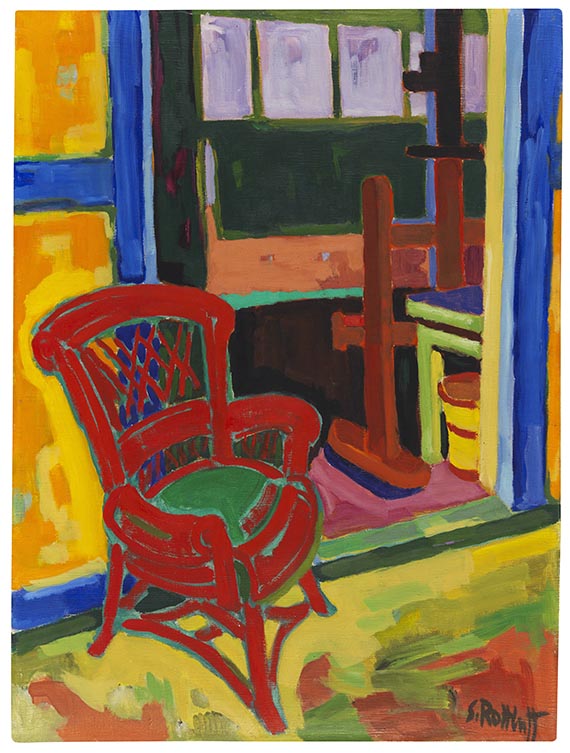
Der rote Stuhl, 1951.
Oil on canvas
Estimate:
€ 120,000 - 180,000
$ 139,200 - 208,800
Information on buyer's premium, taxation and resale right compensation will be available four weeks before the auction.
126000892
Karl Schmidt-Rottluff
Der rote Stuhl, 1951.
Oil on canvas
Estimate:
€ 120,000 - 180,000
$ 139,200 - 208,800
Information on buyer's premium, taxation and resale right compensation will be available four weeks before the auction.
Karl Schmidt-Rottluff
1884 - 1976
Der rote Stuhl. 1951.
Oil on canvas.
Signed in the lower right. Once more signed, titled and inscribed with the work number "516", as well as "gewachst" on the reverse of the stretcher. 101 x 76.2 cm (39.7 x 30 in).
[AR].
• Extraordinarily modern in terms of colors, perspective and image section.
• Schmidt-Rottluff uses powerful, pure colors to offer a glimpse into his studio.
• With this painting he points beyond the purely visible, transforming the object into a symbol of human imagination.
• Part of the renowned collection of Berthold and Else Beitz.
• Shown in many exhibition during the artists's lifetime.
The work is documented in the archive of the Karl and Emy Schmidt-Rottluff Foundation, Berlin.
PROVENANCE: Berthold and Else Beitz Collection (directly from the artist).
Private collection Northern Germany (inherited from the above).
Dietmar Manke Collection, Schleswig-Holstein (since 2022, Ketterer Kunst).
EXHIBITION: Karl Schmidt-Rottluff, Kestner Gesellschaft, Hanover, April 8 - May 11, 1952, cat. no. 36.
Karl Schmidt-Rottluff. Neue Werke - Gemälde, Tuschblätter, Graphik, Galerie Ferdinand Möller, Cologne, May 1953, cat. no. 5 (with illu., with the label on the reverse).
Karl Schmidt-Rottluff zum 70. Geburtstag. Gemälde, Aquarelle, Zeichnungen, Graphik, Skulpturen, Kunsthalle zu Kiel, Kiel, June 20 - July 25, 1954, cat. no. 56.
Karl Schmidt-Rottluff zum 70. Geburtstag, Schloss Charlottenburg, Berlin, September 20 - October 10, 1954, cat. no. 92.
Fränkische Galerie, Nuremberg, 1954, cat. no. 74.
Städtische Galerie, Duisburg, 1955, cat. no. 47.
LITERATURE: Will Grohmann, Karl Schmidt-Rottluff, Stuttgart 1956, pp. 233/306 (illustrated in black and white).
- -
Ketterer Kunst, Munich, auction 533, Modern Art Day Sale and Hermann Gerlinger Collection, December 10, 2022, lot 512 (illustrated in color).
"I think most paintings are about procedures; I always wanted to show the being and the calm and quiet life of the things."
Karl Schmidt-Rottluff, 1960, quoted from: Hans Kinkel, Das stille Leben der Dinge, in: Gunther Thiem (ed.), Schmidt-Rottluff. Retrospektive, Munich 1989, pp. 69-70
Karl Schmidt-Rottluff and the post-war period
For Karl Schmidt-Rottluff, whose Berlin studio was destroyed in an air raid in 1943, the period after the end of the Second World War was characterized by great uncertainties. In a letter to the artist Curt Stoermer from 1945, he wrote: “All that remained was an unimaginable chaos, and it took me the last bit of strength to sort it out. Although we were among the survivors, there is not much else left.” (quoted from: Gunther Thiem (ed.), Schmidt-Rottluff. Retrospective, Munich 1989, p. 100). Together with his wife Emy, Schmidt-Rottluff initially lived penniless in his parents' home in Rottluff near Chemnitz, where even the most necessities were hard to obtain, let alone painting supplies. The situation only improved again when the artist accepted a professorship at the Academy of Fine Arts in Charlottenburg and returned to Berlin in 1946. Although he remained active in teaching, he soon began creating new works that echoed his expressionist phase. As he got older, however, he focused more on his immediate surroundings and personal environment. Depictions of figures became rarer, and they were replaced by still lifes and interiors. "Der rote Stuhl“ (The Red Chair) from 1951 also fits into this group, offering private insights into the artist's life. In addition, the purity and power of the colors returned with great intensity. In contrast to his earlier works, however, these are now more differentiated and structure the exceptionally modern pictorial compositions into large areas.
The studio at the "Blaue Haus" in the Taunus mountains
In the post-war period, the artist, whose work had been inspired by foreign places since the "Brücke" period, began to travel more frequently again. He first stayed in the Taunus mountains with Hanna Bekker vom Rath in 1932 and would regularly return after the war. Over the years, the painter and collector became a close friend of the Schmidt-Rottluffs. She lived in a multi-story house in Hofheim, which is also called the "Blaues Haus" (Blue House) because of its striking exterior. Even during the Nazi period, it offered artists a retreat where they could live and work in seclusion. The house is surrounded by a large garden and a studio with a large window on the upper floor. It can be assumed that our painting "The Red Chair" was also created here, because it shows strong parallels to a self-portrait by the artist from 1951 entitled "Im studio“ (In the Studio) (fig.). Both works show a large easel on the right, the kind of easel found in the "Blue House". The striking window in the background also refers to the premises of Hanna Bekker vom Rath im Taunus. Today some works from her collection are at the Städel Museum in Frankfurt am Main, including a wooden sculpture by Karl Schmidt-Rottluff and a painting by Alexej von Jawlensky.
The chair as a motif in art
In the history of painting, the chair in all its forms and colors is not a rare motif. It can be found time and again, especially in interiors and portraits. In most cases, however, the piece of furniture only plays a secondary role, serving as a seat for the sitter or as part of a historical interior design. Only a few artists have devoted their full attention to the chair, including major figures in art history such as Vincent van Gogh (1888), Henri Matisse (1918), and Roy Lichtenstein (1997). Moved to the center of the depiction, the chairs become the main motif in their works, and all attention is initially focused on their static nature. However, they are often to be understood as placeholders, as in the case of Vincent van Gogh, who does not explicitly depict his friend Paul Gauguin, but who subtly implies his presence with the title "Gauguin's Chair". Henri Matisse's peaches also give the impression that the fruit that has only been put aside temporarily is about to be picked up again at any moment. Whether Roy Lichtenstein's chair, broken down into the typical lines and dots of Pop Art, would actually hold a person is questionable. On the other hand, Karl Schmidt-Rottluff's red wicker chair in the studio anteroom, with the expectant easel in the background, seems like an invitation to take a seat and watch the artist create his art.

Headquarters
Joseph-Wild-Str. 18
81829 Munich
Phone: +49 89 55 244-0
Fax: +49 89 55 244-177
info@kettererkunst.de
Louisa von Saucken / Undine Schleifer
Holstenwall 5
20355 Hamburg
Phone: +49 40 37 49 61-0
Fax: +49 40 37 49 61-66
infohamburg@kettererkunst.de
Dr. Simone Wiechers / Nane Schlage
Fasanenstr. 70
10719 Berlin
Phone: +49 30 88 67 53-63
Fax: +49 30 88 67 56-43
infoberlin@kettererkunst.de
Cordula Lichtenberg
Gertrudenstraße 24-28
50667 Cologne
Phone: +49 221 510 908-15
infokoeln@kettererkunst.de
Hessen
Rhineland-Palatinate
Miriam Heß
Phone: +49 62 21 58 80-038
Fax: +49 62 21 58 80-595
infoheidelberg@kettererkunst.de
We will inform you in time.