


Frame image
Raumbeispiel
31
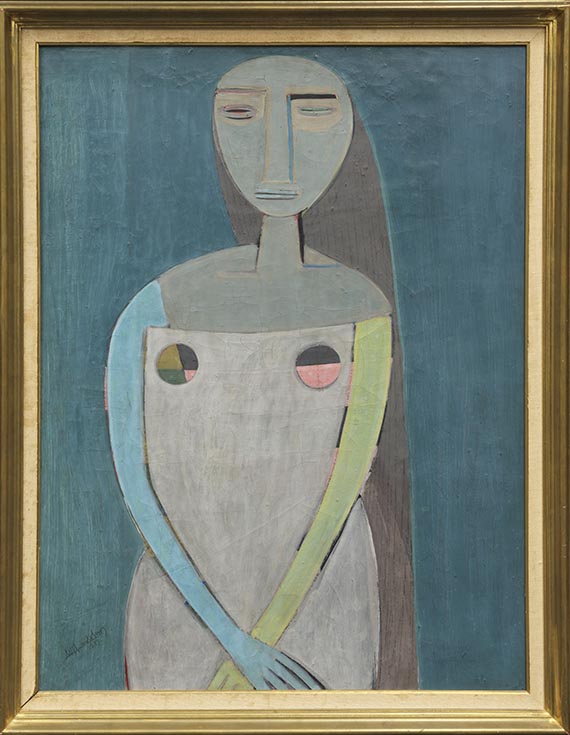
Wifredo Lam
Jeune fille sur fond vert, 1939.
Oil on canvas
Estimate:
€ 250,000 - 350,000
$ 280,000 - 392,000
31
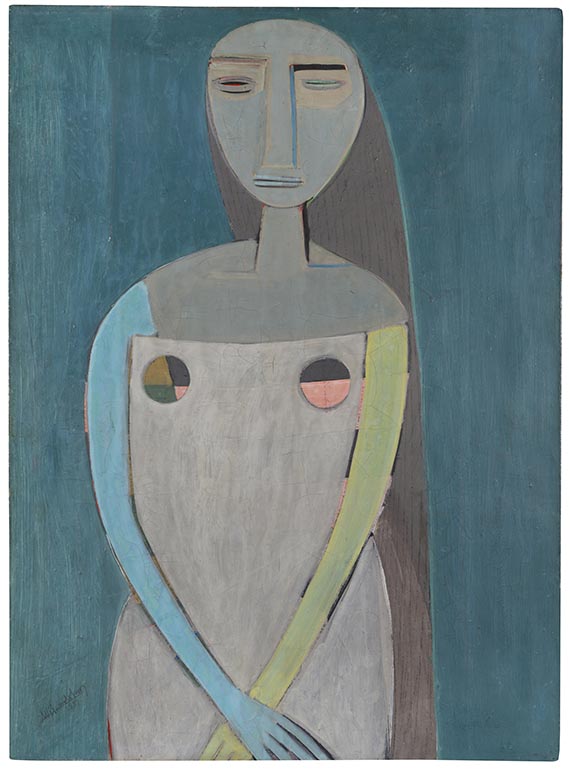
Wifredo Lam
Jeune fille sur fond vert, 1939.
Oil on canvas
Estimate:
€ 250,000 - 350,000
$ 280,000 - 392,000
Wifredo Lam
1902 - 1982
Jeune fille sur fond vert. 1939.
Oil on canvas.
Signed and dated in the lower left. 99 x 72 cm (38.9 x 28.3 in).
• REDUCED FORM A striking example of Wifredo Lam’s geometrically influenced, contemplative female portraits.
• THE MASK The face as an expression of Lam’s synthesis of Afro-Caribbean roots and the European avant-garde.
• PICASSO Created in Paris in 1939, during Lam's close artistic relationship with Picasso, who recognised and nurtured his talent early on.
• MUSE The subject is believed to be Helena Holzer, whom the artist met in 1938 and married in 1944.
• TOPICALITY The retrospective “When I Don’t Sleep, I Dream” at the Museum of Modern Art, New York (November 2025–April 2026), underscores Lam’s enduring international significance.
Accompanied by a photo certificate from Eskil Lam, Paris, dated September 8, 2021. The work is registered in the Wifredo Lam Archive, Paris, under the number “39.62.” We are grateful to Mr. Eskil Lam for his kind assistance.
PROVENANCE: Collection of Dr. Herbert Gross, Zurich.
Private collection, Switzerland (since 1968, acquired from the above)
From a Swiss corporate collection (acquired from the above).
"I knew I was running the risk of not being understood by either the man in the street or by the others. But a true picture has the power to set the imagination to work even if it takes time."
Wifredo Lam, quoted from: Max-Pol Fouchet, Wifredo Lam, Barcelona 1976, pp. 188f.
Called up: December 4, 2026 - ca. 18.00 h +/- 20 min.
Wifredo Lam is widely regarded as one of the most important avant-garde artists of the 20th century. Born in Cuba to a Chinese father and a Congolese-Cuban mother, he first attended the Academy of Fine Arts in Havana before traveling to Spain on scholarship to study at the San Fernando Academy in Madrid.
In 1938, Lam moved to Paris, where he met leading figures of the avant-garde—most notably Pablo Picasso, who would become his closest artistic ally and patron. Picasso, in turn, drew inspiration from Lam and saw him as naturally closer to the African culture he so admired.

Picasso also introduced him to the renowned art dealer and gallery owner Pierre Loeb. Shortly thereafter, in 1939, Lam’s first solo exhibition took place at Galerie Pierre in Paris, where critics gave it rave reviews. That same year, Lam and Picasso exhibited together at Perls Galleries in New York. It was primarily through his encounter with Picasso and his engagement with African objects in Picasso’s private collection that Lam began to reflect more consciously on his African and Cuban cultural and artistic heritage. Encountering these objects was a revelation for Lam: he possessed a keen sensibility for both the abstract and figurative potential of their archetypal, radically reduced forms. A few years later, however, Lam also reflected on how disconcerting it was to see these artifacts uprooted, stripped of their original context, and acquired by people who did not understand their origins.

He sought to reference them in his own work while preserving their dignity and acknowledging their original meaning and purpose: “I have tried to relocate Black cultural objects in relation to their own world. My painting is an act of decolonization—not in a physical sense, but in a mental one.” (Wifredo Lam, 1980, quoted from: Gerardo Mosquera, “‘My Painting Is an Act of Decolonization’—An Interview with Wifredo Lam,” Bohemia, vol. 71, No. 25, June 20, 1980, p. 12). This idea also characterizes the present work, created in late 1939, to a particular degree. In this luminous, dignified portrait, Lam most likely depicted his partner and later wife, the German scholar Helena Holzer, whom he met in 1938. The figure is composed of loosely assembled geometric shapes. Helena’s face, in particular, recalls the African masks in Picasso’s collection: slanted, vigorously contoured eyes and lips appear as geometric, minimalist planes. Her strikingly long hair recalls a horse’s mane and extends beyond the picture's boundaries. This may already hint at the “woman-horse” imagery that Lam would later develop in his “Femme cheval” series.
In a Europe on the eve of war, Wifredo Lam reflected on his Afro-Caribbean roots and developed a distinctive visual language in which cultural memory, formal reduction, and the impulses of the European avant-garde converge. “Jeune fille sur fond vert” combines these influences and transforms them into a new visual vocabulary in which the personal, cultural, and political elements are inextricably intertwined. [KA]
In 1938, Lam moved to Paris, where he met leading figures of the avant-garde—most notably Pablo Picasso, who would become his closest artistic ally and patron. Picasso, in turn, drew inspiration from Lam and saw him as naturally closer to the African culture he so admired.
Wifredo Lam with Pablo Picasso in Vallauris, 1954, photo: André Villers. © VG Bild-Kunst, Bonn 2026
Picasso also introduced him to the renowned art dealer and gallery owner Pierre Loeb. Shortly thereafter, in 1939, Lam’s first solo exhibition took place at Galerie Pierre in Paris, where critics gave it rave reviews. That same year, Lam and Picasso exhibited together at Perls Galleries in New York. It was primarily through his encounter with Picasso and his engagement with African objects in Picasso’s private collection that Lam began to reflect more consciously on his African and Cuban cultural and artistic heritage. Encountering these objects was a revelation for Lam: he possessed a keen sensibility for both the abstract and figurative potential of their archetypal, radically reduced forms. A few years later, however, Lam also reflected on how disconcerting it was to see these artifacts uprooted, stripped of their original context, and acquired by people who did not understand their origins.
Wifredo Lam, Zambezia, Zambezia, 1950, from the work series “Femme cheval (Horse-woman)”, oil on canvas, Solomon R. Guggenheim Museum, New York. © Wifredo Lam Estate / VG Bild-Kunst, Bonn 2026
He sought to reference them in his own work while preserving their dignity and acknowledging their original meaning and purpose: “I have tried to relocate Black cultural objects in relation to their own world. My painting is an act of decolonization—not in a physical sense, but in a mental one.” (Wifredo Lam, 1980, quoted from: Gerardo Mosquera, “‘My Painting Is an Act of Decolonization’—An Interview with Wifredo Lam,” Bohemia, vol. 71, No. 25, June 20, 1980, p. 12). This idea also characterizes the present work, created in late 1939, to a particular degree. In this luminous, dignified portrait, Lam most likely depicted his partner and later wife, the German scholar Helena Holzer, whom he met in 1938. The figure is composed of loosely assembled geometric shapes. Helena’s face, in particular, recalls the African masks in Picasso’s collection: slanted, vigorously contoured eyes and lips appear as geometric, minimalist planes. Her strikingly long hair recalls a horse’s mane and extends beyond the picture's boundaries. This may already hint at the “woman-horse” imagery that Lam would later develop in his “Femme cheval” series.
In a Europe on the eve of war, Wifredo Lam reflected on his Afro-Caribbean roots and developed a distinctive visual language in which cultural memory, formal reduction, and the impulses of the European avant-garde converge. “Jeune fille sur fond vert” combines these influences and transforms them into a new visual vocabulary in which the personal, cultural, and political elements are inextricably intertwined. [KA]
