


440
Otto Dünkelsbühler
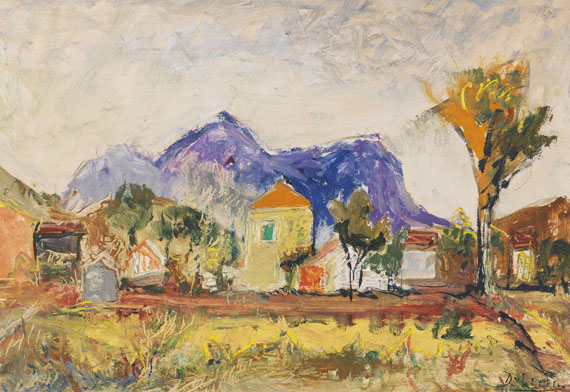
Sanary (Ma Maison III), 1955.
Oil on fibreboard
Estimate:
€ 3,000 / $ 3,480 Sold:
€ 5,000 / $ 5,800 (incl. surcharge)
440
Otto Dünkelsbühler
Sanary (Ma Maison III), 1955.
Oil on fibreboard
Estimate:
€ 3,000 / $ 3,480 Sold:
€ 5,000 / $ 5,800 (incl. surcharge)
Sanary (Ma Maison III). Um 1955.
Oil on fibreboard.
Signed lower right. With title and inscription on verso of frame. 52 x 75 cm (20,4 x 29,5 in).
After Otto Dünkelsbühler had spent a long time in military hospitals after World War I, he began to study art with Julius Dietz and Willi Geiger in his hometown Munich in 1921. Soon after he transferred to the Berlin School of Applied Art, where he studied under Emil Orlik and César Klein. Sojourns to Paris, London and Italy followed. However, as early as in 1933 the National Socialists imposed an exhibition ban on him which would soon lead to an occupational ban. In the following he went to Paris, Rome, London and the Provence, before Dünkelsbühler settled in Nagold in the Black Forest, where he at first painted clandestine, but increased Gestapo raids made it impossible for him to continue his work. After the end of World War II the artist intensified his painting activities and made works characterized by new accents on composition and color dominance. As of the mid 1950s the artist again went on extensive journeys through Germany, France, Spain and the Aegean Sea. [KD]
Oil on fibreboard.
Signed lower right. With title and inscription on verso of frame. 52 x 75 cm (20,4 x 29,5 in).
After Otto Dünkelsbühler had spent a long time in military hospitals after World War I, he began to study art with Julius Dietz and Willi Geiger in his hometown Munich in 1921. Soon after he transferred to the Berlin School of Applied Art, where he studied under Emil Orlik and César Klein. Sojourns to Paris, London and Italy followed. However, as early as in 1933 the National Socialists imposed an exhibition ban on him which would soon lead to an occupational ban. In the following he went to Paris, Rome, London and the Provence, before Dünkelsbühler settled in Nagold in the Black Forest, where he at first painted clandestine, but increased Gestapo raids made it impossible for him to continue his work. After the end of World War II the artist intensified his painting activities and made works characterized by new accents on composition and color dominance. As of the mid 1950s the artist again went on extensive journeys through Germany, France, Spain and the Aegean Sea. [KD]

Headquarters
Joseph-Wild-Str. 18
81829 Munich
Phone: +49 89 55 244-0
Fax: +49 89 55 244-177
info@kettererkunst.de
Louisa von Saucken / Undine Schleifer
Holstenwall 5
20355 Hamburg
Phone: +49 40 37 49 61-0
Fax: +49 40 37 49 61-66
infohamburg@kettererkunst.de
Dr. Simone Wiechers / Nane Schlage
Fasanenstr. 70
10719 Berlin
Phone: +49 30 88 67 53-63
Fax: +49 30 88 67 56-43
infoberlin@kettererkunst.de
Cordula Lichtenberg
Gertrudenstraße 24-28
50667 Cologne
Phone: +49 221 510 908-15
infokoeln@kettererkunst.de
Hessen
Rhineland-Palatinate
Miriam Heß
Phone: +49 62 21 58 80-038
Fax: +49 62 21 58 80-595
infoheidelberg@kettererkunst.de
We will inform you in time.