


Raumbeispiel
24
Ernst Ludwig Kirchner
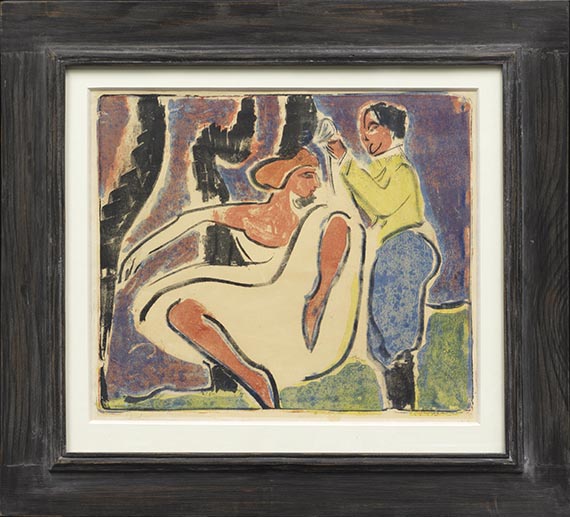
Russisches Tänzerpaar, 1909.
Lithograph in colors in four colors (black, blu...
Estimate:
€ 200,000 / $ 232,000 Sold:
€ 258,000 / $ 299,280 (incl. surcharge)
24
Ernst Ludwig Kirchner
Russisches Tänzerpaar, 1909.
Lithograph in colors in four colors (black, blu...
Estimate:
€ 200,000 / $ 232,000 Sold:
€ 258,000 / $ 299,280 (incl. surcharge)
Ernst Ludwig Kirchner
1880 - 1938
Russisches Tänzerpaar. 1909.
Lithograph in colors in four colors (black, blue, rose and yellow).
Signed and inscribed "Handdruck". From an edition of ten known copies. On wove paper. 33.5 x 39.4 cm (13.1 x 15.5 in). Sheet: 34,7 x 45,1 cm (13,6 x 17,7 in).
Twice stamped "Unverkäuflich E.-L. Kirchner" on the reverse. According to Günther Gercken's catalogue raisonné (vol. II, 1909-1911), the individual primary colors appear in various shades.
• A vibrant and bold hand-printed lithograph from the heyday of the Dresden “Brücke” group.
• Iconic color lithograph from Kirchner’s important series of dance, circus, and variety show motifs.
• Kirchner stages the dancer’s movement masterfully and with incomparable technical finesse.
• Four of the nine other known copies are in the collections of Eberhard W. Kornfeld, Bern, the Staatsgalerie Stuttgart, the Städel Museum, Frankfurt am Main, and the National Gallery of Art, Washington, D.C.
• Part of an acclaimed private collection in Berlin for almost 40 years.
We are grateful to Prof. Dr. Günther Gercken for his kind expert advice.
PROVENANCE: Probably from the artist's estate.
Christian Laely, Davos (taken from the aforementioned estate in 1946 and assigned to the fictitious “Gervais Collection,” with the handwritten number “K FL 12” on the reverse).
Private collection, Berlin (acquired in 1987, Christie's, London).
EXHIBITION: Ernst Ludwig Kirchner, Kunstverein für die Rheinlande und Westfalen, Düsseldorf, Kunsthalle Grabbeplatz, Sep. 9–Oct. 30, 1960, cat. no. 118 (illustrated in black and white, different copy).
Ernst Ludwig Kirchner 1880–1938, Nationalgalerie Berlin, Staatliche Museen Preußischer Kulturbesitz, Nov. 29, 1979–Jan. 20, 1980; Haus der Kunst, Munich, Feb. 9–April 13, 1980; Museum Ludwig in the Kunsthalle Cologne, April 29–June 8, 1980; Kunsthaus Zurich, June 20–Aug. 10, 1980, cat. no. 52 (illustrated in color on p. 127, different copy).
Ernst Ludwig Kirchner: Von Jena nach Davos. Eine Ausstellung zum 90. Gründungsjubiläum des Jenaer Kunstvereins, Stadtmuseum Göhre in Jena, Oct. 10, 1993–Jan. 16, 1994, cat. no. 60 (illustrated in color on p. 173, different copy).
Kirchner's Kosmos: Der Tanz, KirchnerHAUS Aschaffenburg, Sep. 21-Dec. 30, 2018, cat. no. 3 (illustrated in color on pp. 17 and 71, different copy).
LITERATURE: Günther Gercken, Ernst Ludwig Kirchner. Kritisches Werkverzeichnis der Druckgraphik, Vol. II (1909-1911), Bern 2013, CR no. 378 (with color ill. p. 393, different copy).
Annemarie and Wolf-Dieter Dube, E. L. Kirchner. Das graphische Werk, vol. I, Munich 1967, CR no. L 130.
Gustav Schiefler, Die Graphik Ernst Ludwig Kirchners, vol. 1 (until 1916), Berlin-Charlottenburg 1926, CR no. 89.
- -
Eberhard W. Kornfeld, Ernst Ludwig Kirchner. Nachzeichnung seines Lebens, Katalog der Sammlung von Werken von Ernst Ludwig Kirchner im Kirchner Haus Davos, Bern 1979, no. 188 (with color ill. p. 29, different copy).
Bernd Hünlich, Ernst Ludwig Kirchner “Russisches Tanzpaar” und seine Entstehung, in: Dresdener Kunstblätter, 1983, vol. 83, no. 1, (with b/w illustration, different copy).
Christie's, Manson & Woods, London, Important Modern and Contemporary Prints: The Properties of Peter Gidal and from Various Sources, 3732. Auction, December 2, 1987, lot 498 (with color illustration).
Lucius Grisebach, Ernst Ludwig Kirchner 1880-1938, Cologne 1995, p. 33 (with color illustration, different copy).
“Dance is more than just a moment; it is greater than that. Dance condenses time into permanence. Kirchner liberates dance from all statistical grids and shows it for what it really is: structured time.”
Gerd Presler, quoted from: Kirchner’s Kosmos: Tanz, exhibition catalog, KirchnerHAUS Aschaffenburg, 2018, p. 17
1880 - 1938
Russisches Tänzerpaar. 1909.
Lithograph in colors in four colors (black, blue, rose and yellow).
Signed and inscribed "Handdruck". From an edition of ten known copies. On wove paper. 33.5 x 39.4 cm (13.1 x 15.5 in). Sheet: 34,7 x 45,1 cm (13,6 x 17,7 in).
Twice stamped "Unverkäuflich E.-L. Kirchner" on the reverse. According to Günther Gercken's catalogue raisonné (vol. II, 1909-1911), the individual primary colors appear in various shades.
• A vibrant and bold hand-printed lithograph from the heyday of the Dresden “Brücke” group.
• Iconic color lithograph from Kirchner’s important series of dance, circus, and variety show motifs.
• Kirchner stages the dancer’s movement masterfully and with incomparable technical finesse.
• Four of the nine other known copies are in the collections of Eberhard W. Kornfeld, Bern, the Staatsgalerie Stuttgart, the Städel Museum, Frankfurt am Main, and the National Gallery of Art, Washington, D.C.
• Part of an acclaimed private collection in Berlin for almost 40 years.
We are grateful to Prof. Dr. Günther Gercken for his kind expert advice.
PROVENANCE: Probably from the artist's estate.
Christian Laely, Davos (taken from the aforementioned estate in 1946 and assigned to the fictitious “Gervais Collection,” with the handwritten number “K FL 12” on the reverse).
Private collection, Berlin (acquired in 1987, Christie's, London).
EXHIBITION: Ernst Ludwig Kirchner, Kunstverein für die Rheinlande und Westfalen, Düsseldorf, Kunsthalle Grabbeplatz, Sep. 9–Oct. 30, 1960, cat. no. 118 (illustrated in black and white, different copy).
Ernst Ludwig Kirchner 1880–1938, Nationalgalerie Berlin, Staatliche Museen Preußischer Kulturbesitz, Nov. 29, 1979–Jan. 20, 1980; Haus der Kunst, Munich, Feb. 9–April 13, 1980; Museum Ludwig in the Kunsthalle Cologne, April 29–June 8, 1980; Kunsthaus Zurich, June 20–Aug. 10, 1980, cat. no. 52 (illustrated in color on p. 127, different copy).
Ernst Ludwig Kirchner: Von Jena nach Davos. Eine Ausstellung zum 90. Gründungsjubiläum des Jenaer Kunstvereins, Stadtmuseum Göhre in Jena, Oct. 10, 1993–Jan. 16, 1994, cat. no. 60 (illustrated in color on p. 173, different copy).
Kirchner's Kosmos: Der Tanz, KirchnerHAUS Aschaffenburg, Sep. 21-Dec. 30, 2018, cat. no. 3 (illustrated in color on pp. 17 and 71, different copy).
LITERATURE: Günther Gercken, Ernst Ludwig Kirchner. Kritisches Werkverzeichnis der Druckgraphik, Vol. II (1909-1911), Bern 2013, CR no. 378 (with color ill. p. 393, different copy).
Annemarie and Wolf-Dieter Dube, E. L. Kirchner. Das graphische Werk, vol. I, Munich 1967, CR no. L 130.
Gustav Schiefler, Die Graphik Ernst Ludwig Kirchners, vol. 1 (until 1916), Berlin-Charlottenburg 1926, CR no. 89.
- -
Eberhard W. Kornfeld, Ernst Ludwig Kirchner. Nachzeichnung seines Lebens, Katalog der Sammlung von Werken von Ernst Ludwig Kirchner im Kirchner Haus Davos, Bern 1979, no. 188 (with color ill. p. 29, different copy).
Bernd Hünlich, Ernst Ludwig Kirchner “Russisches Tanzpaar” und seine Entstehung, in: Dresdener Kunstblätter, 1983, vol. 83, no. 1, (with b/w illustration, different copy).
Christie's, Manson & Woods, London, Important Modern and Contemporary Prints: The Properties of Peter Gidal and from Various Sources, 3732. Auction, December 2, 1987, lot 498 (with color illustration).
Lucius Grisebach, Ernst Ludwig Kirchner 1880-1938, Cologne 1995, p. 33 (with color illustration, different copy).
“Dance is more than just a moment; it is greater than that. Dance condenses time into permanence. Kirchner liberates dance from all statistical grids and shows it for what it really is: structured time.”
Gerd Presler, quoted from: Kirchner’s Kosmos: Tanz, exhibition catalog, KirchnerHAUS Aschaffenburg, 2018, p. 17
After Ernst Ludwig Kirchner, Erich Heckel, and Karl Schmidt-Rottluff founded the artist group “Brücke” in Dresden in 1905, graphic art quickly became one of the artists’ central means of expression and a defining force of German Expressionism. It opened new opportunities to explore form and content while also increasing the circulation of their works. Using various techniques from woodcuts and etchings to lithographs, they created expressive, dynamic compositions that were a striking reflection of the artists' keen interest in motion, gesture, and rhythm. The artists particularly appreciated the lithography technique, which preserved the spontaneity of drawing and allowed them to capture scenes on the fly. This was particularly appealing to Kirchner, who was a brilliant draftsman. He often printed his lithographs himself, without the assistance of professional printers, as is the case with the work offered here. This resulted in small editions unique for their color nuances and documents Kirchner's experimental approach to the medium.
The Dancing Couple at the Central Theater
Kirchner's fascinating lithograph “Russisches Tänzerpaar” (Russian Dancing Couple) from 1909 vividly illustrates his deep interest in dance and movement. The motif is based on a performance that Kirchner saw at the Central Theater on Waisenhausstraße in Dresden in September of that year. This color lithograph, of which only a few hand-printed copies are known to exist, depicts an incredibly energetic dance scene starring Russian prima ballerina Olga Preobrajensky and ballet master Georges Kiatschk from the St. Petersburg Court Theater, which captures the fluid elegance of their movements. The two dancers appear to have been captured here during a rehearsal. They reappear in Kirchner's oil painting “Russisches Tanzpaar” from 1909 (Donald E. Gordon, Ernst Ludwig Kirchner. Mit einem kritischen Katalog sämtlicher Gemälde, Munich 1968, no. 75), and he sent a sketch on a postcard to Erich Heckel with the remark: “Russian dancer at the Central quite nice. Best regards, Ernst" (Annemarie Dube-Heynig, E. L. Kirchner. Postkarten und Briefe an Erich Heckel, Cologne 1984, no. 6).
From movement to line and color
Kirchner and the other “Brücke” artists drew inspiration from a variety of performing arts, including ballet, variety shows, and circus acts. Venues like the Central Theater and the traveling Sarrasani Circus provided abundant inspiration for their artistic work. The artists observed the performances with great fascination and translated the gestures, costumes, and energetic performances of the dancers and artists into expressive compositions that made the movement and expression tangible. In the present work, Kirchner reduced his graphic style to its essentials.
The lines summarize the complex sequences of movements performed by the dancers, while contrasting color fields become vivid, expressive elements of an intense vitality, as Kirchner himself emphasizes: "Observing movement gives me an intense feeling of vitality, which is the origin of the artwork. A body in motion reveals many individual views, which merge within me into an overall form —the inner image. [...] My pictures are parables, not illustrations." (Ernst Ludwig Kirchner, 1930, quoted from: Exhibition catalog Ernst Ludwig Kirchner, 1880–1938, Berlin 1980, p. 87) [KA]
The Dancing Couple at the Central Theater
Kirchner's fascinating lithograph “Russisches Tänzerpaar” (Russian Dancing Couple) from 1909 vividly illustrates his deep interest in dance and movement. The motif is based on a performance that Kirchner saw at the Central Theater on Waisenhausstraße in Dresden in September of that year. This color lithograph, of which only a few hand-printed copies are known to exist, depicts an incredibly energetic dance scene starring Russian prima ballerina Olga Preobrajensky and ballet master Georges Kiatschk from the St. Petersburg Court Theater, which captures the fluid elegance of their movements. The two dancers appear to have been captured here during a rehearsal. They reappear in Kirchner's oil painting “Russisches Tanzpaar” from 1909 (Donald E. Gordon, Ernst Ludwig Kirchner. Mit einem kritischen Katalog sämtlicher Gemälde, Munich 1968, no. 75), and he sent a sketch on a postcard to Erich Heckel with the remark: “Russian dancer at the Central quite nice. Best regards, Ernst" (Annemarie Dube-Heynig, E. L. Kirchner. Postkarten und Briefe an Erich Heckel, Cologne 1984, no. 6).
From movement to line and color
Kirchner and the other “Brücke” artists drew inspiration from a variety of performing arts, including ballet, variety shows, and circus acts. Venues like the Central Theater and the traveling Sarrasani Circus provided abundant inspiration for their artistic work. The artists observed the performances with great fascination and translated the gestures, costumes, and energetic performances of the dancers and artists into expressive compositions that made the movement and expression tangible. In the present work, Kirchner reduced his graphic style to its essentials.
The lines summarize the complex sequences of movements performed by the dancers, while contrasting color fields become vivid, expressive elements of an intense vitality, as Kirchner himself emphasizes: "Observing movement gives me an intense feeling of vitality, which is the origin of the artwork. A body in motion reveals many individual views, which merge within me into an overall form —the inner image. [...] My pictures are parables, not illustrations." (Ernst Ludwig Kirchner, 1930, quoted from: Exhibition catalog Ernst Ludwig Kirchner, 1880–1938, Berlin 1980, p. 87) [KA]

Headquarters
Joseph-Wild-Str. 18
81829 Munich
Phone: +49 89 55 244-0
Fax: +49 89 55 244-177
info@kettererkunst.de
Louisa von Saucken / Undine Schleifer
Holstenwall 5
20355 Hamburg
Phone: +49 40 37 49 61-0
Fax: +49 40 37 49 61-66
infohamburg@kettererkunst.de
Dr. Simone Wiechers / Nane Schlage
Fasanenstr. 70
10719 Berlin
Phone: +49 30 88 67 53-63
Fax: +49 30 88 67 56-43
infoberlin@kettererkunst.de
Cordula Lichtenberg
Gertrudenstraße 24-28
50667 Cologne
Phone: +49 221 510 908-15
infokoeln@kettererkunst.de
Hessen
Rhineland-Palatinate
Miriam Heß
Phone: +49 62 21 58 80-038
Fax: +49 62 21 58 80-595
infoheidelberg@kettererkunst.de
We will inform you in time.