


Frame image
39
Alexej von Jawlensky
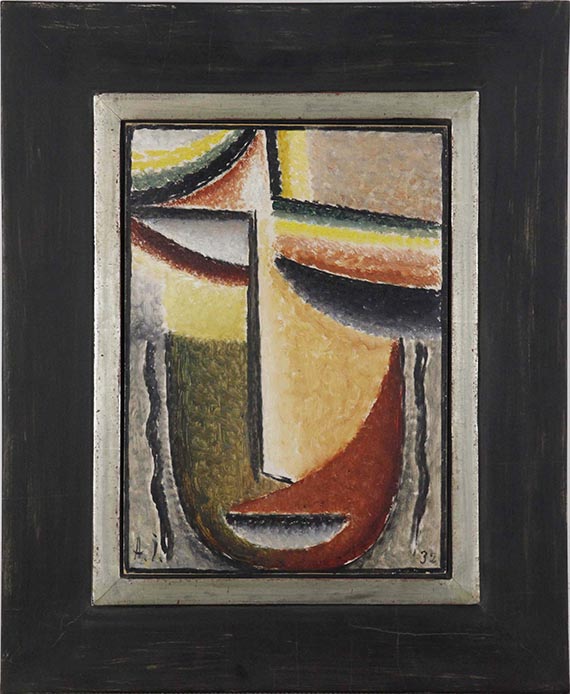
Abstrakter Kopf: Tragische Maske, 1932.
Oil on canvas-structured wove paper, originally...
Estimate:
€ 250,000 / $ 290,000 Sold:
€ 215,430 / $ 249,898 (incl. surcharge)
39
Alexej von Jawlensky
Abstrakter Kopf: Tragische Maske, 1932.
Oil on canvas-structured wove paper, originally...
Estimate:
€ 250,000 / $ 290,000 Sold:
€ 215,430 / $ 249,898 (incl. surcharge)
Alexej von Jawlensky
1864 - 1941
Abstrakter Kopf: Tragische Maske. 1932.
Oil on canvas-structured wove paper, originally mounted on cardboard.
Monogrammed in the lower left corner and dated in the lower right corner. Signed and dated on the reverse. Additionally titled “Tragische Maske” on a label by a hand other than that of the artist. 35.7 x 25.2 cm (14 x 9.9 in).
Recorded as “1932 No. 14” on page 52 of Jawlensky's so-called “Cahier Noir”.
• From the key series of the “Abstract Heads”, created during his late, highly prolific creative phase.
• A particularly harmonious and meditative, calming composition.
• A wonderful synthesis of figuration and abstraction.
• In the present work, Jawlensky reached a formal intensity that does not convey the face as a portrait, but as a universal symbol of human existence.
• The subtitle “Tragic Mask” opens up a psychoanalytical interpretation: The work reflects Jawlensky’s existential situation, marked by his illness and the political threats of the early 1930s.
• Part of a distinguished private collection in Berlin for over 40 years.
PROVENANCE: Artist's estate.
Dalzell Hatfield Galleries, Los Angeles (1960, with the label on the reverse).
Private collection.
Private collection (acquired in 1977, Hauswedell & Nolte, Hamburg).
Private collection, Berlin (since 1984, Hauswedell & Nolte, Hamburg).
EXHIBITION: Father and Son. Andreas Jawlensky – Alexej von Jawlensky, Kleemann Galleries, New York, April 5–May 10, 1958, cat. no. 6.
Alexej von Jawlensky. Paintings from 1906–1937, Dalzell Hatfield Galleries, Los Angeles, April 30–May 25, 1962 (illustrated).
LITERATURE: Maria Jawlensky, Lucia Pieroni-Jawlensky, Angelica Jawlensky, Alexej von Jawlensky. Catalogue Raisonné of the Oil Paintings, vol. 2: 1914–1933, Munich 1992, CR no. 1394 (illustrated).
Clemens Weiler, Jawlensky. Köpfe - Gesichte - Meditationen, Hanau 1970, CR no. 312, here untitled (illustrated).
Clemens Weiler, Alexej Jawlensky, Cologne 1959, CR no. 368 (illustrated on p. 253).
- -
Bernhard S. Myers, Die Malerei des Expressionismus. Eine Generation im Aufbruch, Cologne 1957 (illustrated, no. 56).
Hauswedell & Nolte, Hamburg, 222nd Auction, June 3, 1977, lot 667 (illustrated)
Hauswedell & Nolte, Hamburg, 254th Auction, June 8–9, 1984, lot 792 (illustrated, plate 13).
"[..] greater abstraction found expression in the series of heads he began around 1929–1930, which, while restrained in their emotional expression, remain highly powerful, as illustrated by their spare yet extremely expressive forms, such as the ‘Tragic Mask.’ The face is reduced to the utmost simplicity and austerity, the color pulsates in a new way [..]."
Bernhard S. Myers, in: Malerei des Expressionismus. Eine Generation im Aufbruch, Cologne 1957.
1864 - 1941
Abstrakter Kopf: Tragische Maske. 1932.
Oil on canvas-structured wove paper, originally mounted on cardboard.
Monogrammed in the lower left corner and dated in the lower right corner. Signed and dated on the reverse. Additionally titled “Tragische Maske” on a label by a hand other than that of the artist. 35.7 x 25.2 cm (14 x 9.9 in).
Recorded as “1932 No. 14” on page 52 of Jawlensky's so-called “Cahier Noir”.
• From the key series of the “Abstract Heads”, created during his late, highly prolific creative phase.
• A particularly harmonious and meditative, calming composition.
• A wonderful synthesis of figuration and abstraction.
• In the present work, Jawlensky reached a formal intensity that does not convey the face as a portrait, but as a universal symbol of human existence.
• The subtitle “Tragic Mask” opens up a psychoanalytical interpretation: The work reflects Jawlensky’s existential situation, marked by his illness and the political threats of the early 1930s.
• Part of a distinguished private collection in Berlin for over 40 years.
PROVENANCE: Artist's estate.
Dalzell Hatfield Galleries, Los Angeles (1960, with the label on the reverse).
Private collection.
Private collection (acquired in 1977, Hauswedell & Nolte, Hamburg).
Private collection, Berlin (since 1984, Hauswedell & Nolte, Hamburg).
EXHIBITION: Father and Son. Andreas Jawlensky – Alexej von Jawlensky, Kleemann Galleries, New York, April 5–May 10, 1958, cat. no. 6.
Alexej von Jawlensky. Paintings from 1906–1937, Dalzell Hatfield Galleries, Los Angeles, April 30–May 25, 1962 (illustrated).
LITERATURE: Maria Jawlensky, Lucia Pieroni-Jawlensky, Angelica Jawlensky, Alexej von Jawlensky. Catalogue Raisonné of the Oil Paintings, vol. 2: 1914–1933, Munich 1992, CR no. 1394 (illustrated).
Clemens Weiler, Jawlensky. Köpfe - Gesichte - Meditationen, Hanau 1970, CR no. 312, here untitled (illustrated).
Clemens Weiler, Alexej Jawlensky, Cologne 1959, CR no. 368 (illustrated on p. 253).
- -
Bernhard S. Myers, Die Malerei des Expressionismus. Eine Generation im Aufbruch, Cologne 1957 (illustrated, no. 56).
Hauswedell & Nolte, Hamburg, 222nd Auction, June 3, 1977, lot 667 (illustrated)
Hauswedell & Nolte, Hamburg, 254th Auction, June 8–9, 1984, lot 792 (illustrated, plate 13).
"[..] greater abstraction found expression in the series of heads he began around 1929–1930, which, while restrained in their emotional expression, remain highly powerful, as illustrated by their spare yet extremely expressive forms, such as the ‘Tragic Mask.’ The face is reduced to the utmost simplicity and austerity, the color pulsates in a new way [..]."
Bernhard S. Myers, in: Malerei des Expressionismus. Eine Generation im Aufbruch, Cologne 1957.
As part of Alexej von Jawlensky’s notable series of the “Abstract Heads,” our painting “Abstrakter Kopf: Tragische Maske” (Abstract Head: Tragic Mask, 1932) evokes a particularly harmonious, an almost meditative and soothing feeling. With a palette of earthy, warm tones and the restrained visual language characteristic of this series, the painting draws the viewer’s attention to its structure and form. The brown, gray, and ochre tones, highlighted by a few touches of yellow and green, allow the viewer's eye to fully appreciate the brushwork—its dabbing, pulsating application, and the effect it creates. Jawlensky's deliberate aesthetic decision breaks up the otherwise dense color field. Despite the closed eyes, this complex technique creates a physical presence that captivates the observer.
Starting around 1920, Jawlensky began to explore the motif of the face with increasing intensity and in ever more abstract forms. While humanistic, naturalistic features can still be recognized in the Saviour Faces series, the artist condenses form and color into an autonomous force in his Abstract Heads. Individuality recedes to make way for a timeless, inner visual idea. Anatomical features are transformed into geometric forms and symmetrically arranged, even reminiscent of architecture. The present artwork is centered on a vertical line placed in the middle, which Jawlensky suggests as a nose. The artist constructs the mouth from horizontal lines and a crescent shape; eyes and eyebrows are replaced by horizontal and slightly diagonal lines.
“Tragic Mask,” the subtitle of our painting, invites us to take a deeper psychological look at the work, one that connects to Jawlensky’s personal situation, his deteriorating health, and the political uncertainty in Germany in the early 1930s. Art became increasingly politicized and exploited for agitational purposes. In this context, Expressionism, Abstraction, and New Objectivity in particular were denounced as “degenerate,” and everything Russian was defamed as “Bolshevik.” Furthermore, Jawlensky was repeatedly confined to bed and often spent extended periods at health resorts. These circumstances took a heavy toll on the artist, who lived a relatively secluded life in his Wiesbaden apartment. Despite this financially and physically strenuous period, the response to his “Abstract Heads”—especially among his fellow artists—was extremely positive, and Karl Schmidt-Rottluff and Kandinsky acquired one copy, while Paul Klee acquired two of the Abstract Heads. [MH]
Starting around 1920, Jawlensky began to explore the motif of the face with increasing intensity and in ever more abstract forms. While humanistic, naturalistic features can still be recognized in the Saviour Faces series, the artist condenses form and color into an autonomous force in his Abstract Heads. Individuality recedes to make way for a timeless, inner visual idea. Anatomical features are transformed into geometric forms and symmetrically arranged, even reminiscent of architecture. The present artwork is centered on a vertical line placed in the middle, which Jawlensky suggests as a nose. The artist constructs the mouth from horizontal lines and a crescent shape; eyes and eyebrows are replaced by horizontal and slightly diagonal lines.
“Tragic Mask,” the subtitle of our painting, invites us to take a deeper psychological look at the work, one that connects to Jawlensky’s personal situation, his deteriorating health, and the political uncertainty in Germany in the early 1930s. Art became increasingly politicized and exploited for agitational purposes. In this context, Expressionism, Abstraction, and New Objectivity in particular were denounced as “degenerate,” and everything Russian was defamed as “Bolshevik.” Furthermore, Jawlensky was repeatedly confined to bed and often spent extended periods at health resorts. These circumstances took a heavy toll on the artist, who lived a relatively secluded life in his Wiesbaden apartment. Despite this financially and physically strenuous period, the response to his “Abstract Heads”—especially among his fellow artists—was extremely positive, and Karl Schmidt-Rottluff and Kandinsky acquired one copy, while Paul Klee acquired two of the Abstract Heads. [MH]

Headquarters
Joseph-Wild-Str. 18
81829 Munich
Phone: +49 89 55 244-0
Fax: +49 89 55 244-177
info@kettererkunst.de
Louisa von Saucken / Undine Schleifer
Holstenwall 5
20355 Hamburg
Phone: +49 40 37 49 61-0
Fax: +49 40 37 49 61-66
infohamburg@kettererkunst.de
Dr. Simone Wiechers / Nane Schlage
Fasanenstr. 70
10719 Berlin
Phone: +49 30 88 67 53-63
Fax: +49 30 88 67 56-43
infoberlin@kettererkunst.de
Cordula Lichtenberg
Gertrudenstraße 24-28
50667 Cologne
Phone: +49 221 510 908-15
infokoeln@kettererkunst.de
Hessen
Rhineland-Palatinate
Miriam Heß
Phone: +49 62 21 58 80-038
Fax: +49 62 21 58 80-595
infoheidelberg@kettererkunst.de
We will inform you in time.