


Frame image
Raumbeispiel
13
Hermann Max Pechstein
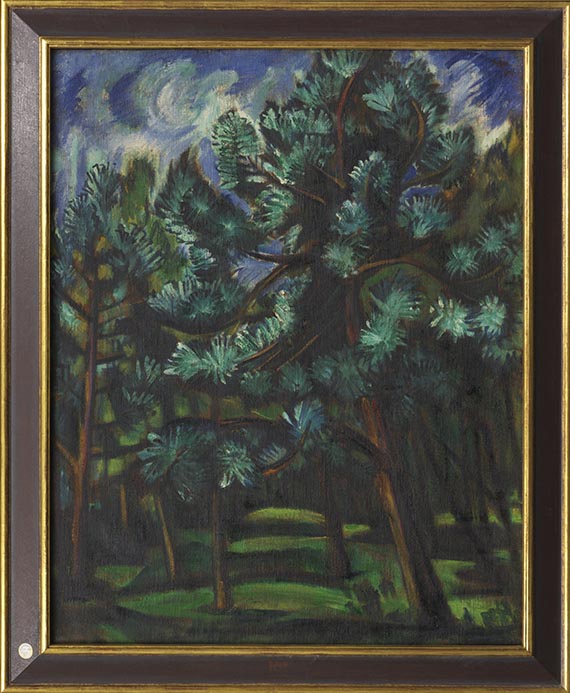
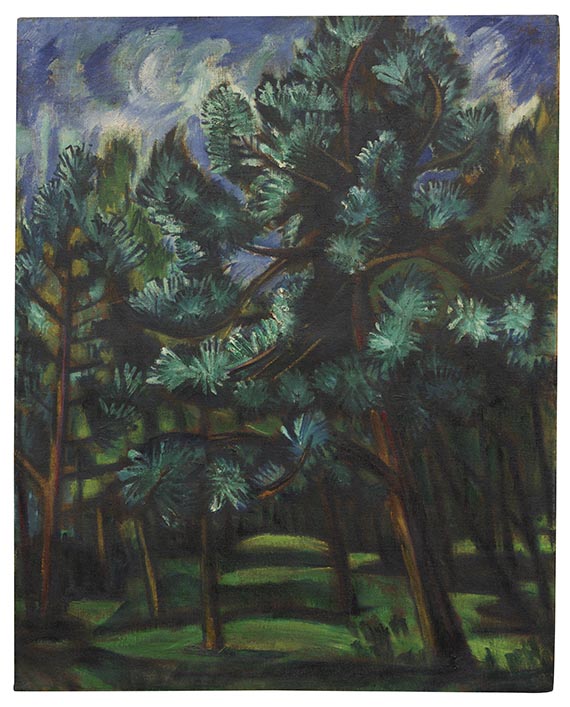
Kiefernwald nach dem Regen, 1919.
Oil on canvas
Estimate:
€ 120,000 / $ 139,200 Sold:
€ 129,000 / $ 149,640 (incl. surcharge)
13
Hermann Max Pechstein
Kiefernwald nach dem Regen, 1919.
Oil on canvas
Estimate:
€ 120,000 / $ 139,200 Sold:
€ 129,000 / $ 149,640 (incl. surcharge)
Hermann Max Pechstein
1881 - 1955
Kiefernwald nach dem Regen. 1919.
Oil on canvas.
Monogrammed and dated in the upper right. With the contours of a nude in blue on the reverse. 101 x 80.5 cm (39.7 x 31.6 in).
• Created immediately after World War I, during a particularly productive phase in Hermann Max Pechstein’s creative life.
• Nida: a place that served as a central source of inspiration for the artist for many years.
• The forest landscape is transformed into a condensed pictorial space.
• Pechstein depicts nature as an elemental, almost sublime force.
• Part of the same private collection for over 30 years.
Accompanied by a photo certificate of authenticity from Max K. Pechstein, Hamburg, May 1987 (copy).
PROVENANCE: Galerie Gurlitt, Berlin (until 1923: on consignment).
Van Diemen-Lilienfeld Galleries, Leipzig/Berlin/New York (until 1957/58).
Peter Josten, New York (1957/58, acquired from the above)
Kleemann Galleries, New York (ca. 1960; with a label on the reverse of the stretcher).
Carl Laemmle, Jr., Beverly Hills (since the 1960s).
Jeffrey Horvitz, Hallandall, Florida.
Galerie Neher, Essen (1987).
Private collection, Switzerland (since 1987, acquired from the previous owner)
In possession of the family ever since.
EXHIBITION: Blickpunkte. Deutsche Kunst im 20. Jahrhundert, Galerie Neher, Essen, September 20-November 28, 1987 (illustrated in color on p. 123).
LITERATURE: Aya Soika, Max Pechstein. Catalogue Raisonné of Oil Paintings, vol. 2: 1919–1954, Munich 2011, CR no. 1919/23 (illustrated)
--
Sotheby’s, New York, May 14, 1980, lot 232 (illustrated)
Sotheby's, New York, May 21, 1982, lot 340 (illustrated)
Sotheby's, London, Auction 7440, Dec. 8–9, 1997, lot 67 (illustrated).
1881 - 1955
Kiefernwald nach dem Regen. 1919.
Oil on canvas.
Monogrammed and dated in the upper right. With the contours of a nude in blue on the reverse. 101 x 80.5 cm (39.7 x 31.6 in).
• Created immediately after World War I, during a particularly productive phase in Hermann Max Pechstein’s creative life.
• Nida: a place that served as a central source of inspiration for the artist for many years.
• The forest landscape is transformed into a condensed pictorial space.
• Pechstein depicts nature as an elemental, almost sublime force.
• Part of the same private collection for over 30 years.
Accompanied by a photo certificate of authenticity from Max K. Pechstein, Hamburg, May 1987 (copy).
PROVENANCE: Galerie Gurlitt, Berlin (until 1923: on consignment).
Van Diemen-Lilienfeld Galleries, Leipzig/Berlin/New York (until 1957/58).
Peter Josten, New York (1957/58, acquired from the above)
Kleemann Galleries, New York (ca. 1960; with a label on the reverse of the stretcher).
Carl Laemmle, Jr., Beverly Hills (since the 1960s).
Jeffrey Horvitz, Hallandall, Florida.
Galerie Neher, Essen (1987).
Private collection, Switzerland (since 1987, acquired from the previous owner)
In possession of the family ever since.
EXHIBITION: Blickpunkte. Deutsche Kunst im 20. Jahrhundert, Galerie Neher, Essen, September 20-November 28, 1987 (illustrated in color on p. 123).
LITERATURE: Aya Soika, Max Pechstein. Catalogue Raisonné of Oil Paintings, vol. 2: 1919–1954, Munich 2011, CR no. 1919/23 (illustrated)
--
Sotheby’s, New York, May 14, 1980, lot 232 (illustrated)
Sotheby's, New York, May 21, 1982, lot 340 (illustrated)
Sotheby's, London, Auction 7440, Dec. 8–9, 1997, lot 67 (illustrated).
Hermann Max Pechstein's painting “Kiefernwald nach dem Regen” (Pine Forest After the Rain) was created in 1919, at the height of an enormously productive creative phase that followed the traumatic events of World War I. Upon his return from the war, Pechstein spent the summer of 1919 in Nida on the Curonian Spit, the place he had discovered as his painter’s paradise as early as 1909. Pechstein later recalled: “In the spring of 1919, I made my way up to Nida, my heart heavy with anxiety over whether I would still find the same conditions up on the Curonian Spit that were suitable for a painter. I was also anxious about reuniting with the landscape and the people whom I had encountered in 1909 as a fertile new territory for me. Certainly, much had changed, but it was still a comfort to be joyfully welcomed by my old fishermen friends.” (quoted from: Max Pechstein. Erinnerungen. Stuttgart 1993, pp. 106f.). Despite this initial uncertainty, the beloved place quickly captivated him once more, and an abundance of new paintings emerged. Working as if in a trance, Pechstein devoted himself tirelessly to his paintings. “Everything is drowning in color for me; my brain is filled only with images, and the idea of what to paint chases me from one place to another (…).” (quoted from: Letter to P. Fechter, Nida, Oct. 2, 1919; copy in the Krüger Archive, Berlin (original in the Getty Archive, Los Angeles).
It is precisely this cautious new beginning, and the euphoria that followed, that gave rise to a special tension, which we can also recognize in the present work, which condenses the motif of the forest into a vibrant interplay of colors. The dark trunks contrast with the luminous, lush shades of green and blue in the trees and sky, creating a mysterious, almost enchanted atmosphere. Nature appears as something sublime, imbued with elemental power.
As a member of the “Brücke” art group, Hermann Max Pechstein left a significant mark on Modernism and Expressionism. He played a key role in giving color its own distinct expressive power. His numerous study trips to Nida on the Curonian Spit had a decisive influence on his oeuvre. His intense engagement with nature led to a series of impressive landscape depictions in which the painter uniquely captured his feelings. [MH]
It is precisely this cautious new beginning, and the euphoria that followed, that gave rise to a special tension, which we can also recognize in the present work, which condenses the motif of the forest into a vibrant interplay of colors. The dark trunks contrast with the luminous, lush shades of green and blue in the trees and sky, creating a mysterious, almost enchanted atmosphere. Nature appears as something sublime, imbued with elemental power.
As a member of the “Brücke” art group, Hermann Max Pechstein left a significant mark on Modernism and Expressionism. He played a key role in giving color its own distinct expressive power. His numerous study trips to Nida on the Curonian Spit had a decisive influence on his oeuvre. His intense engagement with nature led to a series of impressive landscape depictions in which the painter uniquely captured his feelings. [MH]

Headquarters
Joseph-Wild-Str. 18
81829 Munich
Phone: +49 89 55 244-0
Fax: +49 89 55 244-177
info@kettererkunst.de
Louisa von Saucken / Undine Schleifer
Holstenwall 5
20355 Hamburg
Phone: +49 40 37 49 61-0
Fax: +49 40 37 49 61-66
infohamburg@kettererkunst.de
Dr. Simone Wiechers / Nane Schlage
Fasanenstr. 70
10719 Berlin
Phone: +49 30 88 67 53-63
Fax: +49 30 88 67 56-43
infoberlin@kettererkunst.de
Cordula Lichtenberg
Gertrudenstraße 24-28
50667 Cologne
Phone: +49 221 510 908-15
infokoeln@kettererkunst.de
Hessen
Rhineland-Palatinate
Miriam Heß
Phone: +49 62 21 58 80-038
Fax: +49 62 21 58 80-595
infoheidelberg@kettererkunst.de
We will inform you in time.