


Frame image
26
Karl Schmidt-Rottluff
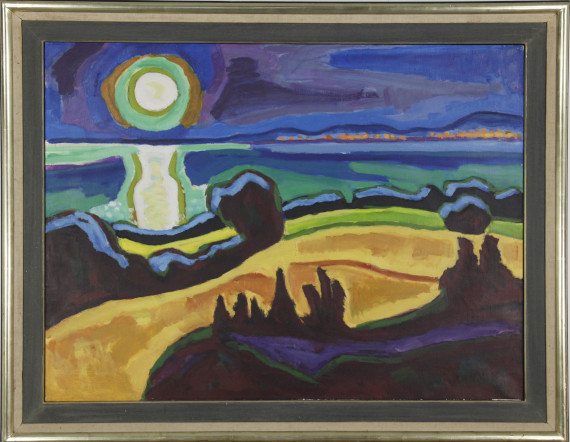
Julimond, 1956.
Oil on canvas
Estimate:
€ 100,000 / $ 116,000 Sold:
€ 283,800 / $ 329,208 (incl. surcharge)
26
Karl Schmidt-Rottluff
Julimond, 1956.
Oil on canvas
Estimate:
€ 100,000 / $ 116,000 Sold:
€ 283,800 / $ 329,208 (incl. surcharge)
Karl Schmidt-Rottluff
1884 - 1976
Julimond. 1956.
Oil on canvas.
Signed in the lower right corner. Signed, titled, and inscribed with the work number “(5615)” and “gewachst” (waxed) on the reverse of the stretcher. 76.5 x 101.5 cm (30.1 x 39.9 in).
• Rediscovery: The location, composition, and color scheme were previously unknown to research.
• The essence of Expressionism: vibrant colors, bold contrasts, and simplified forms, Schmidt-Rottluff created a dynamic composition imbued with a mystical and enigmatic expressiveness.
• Source of inspiration: Beginning in the 1940s, the artist spent the summer months at the Lübeck Bay on the Baltic Sea.
• With this scene of trees silhouetted against the sun, Schmidt-Rottluff draws on a motif from the peak of his career, blending his expressive landscape painting with his graphic art.
The work is documented in the archive of the Karl and Emy Schmidt-Rottluff Foundation, Berlin.
PROVENANCE: Private collection, North Rhine-Westphalia.
Private collection, Southern Germany (inherited from the above).
1884 - 1976
Julimond. 1956.
Oil on canvas.
Signed in the lower right corner. Signed, titled, and inscribed with the work number “(5615)” and “gewachst” (waxed) on the reverse of the stretcher. 76.5 x 101.5 cm (30.1 x 39.9 in).
• Rediscovery: The location, composition, and color scheme were previously unknown to research.
• The essence of Expressionism: vibrant colors, bold contrasts, and simplified forms, Schmidt-Rottluff created a dynamic composition imbued with a mystical and enigmatic expressiveness.
• Source of inspiration: Beginning in the 1940s, the artist spent the summer months at the Lübeck Bay on the Baltic Sea.
• With this scene of trees silhouetted against the sun, Schmidt-Rottluff draws on a motif from the peak of his career, blending his expressive landscape painting with his graphic art.
The work is documented in the archive of the Karl and Emy Schmidt-Rottluff Foundation, Berlin.
PROVENANCE: Private collection, North Rhine-Westphalia.
Private collection, Southern Germany (inherited from the above).
In the immediate postwar years, Karl Schmidt-Rottluff was faced with major difficulties. In the fall of 1943, his studio and apartment in Berlin were destroyed in an air raid. In a letter to the artist Curt Stoermer from 1945, he noted: “It was a tremendous disaster, and cleaning up the mess took every scrap of energy I had left. We were among the survivors, but little else remained. (Quoted from: Gunther Thiem (ed.), Schmidt-Rottluff. Retrospektive, Munich 1989, p. 100). Together with his wife Emy, the artist spent several years in his hometown of Rottluff. It was not until the fall of 1946 that he returned to Berlin, where he took up a professorship at the newly founded Academy of Fine Arts. After the one-year blockade of West Berlin by the Soviet Union—a situation he depicted in some of his works—he returned to his former pace of life in the 1950s. Schmidt-Rottluff began spending the summer months on the Baltic Sea again, with a preference for the Bay of Lübeck, marking the beginning of his impressive series of late landscape paintings. Like “Julimond,” they demonstrate "the possibilities of the absolute fusion of line and form into virtually abstract organic structures. [...] This is not merely about the depiction of landscape, but about the organization of the composition from lines, forms, and color spaces.” (Christiane Remm, in: Exhibition catalog Karl Schmidt-Rottluff. Die Berliner Jahre 1946–1976, Brücke Museum, Berlin 2005/2006, p. 27)
Building on the themes of his expressionist work from the years before the war and his time with the “Brücke” group, Schmidt-Rottluff lets his palette come to life. “The world must be seen anew, reinterpreted over and over again, with everyone contributing their share – so there is no reason to give up,” the artist explained in 1951 (quoted from: ibid., p. 32). In their purity, intensity, and radiance, these late, bold worlds of color take center stage and define the painting's overall visual impact. Trees and bushes appear as black silhouettes against the light, forming a dark counterpoint to the bold coloration of the rest of the composition. In addition to the color, it is the flat painting style and the curved forms that evoke an extraordinary modernity through their clarity, a higher degree of abstraction, and the combination of individual, striking shapes with large, open areas. With a predominantly cool, powerful color palette and dynamic warm-cold and light-dark contrasts, strong contours, and the juxtaposition of soft, curved, and angular, pointed forms, Schmidt-Rottluff created a landscape imbued with a mystical, enigmatic expressiveness, through which the great Expressionist was able to assert his position within German post-war art. [CH]
Building on the themes of his expressionist work from the years before the war and his time with the “Brücke” group, Schmidt-Rottluff lets his palette come to life. “The world must be seen anew, reinterpreted over and over again, with everyone contributing their share – so there is no reason to give up,” the artist explained in 1951 (quoted from: ibid., p. 32). In their purity, intensity, and radiance, these late, bold worlds of color take center stage and define the painting's overall visual impact. Trees and bushes appear as black silhouettes against the light, forming a dark counterpoint to the bold coloration of the rest of the composition. In addition to the color, it is the flat painting style and the curved forms that evoke an extraordinary modernity through their clarity, a higher degree of abstraction, and the combination of individual, striking shapes with large, open areas. With a predominantly cool, powerful color palette and dynamic warm-cold and light-dark contrasts, strong contours, and the juxtaposition of soft, curved, and angular, pointed forms, Schmidt-Rottluff created a landscape imbued with a mystical, enigmatic expressiveness, through which the great Expressionist was able to assert his position within German post-war art. [CH]

Headquarters
Joseph-Wild-Str. 18
81829 Munich
Phone: +49 89 55 244-0
Fax: +49 89 55 244-177
info@kettererkunst.de
Louisa von Saucken / Undine Schleifer
Holstenwall 5
20355 Hamburg
Phone: +49 40 37 49 61-0
Fax: +49 40 37 49 61-66
infohamburg@kettererkunst.de
Dr. Simone Wiechers / Nane Schlage
Fasanenstr. 70
10719 Berlin
Phone: +49 30 88 67 53-63
Fax: +49 30 88 67 56-43
infoberlin@kettererkunst.de
Cordula Lichtenberg
Gertrudenstraße 24-28
50667 Cologne
Phone: +49 221 510 908-15
infokoeln@kettererkunst.de
Hessen
Rhineland-Palatinate
Miriam Heß
Phone: +49 62 21 58 80-038
Fax: +49 62 21 58 80-595
infoheidelberg@kettererkunst.de
We will inform you in time.