


Frame image
42
Keith Haring
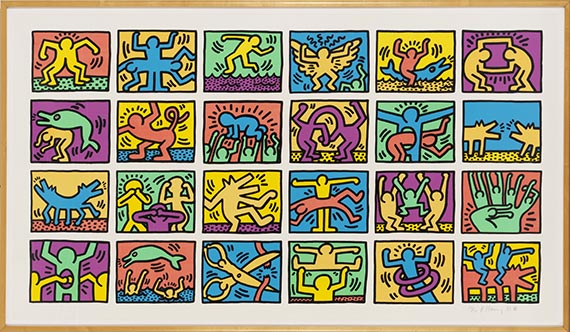
Retrospect, 1989.
Silkscreen in colors
Estimate:
€ 120,000 / $ 139,200 Sold:
€ 152,220 / $ 176,575 (incl. surcharge)
42
Keith Haring
Retrospect, 1989.
Silkscreen in colors
Estimate:
€ 120,000 / $ 139,200 Sold:
€ 152,220 / $ 176,575 (incl. surcharge)
Keith Haring
1958 - 1990
Retrospect. 1989.
Silkscreen in colors.
Signed, dated, numbered, and with the copyright mark. From an edition of 75 copies. On firm wove paper. 103.5 x 195 cm (40.7 x 76.7 in). Sheet: 116 x 207 cm (45,7 x 81,5 in).
Published by Martin Lawrence Limited Editions, New York (with the embossing stamp).
• The crawling baby, the barking dog, and the angel: “Retrospect” unites Haring’s famous icons in a large format.
• From Haring’s colorful symbols to smileys and emojis: with his unmistakable imagery, he anticipated the style of modern communication.
• His universal symbols and figures comment on current events and existential questions of life.
• Haring’s timeless works made him one of the most important American artists of the late 20th century.
PROVENANCE: Martin Lawrence Galleries, New York.
Private collection, Austria (acquired from the above in 1997).
LITERATURE: Klaus Littmann, Keith Haring. Editions on Paper 1982-1990. Das druckgraphische Werk, Stuttgart 1993, pp. 120f. (illustrated in color, different copy).
"I assumed, after all, that the point of making art was to communicate and contribute to culture."
Keith Haring, quoted from: Keith Haring Foundation website, https://www.haring.com/!/pop-shop.
1958 - 1990
Retrospect. 1989.
Silkscreen in colors.
Signed, dated, numbered, and with the copyright mark. From an edition of 75 copies. On firm wove paper. 103.5 x 195 cm (40.7 x 76.7 in). Sheet: 116 x 207 cm (45,7 x 81,5 in).
Published by Martin Lawrence Limited Editions, New York (with the embossing stamp).
• The crawling baby, the barking dog, and the angel: “Retrospect” unites Haring’s famous icons in a large format.
• From Haring’s colorful symbols to smileys and emojis: with his unmistakable imagery, he anticipated the style of modern communication.
• His universal symbols and figures comment on current events and existential questions of life.
• Haring’s timeless works made him one of the most important American artists of the late 20th century.
PROVENANCE: Martin Lawrence Galleries, New York.
Private collection, Austria (acquired from the above in 1997).
LITERATURE: Klaus Littmann, Keith Haring. Editions on Paper 1982-1990. Das druckgraphische Werk, Stuttgart 1993, pp. 120f. (illustrated in color, different copy).
"I assumed, after all, that the point of making art was to communicate and contribute to culture."
Keith Haring, quoted from: Keith Haring Foundation website, https://www.haring.com/!/pop-shop.
With his iconic figurative art, Keith Haring developed a universal visual language in the 1980s—one that everyone could understand—a unique, unmistakable iconography that distanced itself from the elitist art concept prevalent at the time and ultimately defined the cultural identity of an entire decade.
In 1978, the young Keith Haring moved to New York, where he initially studied at the School of Visual Arts. Inspired by graffiti art, his works were often created on unconventional surfaces—in public spaces, on walls, building facades, and gallery walls, or on overpasted posters in New York City subway stations—where his art was accessible to the general public and could be viewed without any institutional barriers. With this goal in mind, Haring opened the “Pop Shop” in New York City’s SoHo neighborhood in 1986, selling T-shirts, buttons, and original merchandise sporting Haring’s famous images, thereby making them available to everyone: “The Pop Shop makes my work accessible. It’s about participation on a large scale." (Keith Haring, quoted from: Keith Haring Foundation website, https://www.haring.com/!/pop-shop) Like his fellow artist Andy Warhol, who was 30 years his senior, Haring also recognized the great potential of graphic art to make his work accessible to a wider audience. Beginning in 1982, the young artist began to explore a wide variety of printing techniques in depth: "Keith's energy was inexhaustible and his curiosity insatiable. The seemingly boundless variety of his means of expression is proof of these qualities. Keith was fascinated with all printing techniques. Over the course of his ten-year career, he created lithographs, screen prints, embossed prints, and etchings." (Julia Gruen, quoted from: Klaus Littmann, Keith Haring. Editions on Paper 1982–1990. Das druckgraphische Werk, Stuttgart 1993, p. 7)
“Retrospect” was created in 1989, just one year before Haring's untimely death at the age of 31. This large-format silkscreen combines the entire cosmos of his distinctive motifs, his so-called “icons.” It serves as a visual autobiography and is an impressive testament to his unmistakable sign language.
Each of the twenty-four individual, black-bordered square panels depicts a self-contained scene featuring the most recognizable figures and motifs from Haring’s visual world, including the crawling baby, the barking dog, the dolphin, the angel, dancing figures, and vibrant, dynamic lines. These colorful pictograms prove to be timeless and, ultimately, absolutely visionary, for since the turn of the millennium, a large part of everyday modern communication—unlike in the 1980s—has consisted of images and symbols such as smileys, emojis, and GIFs.
Using this recurring vocabulary of linear, allegorical figures in his characteristic, simple, and easily understandable visual language, Haring’s artistic work engages with complex, existential themes such as life and death, love, politics and economics, community spirit, and collective humanity. Like the themes they address, his pictorial worlds remain as relevant today as ever. [CH]
In 1978, the young Keith Haring moved to New York, where he initially studied at the School of Visual Arts. Inspired by graffiti art, his works were often created on unconventional surfaces—in public spaces, on walls, building facades, and gallery walls, or on overpasted posters in New York City subway stations—where his art was accessible to the general public and could be viewed without any institutional barriers. With this goal in mind, Haring opened the “Pop Shop” in New York City’s SoHo neighborhood in 1986, selling T-shirts, buttons, and original merchandise sporting Haring’s famous images, thereby making them available to everyone: “The Pop Shop makes my work accessible. It’s about participation on a large scale." (Keith Haring, quoted from: Keith Haring Foundation website, https://www.haring.com/!/pop-shop) Like his fellow artist Andy Warhol, who was 30 years his senior, Haring also recognized the great potential of graphic art to make his work accessible to a wider audience. Beginning in 1982, the young artist began to explore a wide variety of printing techniques in depth: "Keith's energy was inexhaustible and his curiosity insatiable. The seemingly boundless variety of his means of expression is proof of these qualities. Keith was fascinated with all printing techniques. Over the course of his ten-year career, he created lithographs, screen prints, embossed prints, and etchings." (Julia Gruen, quoted from: Klaus Littmann, Keith Haring. Editions on Paper 1982–1990. Das druckgraphische Werk, Stuttgart 1993, p. 7)
“Retrospect” was created in 1989, just one year before Haring's untimely death at the age of 31. This large-format silkscreen combines the entire cosmos of his distinctive motifs, his so-called “icons.” It serves as a visual autobiography and is an impressive testament to his unmistakable sign language.
Each of the twenty-four individual, black-bordered square panels depicts a self-contained scene featuring the most recognizable figures and motifs from Haring’s visual world, including the crawling baby, the barking dog, the dolphin, the angel, dancing figures, and vibrant, dynamic lines. These colorful pictograms prove to be timeless and, ultimately, absolutely visionary, for since the turn of the millennium, a large part of everyday modern communication—unlike in the 1980s—has consisted of images and symbols such as smileys, emojis, and GIFs.
Using this recurring vocabulary of linear, allegorical figures in his characteristic, simple, and easily understandable visual language, Haring’s artistic work engages with complex, existential themes such as life and death, love, politics and economics, community spirit, and collective humanity. Like the themes they address, his pictorial worlds remain as relevant today as ever. [CH]

Headquarters
Joseph-Wild-Str. 18
81829 Munich
Phone: +49 89 55 244-0
Fax: +49 89 55 244-177
info@kettererkunst.de
Louisa von Saucken / Undine Schleifer
Holstenwall 5
20355 Hamburg
Phone: +49 40 37 49 61-0
Fax: +49 40 37 49 61-66
infohamburg@kettererkunst.de
Dr. Simone Wiechers / Nane Schlage
Fasanenstr. 70
10719 Berlin
Phone: +49 30 88 67 53-63
Fax: +49 30 88 67 56-43
infoberlin@kettererkunst.de
Cordula Lichtenberg
Gertrudenstraße 24-28
50667 Cologne
Phone: +49 221 510 908-15
infokoeln@kettererkunst.de
Hessen
Rhineland-Palatinate
Miriam Heß
Phone: +49 62 21 58 80-038
Fax: +49 62 21 58 80-595
infoheidelberg@kettererkunst.de
We will inform you in time.