


Video
34
Richard Serra
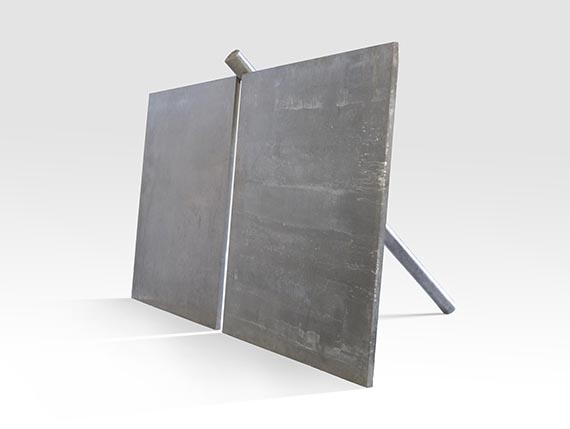
No. 1, 1969.
Lead antimony, 3 parts
Estimate:
€ 600,000 / $ 696,000 Sold:
€ 903,000 / $ 1,047,479 (incl. surcharge)
34
Richard Serra
No. 1, 1969.
Lead antimony, 3 parts
Estimate:
€ 600,000 / $ 696,000 Sold:
€ 903,000 / $ 1,047,479 (incl. surcharge)
Richard Serra
1939 - 2024
No. 1. 1969.
Lead antimony, 3 parts.
Installation dimensions: 122 x 122 x 2.5 cm (48 x 48 x 0.9 in).
The 1969 version was made of lead, but in the 1980s, Richard Serra and his studio replaced it with a version made of lead antimony for reasons of stability. This practice is commonly found in Serra’s early works; cf., for example, Richard Serra’s “One Ton Prop (House of Cards)” (1969 [refabricated 1986], Museum of Modern Art, New York). Almost all of these early works were replaced in the 1980s with a harder version made of lead antimony for conservation reasons. In the case of “No. 1,” the thickness of the lead plates was increased from 1.9 cm to 2.5 cm, and the length of the lead roll was adjusted to ensure stability. [JS].
• “No. 1,” 1969: One of the first, legendary ‘Prop’ sculptures.
• Featured in the artist's first American solo exhibition at the Castelli Gallery warehouse in New York in 1969.
• Fragile beauty: A perfect symbiosis of balance and gravity.
• Featured in the 1986 catalog of the major exhibition “Richard Serra. Sculpture“ at the Museum of Modern Art, New York.
• Rarity: To date, only three of these significant early ”Prop" sculptures have been offered on the international auction market (www.artprice.com).
• Comparable works are now largely in museum collections, including the Museum of Modern Art, New York, the Tate Modern, London, and the Guggenheim Museum, New York.
Since its founding in 1984, Reiners Stiftung GmbH has been dedicated to supporting Mönchengladbach’s museums. Through numerous loans, historical research, and generous donations, it makes an indispensable contribution to Mönchengladbach’s cultural scene. The proceeds from both lots (Polke and Serra) will benefit Reiners Stiftung, enabling the family to continue its social commitment in the long term.
PROVENANCE: Leo Castelli Gallery, New York (1969, directly from the artist).
Galerie m, Bochum.
Reiners Stiftung GmbH, Mönchengladbach (formerly Schlafhorst Foundation, acquired from the above in 1986).
EXHIBITION: Richard Serra, Leo Castelli Warehouse, New York, Dec. 16, 1969–Jan. 10, 1970 (Exhibition view: https://www.castelligallery.com/exhibitions/richard-serra9?view=slider#2).
Richard Serra. Frühe Bleiskulpturen, Lithografien, Galerie m, Bochum, Dec. 16–June 19, 1986.
Richard Serra. Props, Wilhelm Lehmbruck Museum, Duisburg, Jan. 16–Apr. 3, 1994.
Richard Serra. Props, Films, Early Works, Jawlensky Prize 2017, Museum Wiesbaden, Mar. 17–June 18, 2017.
LITERATURE: Kunst der Gegenwart 1960–2007, inventory catalog of the Museum Abteiberg, 2007, p. 423, illustrated in color on p. 422.
Ernst Gerhard Güse (ed.): Richard Serra, Stuttgart 1987, cat. no. 45 (illustrated)
Dierk Stemmler, Schwerpunkt: 50er Jahre bis zur Gegenwart. Das Städtische Museum Abteiberg in Mönchengladbach, in: Landschaftsverband Rheinland, Das Rheinische Landesmuseum Bonn, Berichte aus der Abtei des Museums, 6, 1987, illustrated on p. 96.
art. Kunstmagazin, October 10, 1987, p. 73 (illustrated).
Dierk Stemmler, Städtisches Museum Mönchengladbach, Berichte aus westdeuschen Museen, in: Wallfraf-Richartz-Jahrbuch, Vol. XLVIII/XLiX, Cologne 1987/88, p. 542 (illustrated).
Short Guide, Municipal Museum Abteiberg, Mönchengladbach, 1988, illustrated in color on p. 39.
Kunst der Gegenwart, 1960 bis Ende der 80er Jahre. Inventory catalog of the Municipal Museum Abteiberg Mönchengladbach. Mönchengladbach: Municipal Museum Abteiberg, 1988, p. 282 (illustrated, and illustrated p. 283).
Municipal Museum Abteiberg Mönchengladbach. Ein kommentierter Bildband, Mönchengladbach 2001/02, p. 88 (illustrated in color on p. 89).
Richard Serra, Props, Wilhelm Lehmbruck Museum, Duisburg 1994, cat. no. 149, p. 227 (illustrated on p. 119)
Richard Serra. Sculpture, The Museum of Modern Art, New York 1986, cat. no. 42, illustrated on p. 82.
art, art magazine, October 10, 1986 (illustrated in color on p. 64).
Richard Stella, Early Work, David Zwirner, New York, Göttingen 2013, illustrated on p. 161.
When something is truly balanced, it becomes weightless.“
Richard Serra, 1983, in an interview with Peter Eisenman, quoted from: Richard Serra. Writings/Interviews, p. 144.
"You can build a structure under compression that implies collapse and impermanence and yet in its mere existence denies this.“
Richard Serra, 1983, in an interview with Peter Eisenman, quoted from: Richard Serra. Writings/Interviews, p. 144.
1939 - 2024
No. 1. 1969.
Lead antimony, 3 parts.
Installation dimensions: 122 x 122 x 2.5 cm (48 x 48 x 0.9 in).
The 1969 version was made of lead, but in the 1980s, Richard Serra and his studio replaced it with a version made of lead antimony for reasons of stability. This practice is commonly found in Serra’s early works; cf., for example, Richard Serra’s “One Ton Prop (House of Cards)” (1969 [refabricated 1986], Museum of Modern Art, New York). Almost all of these early works were replaced in the 1980s with a harder version made of lead antimony for conservation reasons. In the case of “No. 1,” the thickness of the lead plates was increased from 1.9 cm to 2.5 cm, and the length of the lead roll was adjusted to ensure stability. [JS].
• “No. 1,” 1969: One of the first, legendary ‘Prop’ sculptures.
• Featured in the artist's first American solo exhibition at the Castelli Gallery warehouse in New York in 1969.
• Fragile beauty: A perfect symbiosis of balance and gravity.
• Featured in the 1986 catalog of the major exhibition “Richard Serra. Sculpture“ at the Museum of Modern Art, New York.
• Rarity: To date, only three of these significant early ”Prop" sculptures have been offered on the international auction market (www.artprice.com).
• Comparable works are now largely in museum collections, including the Museum of Modern Art, New York, the Tate Modern, London, and the Guggenheim Museum, New York.
Since its founding in 1984, Reiners Stiftung GmbH has been dedicated to supporting Mönchengladbach’s museums. Through numerous loans, historical research, and generous donations, it makes an indispensable contribution to Mönchengladbach’s cultural scene. The proceeds from both lots (Polke and Serra) will benefit Reiners Stiftung, enabling the family to continue its social commitment in the long term.
PROVENANCE: Leo Castelli Gallery, New York (1969, directly from the artist).
Galerie m, Bochum.
Reiners Stiftung GmbH, Mönchengladbach (formerly Schlafhorst Foundation, acquired from the above in 1986).
EXHIBITION: Richard Serra, Leo Castelli Warehouse, New York, Dec. 16, 1969–Jan. 10, 1970 (Exhibition view: https://www.castelligallery.com/exhibitions/richard-serra9?view=slider#2).
Richard Serra. Frühe Bleiskulpturen, Lithografien, Galerie m, Bochum, Dec. 16–June 19, 1986.
Richard Serra. Props, Wilhelm Lehmbruck Museum, Duisburg, Jan. 16–Apr. 3, 1994.
Richard Serra. Props, Films, Early Works, Jawlensky Prize 2017, Museum Wiesbaden, Mar. 17–June 18, 2017.
LITERATURE: Kunst der Gegenwart 1960–2007, inventory catalog of the Museum Abteiberg, 2007, p. 423, illustrated in color on p. 422.
Ernst Gerhard Güse (ed.): Richard Serra, Stuttgart 1987, cat. no. 45 (illustrated)
Dierk Stemmler, Schwerpunkt: 50er Jahre bis zur Gegenwart. Das Städtische Museum Abteiberg in Mönchengladbach, in: Landschaftsverband Rheinland, Das Rheinische Landesmuseum Bonn, Berichte aus der Abtei des Museums, 6, 1987, illustrated on p. 96.
art. Kunstmagazin, October 10, 1987, p. 73 (illustrated).
Dierk Stemmler, Städtisches Museum Mönchengladbach, Berichte aus westdeuschen Museen, in: Wallfraf-Richartz-Jahrbuch, Vol. XLVIII/XLiX, Cologne 1987/88, p. 542 (illustrated).
Short Guide, Municipal Museum Abteiberg, Mönchengladbach, 1988, illustrated in color on p. 39.
Kunst der Gegenwart, 1960 bis Ende der 80er Jahre. Inventory catalog of the Municipal Museum Abteiberg Mönchengladbach. Mönchengladbach: Municipal Museum Abteiberg, 1988, p. 282 (illustrated, and illustrated p. 283).
Municipal Museum Abteiberg Mönchengladbach. Ein kommentierter Bildband, Mönchengladbach 2001/02, p. 88 (illustrated in color on p. 89).
Richard Serra, Props, Wilhelm Lehmbruck Museum, Duisburg 1994, cat. no. 149, p. 227 (illustrated on p. 119)
Richard Serra. Sculpture, The Museum of Modern Art, New York 1986, cat. no. 42, illustrated on p. 82.
art, art magazine, October 10, 1986 (illustrated in color on p. 64).
Richard Stella, Early Work, David Zwirner, New York, Göttingen 2013, illustrated on p. 161.
When something is truly balanced, it becomes weightless.“
Richard Serra, 1983, in an interview with Peter Eisenman, quoted from: Richard Serra. Writings/Interviews, p. 144.
"You can build a structure under compression that implies collapse and impermanence and yet in its mere existence denies this.“
Richard Serra, 1983, in an interview with Peter Eisenman, quoted from: Richard Serra. Writings/Interviews, p. 144.
Richard Serra – Sculpture Innovator
Richard Serra, one of the most significant figures in American Minimal Art, was only 36 years old when the Museum of Modern Art in New York planned to dedicate a first solo exhibition to his revolutionary sculptural work as early as the 1970s. William Rubin, the then director of the Department of Sculpture, remarked on the internationally celebrated work: “We felt that the pieces he had then been producing—most of them indoor and landscape-sited works—were of the highest order of creative energy and quality.” However, due to organizational reasons, the exhibition project at MoMA had to be postponed several times before it finally came to pass with the first American retrospective, “Richard Serra. Sculpture” in 1986. In the accompanying exhibition catalog, our work “No. 1” is published alongside “One Ton Prop (House of Cards),” also created in 1969, which has been in the MoMA collection since. “No. 1” was also part of the artist’s first American solo show, organized as early as 1969 by the Castelli Gallery in its legendary New York warehouse, dedicated solely to those monumental early, multi-part lead sculptures with which Serra would revolutionize the concept of sculpture. Some twenty years after his first solo exhibition, the MoMA dedicates another major retrospective, “Richard Serra Sculpture: Forty Years,” to his oeuvre, which transcends traditional spatial boundaries, once again celebrating him as a spectacular innovator of sculpture.
The early “Corner Props” series – Fragile aesthetics: a perfect symbiosis of balance and gravity
The “Props” series occupied a prominent part in the first MoMA exhibition in 1986; this groundbreaking body of work would go on to define Serra’s oeuvre from the late 1960s through the 1980s. Our three-part work titled “No. 1” is, along with “One Ton Prop (House of Cards)” (1969) from the MoMA’s collection, an early example from this revolutionary group of works, a large number of which are museum-owned today. What the sculptures in this series have in common is a captivating, fragile aesthetic that Serra derives through gravity and balance; this subtly orchestrated interplay lends Serra’s massive creations—composed of solid lead plates—a distinctive quality of fragility and transience despite their enormous weight. Serra establishes the intricate balance between the metal parts—held together solely by weight and gravity—in numerous construction drawings, thereby creating a radically new sculptural aesthetic and a form of construction. This goes far beyond Barnett Newman’s famous “Broken Obelisk,” in which the top is still firmly connected to the base by an internal steel core. Newman's fragile balance is thus merely an illusion, whereas Serra's famous “Props” become a fascinating reality. Richard Serra once described this seemingly ephemeral moment with the following words: “When something is truly balanced, it becomes weightless.” (R. S. 1983, quoted from Richard Serra. Writings/Interviews, p. 144). The meticulously balanced construction makes Serra’s massive, multi-ton arrangements appear uniquely weightless and fragile by staging the moment of perfect balance. Unsurprisingly, one of the works exhibited at MoMA at the time—comprising four steel plates leaning against one another—bears the title “One Ton Prop (House of Cards)” (1969/1986, Museum of Modern Art, New York), which pointedly addresses this apparent paradox. Serra's fascination has since been devoted to creating an aesthetic in which, as in our early “Prop” sculpture “No. 1,” collapse and transience are always present. Serra summarizes this implicit contradiction with the following words: “You can build a structure under compression that implies collapse and impermanence and yet, in its mere existence, denies this.” (R. S. 1983, quoted from: Richard Serra. Writings/Interviews, p. 144). Serra’s “Prop” sculptures do not stand on a pedestal; free interaction with the space is essential to them, and it is precisely this lack of boundaries that, when walking around them, inevitably gives rise to the feeling that they could suddenly lose their balance like a house of cards and crash to the ground with a loud bang.
Serra and the discovery of space – “No. 1” and Malevich’s “Black Square”
Starting with his works from the 1960s, Serra began to redefine the concept of sculpture; his works are not only designed to be viewed from all angles, but must be experienced within the space, surrounded, and – as in his more recent, space-filling steel sculptures – even traversed. Formally, Serra’s oeuvre belongs to the American Minimal Art movement. Always based on the contrast between the dark metal and the white space, the reduction of color—alongside the formal reduction to basic geometric forms—became a defining characteristic of Serra’s work. His sculptural oeuvre carries the principles of Constructivism and Suprematism—above all, the monochromaticism and sophisticated balance of Kazimir Malevich’s compositions—into three-dimensionality and monumentality. What both artists share is the active incorporation of space as an integral compositional element, a principle that makes Malevich’s work particularly significant for American Minimal Art.
Serra’s legendary “Prop” sculptures appear as a homage to Malevich’s famous painting “Black Square” (1915, first version), considered a key work of Modernism. Just as Malevich sought to free painting from the “burden of representationalism” with the “Black Square”, Serra strives to break down all the spatial constraints of sculpture.
Serra’s sculptural work – monumentality and aura
His work is not monumental in a way that feels oppressive; rather, it liberates and slows down the mind and senses in an almost meditative act of observation and comprehension. Serra’s sculptures and their interaction with space must be approached and understood through deep concentration. Since the late 1960s, Serra has invited us to wander among oversized lead and steel formations, to explore his masterful interplay of lightness and heaviness, and to discover shifting relationships and tensions within space that must be traversed in a contemplative act and experienced with the whole body. It comes as no surprise that one of Serra’s latest mega-creations, exhibited at the Gagosian Gallery in 2021/22, bears the title “Transmitter” (2020, Gagosian Gallery, New York). Standing 4 meters tall, 17 meters wide, and 18 meters long, this structure—conceived from long, gently curved steel plates—spreads out into the space like a labyrinth, challenging our accustomed viewing habits and the limits of our sensory perception. “Transmitter” is yet another testament to the unique aura of Serra’s sculptural work, which defies any form of reproduction and can only be experienced in the presence of the original work. [JS]
Richard Serra, one of the most significant figures in American Minimal Art, was only 36 years old when the Museum of Modern Art in New York planned to dedicate a first solo exhibition to his revolutionary sculptural work as early as the 1970s. William Rubin, the then director of the Department of Sculpture, remarked on the internationally celebrated work: “We felt that the pieces he had then been producing—most of them indoor and landscape-sited works—were of the highest order of creative energy and quality.” However, due to organizational reasons, the exhibition project at MoMA had to be postponed several times before it finally came to pass with the first American retrospective, “Richard Serra. Sculpture” in 1986. In the accompanying exhibition catalog, our work “No. 1” is published alongside “One Ton Prop (House of Cards),” also created in 1969, which has been in the MoMA collection since. “No. 1” was also part of the artist’s first American solo show, organized as early as 1969 by the Castelli Gallery in its legendary New York warehouse, dedicated solely to those monumental early, multi-part lead sculptures with which Serra would revolutionize the concept of sculpture. Some twenty years after his first solo exhibition, the MoMA dedicates another major retrospective, “Richard Serra Sculpture: Forty Years,” to his oeuvre, which transcends traditional spatial boundaries, once again celebrating him as a spectacular innovator of sculpture.
The early “Corner Props” series – Fragile aesthetics: a perfect symbiosis of balance and gravity
The “Props” series occupied a prominent part in the first MoMA exhibition in 1986; this groundbreaking body of work would go on to define Serra’s oeuvre from the late 1960s through the 1980s. Our three-part work titled “No. 1” is, along with “One Ton Prop (House of Cards)” (1969) from the MoMA’s collection, an early example from this revolutionary group of works, a large number of which are museum-owned today. What the sculptures in this series have in common is a captivating, fragile aesthetic that Serra derives through gravity and balance; this subtly orchestrated interplay lends Serra’s massive creations—composed of solid lead plates—a distinctive quality of fragility and transience despite their enormous weight. Serra establishes the intricate balance between the metal parts—held together solely by weight and gravity—in numerous construction drawings, thereby creating a radically new sculptural aesthetic and a form of construction. This goes far beyond Barnett Newman’s famous “Broken Obelisk,” in which the top is still firmly connected to the base by an internal steel core. Newman's fragile balance is thus merely an illusion, whereas Serra's famous “Props” become a fascinating reality. Richard Serra once described this seemingly ephemeral moment with the following words: “When something is truly balanced, it becomes weightless.” (R. S. 1983, quoted from Richard Serra. Writings/Interviews, p. 144). The meticulously balanced construction makes Serra’s massive, multi-ton arrangements appear uniquely weightless and fragile by staging the moment of perfect balance. Unsurprisingly, one of the works exhibited at MoMA at the time—comprising four steel plates leaning against one another—bears the title “One Ton Prop (House of Cards)” (1969/1986, Museum of Modern Art, New York), which pointedly addresses this apparent paradox. Serra's fascination has since been devoted to creating an aesthetic in which, as in our early “Prop” sculpture “No. 1,” collapse and transience are always present. Serra summarizes this implicit contradiction with the following words: “You can build a structure under compression that implies collapse and impermanence and yet, in its mere existence, denies this.” (R. S. 1983, quoted from: Richard Serra. Writings/Interviews, p. 144). Serra’s “Prop” sculptures do not stand on a pedestal; free interaction with the space is essential to them, and it is precisely this lack of boundaries that, when walking around them, inevitably gives rise to the feeling that they could suddenly lose their balance like a house of cards and crash to the ground with a loud bang.
Serra and the discovery of space – “No. 1” and Malevich’s “Black Square”
Starting with his works from the 1960s, Serra began to redefine the concept of sculpture; his works are not only designed to be viewed from all angles, but must be experienced within the space, surrounded, and – as in his more recent, space-filling steel sculptures – even traversed. Formally, Serra’s oeuvre belongs to the American Minimal Art movement. Always based on the contrast between the dark metal and the white space, the reduction of color—alongside the formal reduction to basic geometric forms—became a defining characteristic of Serra’s work. His sculptural oeuvre carries the principles of Constructivism and Suprematism—above all, the monochromaticism and sophisticated balance of Kazimir Malevich’s compositions—into three-dimensionality and monumentality. What both artists share is the active incorporation of space as an integral compositional element, a principle that makes Malevich’s work particularly significant for American Minimal Art.
Serra’s legendary “Prop” sculptures appear as a homage to Malevich’s famous painting “Black Square” (1915, first version), considered a key work of Modernism. Just as Malevich sought to free painting from the “burden of representationalism” with the “Black Square”, Serra strives to break down all the spatial constraints of sculpture.
Serra’s sculptural work – monumentality and aura
His work is not monumental in a way that feels oppressive; rather, it liberates and slows down the mind and senses in an almost meditative act of observation and comprehension. Serra’s sculptures and their interaction with space must be approached and understood through deep concentration. Since the late 1960s, Serra has invited us to wander among oversized lead and steel formations, to explore his masterful interplay of lightness and heaviness, and to discover shifting relationships and tensions within space that must be traversed in a contemplative act and experienced with the whole body. It comes as no surprise that one of Serra’s latest mega-creations, exhibited at the Gagosian Gallery in 2021/22, bears the title “Transmitter” (2020, Gagosian Gallery, New York). Standing 4 meters tall, 17 meters wide, and 18 meters long, this structure—conceived from long, gently curved steel plates—spreads out into the space like a labyrinth, challenging our accustomed viewing habits and the limits of our sensory perception. “Transmitter” is yet another testament to the unique aura of Serra’s sculptural work, which defies any form of reproduction and can only be experienced in the presence of the original work. [JS]

Headquarters
Joseph-Wild-Str. 18
81829 Munich
Phone: +49 89 55 244-0
Fax: +49 89 55 244-177
info@kettererkunst.de
Louisa von Saucken / Undine Schleifer
Holstenwall 5
20355 Hamburg
Phone: +49 40 37 49 61-0
Fax: +49 40 37 49 61-66
infohamburg@kettererkunst.de
Dr. Simone Wiechers / Nane Schlage
Fasanenstr. 70
10719 Berlin
Phone: +49 30 88 67 53-63
Fax: +49 30 88 67 56-43
infoberlin@kettererkunst.de
Cordula Lichtenberg
Gertrudenstraße 24-28
50667 Cologne
Phone: +49 221 510 908-15
infokoeln@kettererkunst.de
Hessen
Rhineland-Palatinate
Miriam Heß
Phone: +49 62 21 58 80-038
Fax: +49 62 21 58 80-595
infoheidelberg@kettererkunst.de
We will inform you in time.