


Raumbeispiel
174
Helmut Kolle gen. vom Hügel
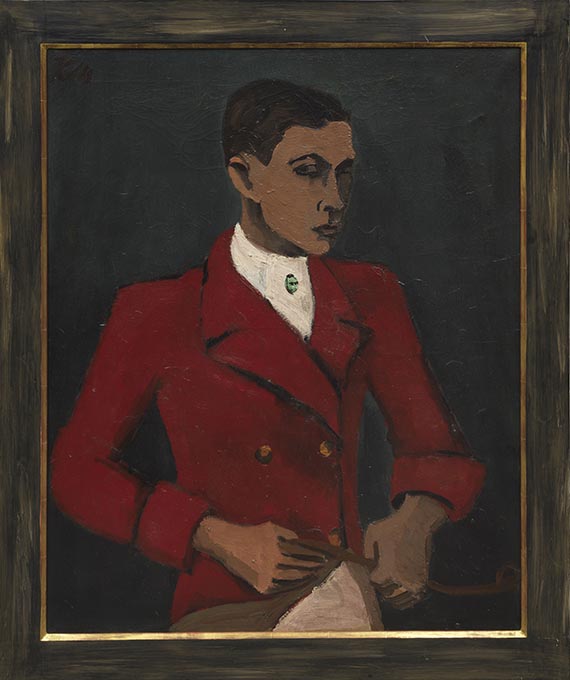
Selbstbildnis im Jagdkostüm, Um 1930.
Oil on canvas
Estimate:
€ 30,000 - 40,000
$ 33,600 - 44,800
174
Helmut Kolle gen. vom Hügel
Selbstbildnis im Jagdkostüm, Um 1930.
Oil on canvas
Estimate:
€ 30,000 - 40,000
$ 33,600 - 44,800
Helmut Kolle gen. vom Hügel
1899 - 1931
Selbstbildnis im Jagdkostüm. Um 1930.
Oil on canvas.
Signed in the upper left. 100 x 81 cm (39.3 x 31.8 in). [JS].
More works from the Kropatscheck Collection are offered in our Evening Sale on Friday, December 4, 2026; our “Valuable Books” auction on Monday, November 23, 2026; and in our Online Sale from January 15 through February 15, 2027.
• Helmut Kolle – Protagonist of Parisian modernism between the wars: prematurely deceased – forgotten – rediscovered.
• Masterpiece: One of the artist’s famous and widely published paintings.
• Self-portrayal: One of his last self-portraits, the severely ill artist as a dandy in a red hunting coat.
• Significance: This self-portrait was displayed in the salon of Kolle’s home in Chantilly and he selected it for his London gallerist on his deathbed.
• Exhibition history: Featured in all major Kolle exhibitions, it graced their exhibition posters and was most recently on permanent loan to the Hamburger Kunsthalle.
• Provenance: Part of the Hamburg Modern Art Collection of Fritz Eugen and Hannemarie Kropatscheck for over 30 years.
PROVENANCE: Lucy Carrington Wertheim, London (since 1930).
Private collection, England.
Galerie Vömel, Düsseldorf (circa 1988).
Fritz Eugen and Hannemarie Kropatscheck Collection, Hamburg (possibly acquired from the above in 1988, or no later than 1994).
EXHIBITION: Paintings by Kolle, Dealer’s Catalogue, published to accompany an exhibition held at Wertheim Gallery, London, typescript, National Art Library, Victoria & Albert Museum, London, 1935, cat. no. 12.
Paintings by Kolle, Dealer’s Catalogue, published to accompany an exhibition held at Wertheim Gallery, London, typescript, National Art Library, Victoria & Albert Museum, London, 1938, cat. no. 6.
Helmut Kolle, Galerie Vömel, Art Cologne, Cologne, 1988.
Helmut Kolle 1899–1931, Städtische Galerie im Lenbachhaus, Munich, 1994, cat. no. 73 (“Selbstbildnis mit Jagdkostüm” depicted on the exhibition's poster).
Helmut Kolle. Ein Deutscher in Paris, Kunstsammlungen Chemnitz, Museum Gunzenhauser, Nov. 7, 2010–Jan. 5, 2011; Ernst Barlach House, Hermann F. Reemtsma Foundation, Hamburg, May 22–September 25, 2011, pp. 52–53, cat. no. 65 (with color illustration) (“Selbstbildnis mit Jagdkostüm” depicted on exhibition poster and banners).
Kunsthalle Hamburg (permanent loan from the Kropatscheck Collection, 2020–2026).
LITERATURE: Philippe Gérard Chabert: Helmut Kolle 1899–1931. Catalogue Raisonné de l’œuvre peint, 2 vols., Dissertation, University of Paris I–Sorbonne, Paris 1981, CR no. 272.
-
Wilhelm Uhde, Der Maler Helmut Kolle. Das Bildnis eines Frühvollendeten, Zurich/Berlin 1935, p. 53.
Lucy Carrington Wertheim, Adventure in Art, London/Brussels 1947, p. 25, Plate II.
Harald Behm, “Helmut Kolle (1899–1931): Früh vollendet und in Vergessenheit geraten, in: Weltkunst, no. 21, 1985, pp. 3298–3301.
Helmut Kolle, Galerie Vömel, Art Cologne, Cologne, Düsseldorf 1988, pp. 54ff.
“Kolle was lying in bed, and the moment I saw him, my heart sank. He was obviously so hopelessly, hopelessly ill. I went and sat down by his bed and asked him to tell me what I could do to make him feel better. He asked me to buy the self-portrait in hunting attire that was hanging downstairs in his living room. [.] I agreed, and his gratitude was infinitely touching.”
Lucy Carrington Wertheim, *Adventure in Art*, London/Brussels 1947, p. 25.
“Just as Marie Laurencin and Tamara de Lempicka addressed and challenged the role of women in their portraits and figure paintings, Helmut Kolle—particularly through his depictions of athletes and soldiers—questioned the established image of men and raised awareness of its questionable nature and fragility.”
Thomas Bauer-Friedrich, Von Boxern, Toreros und Spahis – Helmut Kolles Figurenbilder, in: Helmut Kolle: Ein Deutscher in Paris, exhibition catalog, Bonn 2010, p. 178
Called up: December 5, 2026 - ca. 14.38 h +/- 20 min.
Helmut Kolle’s small body of work, which ended abruptly with his early death at 32, occupies a unique place in the art history of European modernism. Born in Berlin in 1899, Kolle soon realized that the Berlin art scene—which, even in the late 1910s, was still largely dominated by Max Liebermann’s Impressionist painting—did not yet seem ready for his work. In September 1918, Kolle met the art dealer and critic Wilhelm Uhde. His close friendship with Uhde—who became Kolle’s friend, partner, and patron, opened a gallery in Montparnasse as early as 1904, and was regarded as the discoverer of Picasso, Braque, and Rousseau—would also become central to Kolle’s artistic development. Wilhelm Uhde also came into contact with Max Beckmann when the latter lived and worked in Paris intermittently from 1929 to 1932. Beckmann, who served as a professor at the Städelschule in Frankfurt until his dismissal in 1933, believed that Uhde—with his extensive network in Paris—would grant him access to influential circles and gallery owners.
Together with his partner Uhde, the artist—who, according to surviving photographs, cultivated a particularly fashionable, almost dandyish appearance—finally moved to Paris, the art capital, in 1924. While Kolle’s early Berlin work still often shows clear echoes of Parisian avant-garde artists such as Picasso, Braque, and Laurencin, in Paris he increasingly developed his own distinctive artistic style. From then on, he produced almost exclusively self-portraits and portraits, primarily of young, vigorous men, with a fluid transition from portraiture to idealized role portraits. This deliberate painterly gaze upon himself—this painterly dissection of his own person—also links Kolle’s work artistically, beyond the biographical overlaps, in Paris around 1930. Even while living with fragile health, Kolle seems to have seen in his depictions of young, vigorous men a dreamlike ideal of strength and masculinity that he himself never attained. Yet all his figures carry within them a certain fragility and melancholy, which makes them so enigmatic and unmistakable.
Kolle’s works soon enjoyed equal success with the public and the press in Paris. Shortly after collectors and museums began purchasing works by the German painter, Kolle—who suffered from heart and lung disease—was forced to leave the city in 1928 and moved in with his friend Wilhelm Uhde in Chantilly. In the fascinatingly powerful “Self-Portrait in Hunting Attire,” the young Kolle—already seriously ill and often bedridden—portrayed himself one last time, in the year before his death, as healthy, athletic, and dandyish. Despite appearances, Kolle was already well aware of his impending death. On the back of a letter to his friend Michelis, he also jotted down a quote from Jean-Jacques Rousseau during this time: “The weaker the body is, the more it commands; the stronger it is, the more it obeys” (quoted from: W. Uhde, Helmut Kolle, Zurich/Berlin 1935, p. 54).
On November 17, 1931, Kolle died at the age of 32 in the presence of Wilhelm Uhde at the latter’s home in Chantilly; shortly before his death, he sold his “Self-Portrait in Hunting Attire”—a work that artistically defied death—to his London art dealer Lucy Wertheim, to make himself and his art known in Great Britain as well. After Kolle’s death, Uhde eventually wrote the painter’s first biography, which would cement Kolle’s reputation as a protagonist of European modernism who died too soon. One year after Kolle’s death, Uhde organized a memorial exhibition at Christian Dior’s Paris gallery, Jacques Bonjean, and Pablo Picasso also praised “the unprecedented virility of these paintings.” [JS]



Buyer's premium and taxation for Helmut Kolle gen. vom Hügel "Selbstbildnis im Jagdkostüm"
This lot can be purchased subject to differential or regular taxation.
Differential taxation:
Hammer price up to 2,000,000 €: herefrom 34 % premium.
The share of the hammer price exceeding 2,000,000 € is subject to a premium of 29 % and is added to the premium of the share of the hammer price up to 2,000,000 €.
The share of the hammer price exceeding 4,000,000 € is subject to a premium of 22 % and is added to the premium of the share of the hammer price up to 4,000,000 €.
The buyer's premium contains VAT, however, it is not shown.
Regular taxation:
Hammer price up to 2,000,000 €: herefrom 29 % premium.
The share of the hammer price exceeding 2,000,000 € is subject to a premium of 23% and is added to the premium of the share of the hammer price up to 2,000,000 €.
The share of the hammer price exceeding 4,000,000 € is subject to a premium of 15% and is added to the premium of the share of the hammer price up to 4,000,000 €.
The statutory VAT of currently 7 % is levied to the sum of hammer price and premium.
We kindly ask you to notify us before invoicing if you wish to be subject to regular taxation.
Headquarters
Joseph-Wild-Str. 18
81829 Munich
Phone: +49 89 55 244-0
Fax: +49 89 55 244-177
info@kettererkunst.de
Louisa von Saucken / Undine Schleifer
Holstenwall 5
20355 Hamburg
Phone: +49 40 37 49 61-0
Fax: +49 40 37 49 61-66
infohamburg@kettererkunst.de
Dr. Simone Wiechers
Fasanenstr. 70
10719 Berlin
Phone: +49 30 88 67 53-63
Fax: +49 30 88 67 56-43
infoberlin@kettererkunst.de
Cordula Lichtenberg / Eva Donnerhack
Gertrudenstraße 24-28
50667 Cologne
Phone: +49 (0)221 510 908-00
infokoeln@kettererkunst.de
Hessen
Rhineland-Palatinate
Miriam Heß
Phone: +49 62 21 58 80-038
Fax: +49 62 21 58 80-595
infoheidelberg@kettererkunst.de
We will inform you in time.