


Sale: 611 / Day Sale, Dec. 05. 2026 in Munich → Lot 119000484
119000484
Ernst Ludwig Kirchner
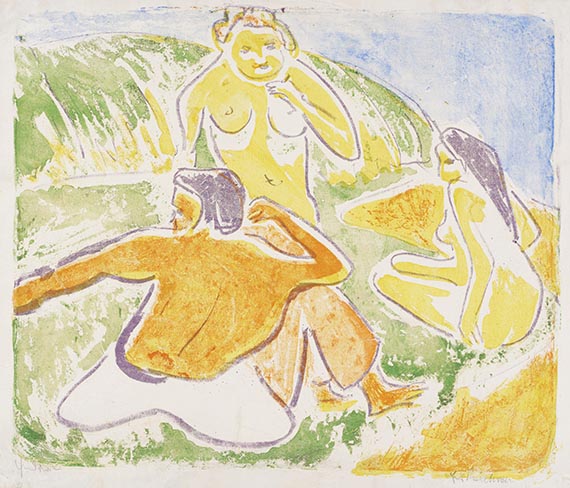
Picknick der Badenden, 1909.
Lithograph in colors. Color print from the same...
Estimate:
€ 80,000 - 120,000
$ 92,800 - 139,200
Information on buyer's premium, taxation and resale right compensation will be available four weeks before the auction.
119000484
Ernst Ludwig Kirchner
Picknick der Badenden, 1909.
Lithograph in colors. Color print from the same...
Estimate:
€ 80,000 - 120,000
$ 92,800 - 139,200
Information on buyer's premium, taxation and resale right compensation will be available four weeks before the auction.
Ernst Ludwig Kirchner
1880 - 1938
Picknick der Badenden. 1909.
Lithograph in colors. Color print from the same stone, made in four steps in violet, yellow, green, and blue (combined in a single process) and orange.
Signed and inscribed “Handdruck.” With the estate stamp of the Kunstmuseum Basel (Lugt 1570 b) and the hand-written registration number “L 133 III” on the reverse. One of only seven known copies. 51.5 x 59.2 cm (20.2 x 23.3 in). Sheet: 54,6 x 64,3 cm (21,5 x 25,3 in).
[CH].
• Hand-printed by the artist.
• One of Kirchner’s extremely rare large-format color prints.
• Two of the six other known copies are in museum collections: the Brooklyn Museum of Art, Brooklyn, NY, and the Stiftung Museum Kunstpalast, Düsseldorf.
• The only copy of this print to have been offered on the international auction market in the last 30 years (source: artprice.com).
• Reduced, flat, and expressive forms: Around 1909, influenced in part by Henri Matisse, Kirchner developed a radical and powerful visual language.
• The motif of bathers and outdoor nudes are among the primary themes of the “Brücke” artists.
PROVENANCE: Galerie Clasing, Münster (presumably on consignment; stamped on the reverse).
Alice Adam Ltd., Chicago.
Private collection, USA.
Private collection, Southern Germany (acquired from the above in 2014, Grisebach, Berlin).
In the family’s possession ever since.
EXHIBITION: Women and Modernity in and Around German Expressionism, Los Angeles County Museum of Art, November 24, 2000 - April 8, 2001.
LITERATURE: Günther Gercken, Ernst Ludwig Kirchner. Critical Catalog of Prints, Vol. 2 (1909–1911), Bern 2013, CR no. 306 (with ill., different copy).
Annemarie and Wolf-Dieter Dube, E. L. Kirchner. Das graphische Werk, Munich 1967, CR no. L 119.
Gustav Schiefler, Die Graphik Ernst Ludwig Kirchners, vol. 1 (through 1916), Berlin-Charlottenburg 1926, CR no. L 133.
- -
Grisebach, Berlin, Selected Works, May 29, 2014, lot 13 (with illustration).
In the Open Air: Living and Working in Harmony with Nature
Faced with rapidly advancing urbanization and driven by a shared longing for a simpler, more peaceful life, Ernst Ludwig Kirchner and his fellow artists from “Die Brücke” were often drawn to the countryside. From 1909 to 1911, E. L. Kirchner, Hermann Max Pechstein, and Erich Heckel frequently spent the summer days at the Moritzburg Ponds near Dresden; Schmidt-Rottluff would occasionally join them. Here, the artists could live out their dream of harmony between life and art—a life in touch with nature and a sense of primal simplicity. They enjoyed a simpler life, went swimming naked with their models, and painted and sketched. Because of their radical innovation and playful lightness, the works created during these visits are considered the pinnacle of the group’s oeuvre. The color lithograph “Picnic of the Bathers” also stems from these memorable summer months at the Moritzburg Ponds. Numerous sketches created outdoors were then refined into paintings and prints in the studio. For example, Kirchner likely captured the girls playing on the Elbe quay in several quick drawings, transferring the scene directly onto paper, then later refining the motif and transforming it into an exceptionally charming, dynamic color lithograph.
Later, E. L. Kirchner and his former artist colleagues from the “Brücke” group—which disbanded in 1913—frequently drew in the North Sea and, in particular, along the Baltic Sea coast during the summer months. They escaped the city and found their personal retreats. Kirchner initially favored the Baltic island of Fehmarn and, after the end of World War I, moved to Davos with his partner, where they settled in the secluded mountain world of the Swiss Alps; Karl Schmidt-Rottluff frequently stayed in Jershöft on the Baltic Sea, at Lake Leba, or in Ticino; Erich Heckel traveled through Italy, France, Switzerland, and numerous other European countries, and otherwise retreated to the Baltic Sea, the Flensburg Fjord, and Lake Constance.
The bustling activity of Dresden and metropolitan Berlin also found entrance into their respective works. Yet, rural life, with its entirely different rhythm, and the harmony between humanity and nature not only offer restorative tranquility and provide much-needed recreation, but also prove to be an important—and in some cases even the most significant—source of inspiration, giving rise to an abundance of new ideas, artistic achievements, and fascinating works of art that have left a lasting mark on art history and continue to influence it to this day. [CH]

Headquarters
Joseph-Wild-Str. 18
81829 Munich
Phone: +49 89 55 244-0
Fax: +49 89 55 244-177
info@kettererkunst.de
Louisa von Saucken / Undine Schleifer
Holstenwall 5
20355 Hamburg
Phone: +49 40 37 49 61-0
Fax: +49 40 37 49 61-66
infohamburg@kettererkunst.de
Dr. Simone Wiechers / Nane Schlage
Fasanenstr. 70
10719 Berlin
Phone: +49 30 88 67 53-63
Fax: +49 30 88 67 56-43
infoberlin@kettererkunst.de
Cordula Lichtenberg
Gertrudenstraße 24-28
50667 Cologne
Phone: +49 221 510 908-15
infokoeln@kettererkunst.de
Hessen
Rhineland-Palatinate
Miriam Heß
Phone: +49 62 21 58 80-038
Fax: +49 62 21 58 80-595
infoheidelberg@kettererkunst.de
We will inform you in time.