


Sale: 611 / Day Sale, Dec. 05. 2026 in Munich → Lot 126000568
126000568
Cy Twombly
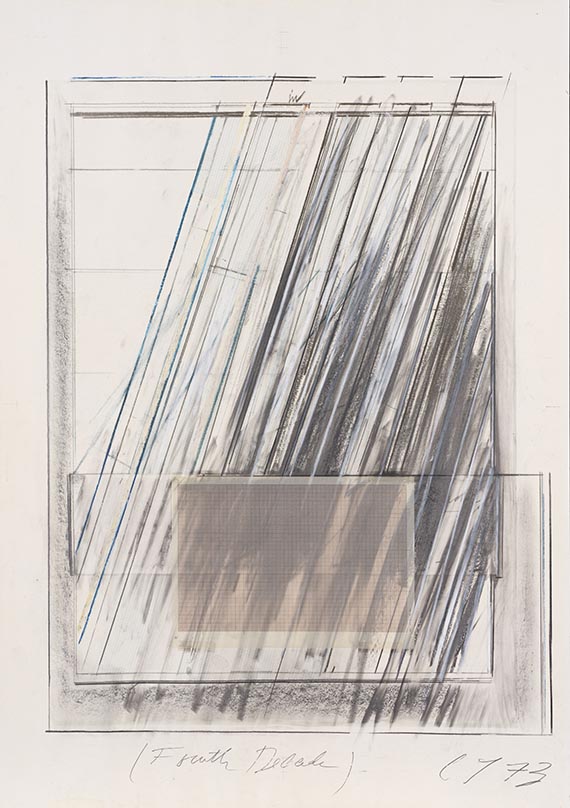
Gladings (Love's Infinite Causes), 1973.
Collage. Oil pastel, pencil, and collaged trans...
Estimate:
€ 70,000 - 90,000
$ 81,200 - 104,400
Information on buyer's premium, taxation and resale right compensation will be available four weeks before the auction.
126000568
Cy Twombly
Gladings (Love's Infinite Causes), 1973.
Collage. Oil pastel, pencil, and collaged trans...
Estimate:
€ 70,000 - 90,000
$ 81,200 - 104,400
Information on buyer's premium, taxation and resale right compensation will be available four weeks before the auction.
Cy Twombly
1928 - 2011
Gladings (Love's Infinite Causes). 1973.
Collage. Oil pastel, pencil, and collaged transparent graph paper over offset lithograph.
Monogrammed and dated in the lower right. Inscribed “(Forth Decade)” in bottom center. 99.9 x 69.7 cm (39.3 x 27.4 in), the full sheet.
As the starting point for the series “Gladings (Love’s Infinite Causes),” Twombly used unnumbered proofs of his print “Untitled” (1973); see Heiner Bastian, Cy Twombly. A Catalogue Raisonné of The Printed Graphic Work, Munich/New York 1984, CR numbers 39 and 40. [JS].
• Poetic condensation and enigmatic imagery: a masterful transformation of existential feelings into a symbolic language of condensed signs.
• Love/Rome/Antiquity/Poetry: A mysterious interweaving of biographical, historical, poetic, and philosophical references.
• “Gladings (Love’s Infinite Causes)”: A rare combination of drawing and collage.
• Since 1990, only four other works from the 12-part series have been offered on the international auction market.
PROVENANCE: Galerie Art in Progress, Munich (with a label on the back of the frame).
Southern German Foundation (formerly part of a private collection in Munich, likely acquired from the above around 1974).
LITERATURE: Nicola del Roscio, Cy Twombly. Drawings. Catalogue Raisonné, Vol. 6: 1972–1979, New York 2016, p. 62, CR no. 53 (with ill.).
Yvon Lambert, Cy Twombly. Catalogue Raisonné of Works on Paper, vol. VI, 1973–1976, Milan 1979, p. 38, CR no. 15 (with ill. on p. 36).
"Cy Twombly benefitted from the fact that he lived on both shores of the Atlantic and, in particular, on the Mediterranean. That made him not only an American or European artist but bestowed upon him one of the rarest gifts: the possibility to continuously renew his art in a creative way up until the end of his life."
Nicola del Roscio, quoted from: Cy Twombly. Drawings. Catalogue Raisonné, vol. 6, p. 10.
Cy Twombly is a master of a poetic-abstract style. Building on his early collaboration with classmate Robert Rauschenberg in New York during the 1950s—the heyday of Abstract Expressionism—Twombly developed his enigmatic imagery over the following years, characterized by overlapping symbols and pictorial abbreviations. In 1973, the year this composition “Gladings (Love’s Infinite Causes)” was created—which, among other elements, features lettering painted over beyond recognition and, at the bottom center, the spontaneously scribbled, enigmatic note “(Forth Decade)”—Twombly had already been living in Rome and elsewhere in Italy for more than a decade. At Via di Monserrato 33 in Rome, the American artist—who had recently married his aristocratic wife Tatiana Franchetti in the late 1950s—moved into an impressive 17th-century palazzo, a biographical context that is perfectly in harmony with Twombly’s series of works titled “Love’s Infinite Causes.” Via di Monserrato 33 is home to those impressive living and working spaces that, thanks to a 1966 photo in Vogue magazine, became one of the world’s most famous and fascinating artists’ studios. Twombly's work appears strikingly spontaneous, yet it is always rich in content and poetically condensed. At the time, it was influenced not only by the country’s mentality and rich cultural history but also by Romantic and Symbolist poetry that drew on antiquity. Because of its distinctive linguistic density and imagery, this poetry exerted a powerful attraction on the American artist. In addition to Friedrich Hölderlin’s hymns, the Symbolist works of the French poet Stéphane Mallarmé—and thus 19th-century poetry—primarily inspired Twombly's metaphorical and poetic visual language. Although “Love’s Infinite Causes” does not refer directly to any of Friedrich Hölderlin’s poems, it reflects the central motif of his entire philosophy of nature and love. For Hölderlin, love was not merely a human emotion, but a cosmic, divine primal force that unites opposites and holds the universe together at its very core, despite all finitude and transience. In keeping with this, another sheet in the series bears the enigmatic reference “H. Lied”—presumably a cryptic abbreviation referring to Hölderlin’s “Hyperion’s Song of Destiny,” which includes the lines: “Yet it is given to us / to rest in no place; / they fade, they fall, / the suffering people / blindly from one / hour to the next, / Like water from cliff/ To cliff cast, / Year after year down into the unknown.”
Does “Gladings (Love’s Infinite Causes)” also embody Twombly’s fascination with the imagery of the sea's infinite roar? Twombly explored this as early as 1959 in the drawing series “Poems to the Sea” and other works created in Anacapri, and through these watery-blue tones and his complete devotion to the line, he translates the endless crashing of the waves into an intoxicating artistic style. Just like a wave, every line exists in the artistic experience only in the here and now, for, as Twombly explains, “each line is now the experience with its own innate history. It does not illustrate—it is the sensation of its own realization” (C. Twombly, 2000, cited in: Claire Daigle, “Lingering at The Threshold,” in: Tate etc., Vol. 13, Summer 2008). Furthermore, the line “(Fourth Decade)” placed by Twombly at the bottom center of the sheet also contains a retrospective reflection on the rushing by of his own life, mirroring the flow of his drawing style. For Twombly, who was in his mid-forties when the work was created, it was looking back at four completed decades of his life at that time. He was—much like his literary inspiration, Hölderlin—at the absolute peak of his creative expressiveness during this period of his life. [JS]
Does “Gladings (Love’s Infinite Causes)” also embody Twombly’s fascination with the imagery of the sea's infinite roar? Twombly explored this as early as 1959 in the drawing series “Poems to the Sea” and other works created in Anacapri, and through these watery-blue tones and his complete devotion to the line, he translates the endless crashing of the waves into an intoxicating artistic style. Just like a wave, every line exists in the artistic experience only in the here and now, for, as Twombly explains, “each line is now the experience with its own innate history. It does not illustrate—it is the sensation of its own realization” (C. Twombly, 2000, cited in: Claire Daigle, “Lingering at The Threshold,” in: Tate etc., Vol. 13, Summer 2008). Furthermore, the line “(Fourth Decade)” placed by Twombly at the bottom center of the sheet also contains a retrospective reflection on the rushing by of his own life, mirroring the flow of his drawing style. For Twombly, who was in his mid-forties when the work was created, it was looking back at four completed decades of his life at that time. He was—much like his literary inspiration, Hölderlin—at the absolute peak of his creative expressiveness during this period of his life. [JS]

Headquarters
Joseph-Wild-Str. 18
81829 Munich
Phone: +49 89 55 244-0
Fax: +49 89 55 244-177
info@kettererkunst.de
Louisa von Saucken / Undine Schleifer
Holstenwall 5
20355 Hamburg
Phone: +49 40 37 49 61-0
Fax: +49 40 37 49 61-66
infohamburg@kettererkunst.de
Dr. Simone Wiechers / Nane Schlage
Fasanenstr. 70
10719 Berlin
Phone: +49 30 88 67 53-63
Fax: +49 30 88 67 56-43
infoberlin@kettererkunst.de
Cordula Lichtenberg
Gertrudenstraße 24-28
50667 Cologne
Phone: +49 221 510 908-15
infokoeln@kettererkunst.de
Hessen
Rhineland-Palatinate
Miriam Heß
Phone: +49 62 21 58 80-038
Fax: +49 62 21 58 80-595
infoheidelberg@kettererkunst.de
We will inform you in time.