


Frame image
Raumbeispiel
172
Hermann Max Pechstein
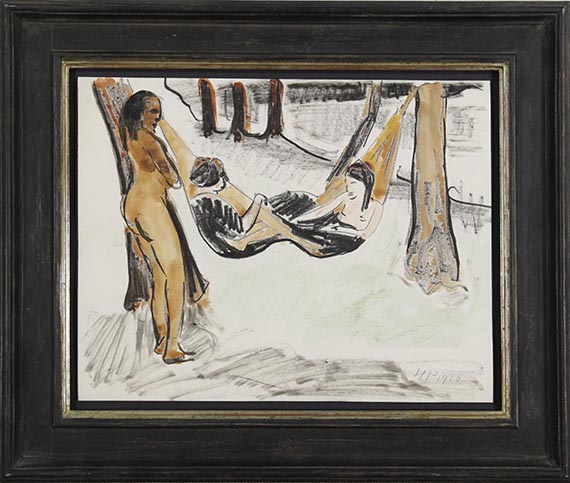
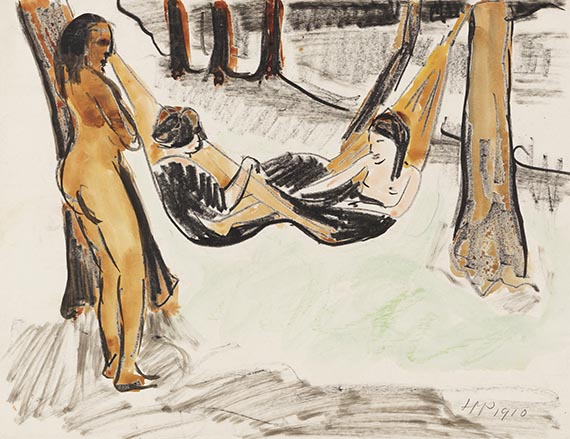
Zwei Mädchen in Hängematte, 1910.
Ink, Watercolor and black as well as color chalk
Estimate:
€ 30,000 - 40,000
$ 33,600 - 44,800
172
Hermann Max Pechstein
Zwei Mädchen in Hängematte, 1910.
Ink, Watercolor and black as well as color chalk
Estimate:
€ 30,000 - 40,000
$ 33,600 - 44,800
Hermann Max Pechstein
1881 - 1955
Zwei Mädchen in Hängematte. 1910.
Ink, Watercolor and black as well as color chalk.
Monogrammed (in ligature) and dated in the lower right. On wove paper (with the watermark “F. W. Ebbinghaus”). 35 x 45.2 cm (13.7 x 17.7 in), the full sheet. [CH].
• Frequently exhibited and published, including the much-discussed 2010–2011 retrospective “Max Pechstein: Ein Expressionist aus Leidenschaft” (Max Pechstein: An Expressionist by Passion).
• The painting “In der Hängematte” (Soika 1910/38), with a closely related motif, was created the same year.
• During the summers of 1909 through 1911, Pechstein, Ernst Ludwig Kirchner, and Erich Heckel spent much of their time at the Moritzburg Ponds near Dresden.
• Free from all academic norms, they created informal nude portraits in the untouched nature around Moritzburg.
Accompanied by a photographic certificate of authenticity issued by Alexander Pechstein, Dobersdorf, on November 22, 2014.
PROVENANCE: From the artist’s estate.
Marta Pechstein, Berlin (1970).
Private collection, Europe (until 2015).
Galerie Schüller, Munich.
Dietmar Manke Collection, Schleswig-Holstein (acquired from the above in 2015).
EXHIBITION: Der Junge Pechstein, Nationalgalerie Berlin, Feb. 1–Mar. 15, 1959, cat. no. 82.
Künstler der Brücke an den Moritzburger Seen, Brücke Museum, Berlin, Oct. 1–Dec. 15, 1970, cat. no. 40.
Max Pechstein 1881–1955. Zeichnungen und Aquarelle – Stationen seines Lebens, Brücke Museum, Berlin, Sept. 19–Nov. 22, 1981, cat. no. 51 (with ill.).
Max Pechstein, Cappenberg Castle, Selm, Aug. 8–Oct. 15, 1989 (with ill.).
Künstler der Brücke in Moritzburg, Moritzburg Castle, July 1–October 1, 1995, cat. no. 4 (with ill.).
Inspiration Moritzburg—Kunst im 20. Jahrhundert, Moritzburg Castle, May 12–August 5, 2001, cat. no. 43 (with ill.).
Max Pechstein: Ein Expressionist aus Leidenschaft (Retrospective), Kunsthalle Kiel, September 19, 2010–January 9, 2011; Kunstforum Ostdeutsche Galerie, Regensburg, March 6–June 26, 2011; Ahlen Art Museum, July 10–October 30, 2011, cat. no. 47 (with ill., p. 46).
LITERATURE: Sotheby’s, London, February 4, 2015, lot 322 (with ill.).
Called up: December 5, 2026 - ca. 14.36 h +/- 20 min.
On July 18, 1910, Hermann Max Pechstein traveled to Moritzburg with Erich Heckel and Ernst Ludwig Kirchner. The idea for this joint summer trip had occurred to them as early as the spring: “When we were together in Berlin, Heckel, Kirchner, and I agreed that the three of us would go to work by the lakes around Moritzburg, near Dresden. We had long been familiar with the landscape, and we knew that there we would have the opportunity to paint nudes in the great outdoors without being disturbed.” (quoted from: Hermann Max Pechstein, Memories, 1993, p. 41) The “Brücke” artists spent the summer with girlfriends and models, painting and swimming around the lakes of the remote Moritzburg forest area. “We painters set out early in the morning, heavily laden,” Pechstein later recalled, “with the models trailing behind, carrying bags full of food and drink. We lived in absolute harmony, working and swimming. If we were short a male model, one of us would step into the breach” (Max Pechstein, in: Junge Kunst, Vol. 1, Leipzig 1919).
The artists wanted nonprofessional models. They were meant to move naturally and avoid the rigid poses demanded by academic painting at the time.
Moritzburg, not yet a tourist destination, and its close-knit community provided the perfect conditions for intensive work. The result is powerful works whose raw intensity testifies to the painters’ connection to life in the great outdoors. For one month, the artists worked together in Moritzburg. For the “Brücke” artists, this summer proved a decisive chapter—one that shaped their individual creative work and left a lasting imprint. Working in proximity, the artists’ styles began to converge. During this idyllic month in Moritzburg, each artist's work reached a new level. They developed a visual language that would henceforth be known as the “Brücke” style and marks the pinnacle of their time together.
In particular, depictions of nudes by the water or in the forest have become the epitome of this artists’ expressionist heyday. This uninhibited nudity expresses liberation from inner constraints, which is also visibly incorporated into the artistic work. Nature and humanity form a deliberate unity that is powerfully conveyed to the viewer. What unites the works created in Moritzburg by all the artists is the directness and immediacy of expression, evident in the work offered here. That same year also saw the creation of the thematically closely related painting “In the Hammock” (Soika 1910/38, Hermann Gerlinger Collection, Würzburg, until 2022). [SM/CH]
