


Sale: 612 / Evening Sale, Dec. 04. 2026 in Munich → Lot 126000585
Raumbeispiel
126000585
Alexej von Jawlensky
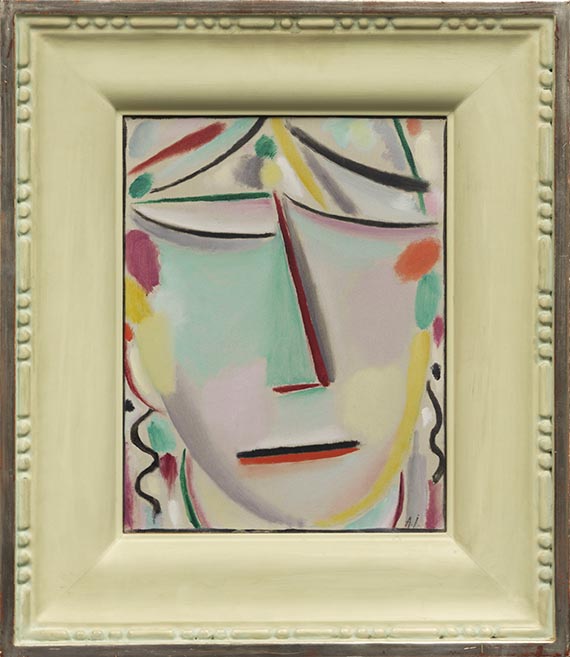
Heilandsgesicht ”Einkehr”, 1918.
Oil on canvas-structured paper, mounted on card...
Estimate:
€ 250,000 - 350,000
$ 280,000 - 392,000
Information on buyer's premium, taxation and resale right compensation will be available four weeks before the auction.
126000585
Alexej von Jawlensky
Heilandsgesicht ”Einkehr”, 1918.
Oil on canvas-structured paper, mounted on card...
Estimate:
€ 250,000 - 350,000
$ 280,000 - 392,000
Information on buyer's premium, taxation and resale right compensation will be available four weeks before the auction.
Alexej von Jawlensky
1864 - 1941
Heilandsgesicht ”Einkehr”. 1918.
Oil on canvas-structured paper, mounted on cardboard, mounted on panel.
Monogrammed in the lower right corner. Signed, dated, and titled “Heilandsgesicht” on the reverse side of the cardboard. Here titled “Einkehr” by Andreas Jawlensky.
Inscribed and titled again by Andreas Jawlensky on the wooden backing on the reverse.
This work is mentioned on page 70 in the so-called Cahier Noir, which the artist compiled together with his secretary Lisa Kümmel in 1934. 36 x 28 cm (14.1 x 11 in).
• PROVENANCE Acquired from the estate in 1974; part of a family collection ever since.
• SAVIOR'S FACE – CONTEMPLATION inner contemplation; the gentle expression conveys spiritual serenity and inner peace.
• HIGHLIGHT In the Savior's Face, Jawlensky crystallizes his quest for a spiritual pictorial form
• MUSEUM QUALITY Works from the series are at, among others, the Museum Wiesbaden, the Lenbachhaus in Munich, the Los Angeles County Museum of Art, and the Galka Scheyer Collection at the Norton Simon Museum in Pasadena.
We are grateful to the Museum Wiesbaden for the kind assistance.
PROVENANCE: From the artist’s estate
Galerie Grosshennig, Düsseldorf, (1968, on consignment from the above)
Private collection, Rhineland (1974, in the family’s possession ever since).
EXHIBITION: Alexej von Jawlensky, Städtische Galerie im Lenbachhaus, Munich, July 17–September 13, 1964, cat. no. 105.
Ausstellung deutscher und französischer Meisterwerke des 20. Jahrhunderts. Gemälde, Plastik, Aquarelle, Handzeichnungen, Galerie Wilhelm Grosshennig, Düsseldorf, Nov. 10, 1968–Jan. 31, 1969, p. 58 (illustrated in color).
Kunst aus Krefelder Sammlungen in Haus Greiffenhorst 1904 -1974, Kunstverein Krefeld, Oct. 20.-Nov. 20, 1974, cat. no. 152.
Wolfgang Wittrock Kunsthandel, Düsseldorf 1986, no.23, col.ill.
Galerie Thomas, Munich (with a label on the reverse, before 1993).
Jawlensky in der Schweiz / Jawlensky en Suisse, Kunsthaus Zürich, October 27, 2000–January 14, 2001, / Fondation de l’Hérimitage, Lausanne, January 26–May 13, 2001, Cat. No. 201 (each with a label on the reverse of the frame cover).
LITERATURE: Maria Jawlensky, Lucia Pieroni-Jawlensky, Angelica Jawlensky, Alexej von Jawlensky. Catalogue Raisonné of the Oil Paintings, vol. 2: 1914–1933, Munich 1992, CR no. 991 (illustrated in color on p. 247)
Clemens Weiler, Alexej Jawlensky, Cologne 1959, no. 248, ill. on p. 245.
- -
Clemens Weiler, Alexej Jawlensky. Köpfe, Gesichte, Meditationen, Hanau 1970, cat. no. 143, (illustrated in color on p. 247).
Angelika Affentranger-Kirchrath, Jawlensky. Das andere Gesicht, Bern, 2000, illustrated in color on p. 109.
Mirna Rudan Lisak, Apstraktna reproduktivna kao produktivna umjetnost. Kromatske fantazije skladatelja Aleksandra Skrjabina, slikara Alekseja Javljenskoga i pijanista Ive Pogorelica, Zagreb, 2015, illustrated in color on p. 114.
"I understood that the artist, through his art, must express through forms and colors what is divine within him. That is why the work of art is a visible god, and art is a longing for God.“
Alexej von Jawlensky, in: exhibition catalog Alexej von Jawlensky, Lenbachhaus Munich/Staatliche Kunsthalle Baden-Baden 1983, p. 28.
Early Portraits and the Turning Point of 1914
From the early days of his career, Alexej von Jawlensky devoted his art to three main themes: landscape, still life, and portraiture. He consistently stripped each subject of any extraneous elements. Even his early portraits lack cluttered background details. Everything shown is truly essential; everything characterizes the subject’s personality. Around 1911–12, he created his powerful, expressive portraits, the “Colorful Heads”, in the typical square format, including the “Self-Portrait” from 1912 (Museum Wiesbaden). When World War I broke out in 1914, Jawlensky, as a Russian citizen, was forced to leave Germany within 48 hours. He and his family, along with Marianne von Werefkin, moved to Saint-Prex, a small town on Lake Geneva, and ultimately lived in Switzerland until 1921. The once-close ties to his circle of friends and fellow artists in Munich were beyond reach. This upheaval marked a decisive turning point not only in his personal life but also in his art. Jawlensky wrote in his memoirs: “My soul had been transformed by great suffering, and this required me to find different forms and colors to express what moved my soul.” (A. v. Jawlensky, Lebenserinnerungen, quoted from: C. Weiler, Alexej Jawlensky. Köpfe, Gesichte, Meditationen, Hanau 1970, p. 116) Beginning in 1915, he returned to painting female heads and began work on his famous “Variations”, a series inspired by the view from his window in Saint-Prex. In 1916, he met Emmy (Galka) Scheyer in Lausanne, who would become a close confidante and manager. A portrait of Galka marks the beginning of a dense series of heads. Her black curls and curved nose are frequently reflected in the “Mystical Heads.”
The “Mystical Heads” and “Saviors' Faces”
Just a few years later, another relocation was on the horizon: “We moved to Ascona in early April 1918. The following three years in Ascona were the most interesting of my life. [..] I created many variations there. And then I began painting my “Saviors' Faces” and the “Abstract Heads”. To me, they were heads of saints. When I recall that time now in 1937, at a point where I am ill and over seventy years old, my soul weeps with sorrow and longing." (A. v. Jawlensky, Memoirs, quoted from: ibid., p. 119) In his series “Mystical Heads,” he explored portraiture in depth; in “Saviors' Faces,” he distilled it to its essence, making the portrait a reflection of a hidden inner life.
Personal characterization merges with the artistic quest to explore formal variation. With reduced yet expressively varied lines, Alexej von Jawlensky focuses on the basic forms of the face: eyes, nose, and mouth, framed by U-shaped contour lines. In the early works, the eyes are wide open; in the 1917 paintings, large eyes gaze at the viewer. In 1918, Jawlensky intensified the effect of the “Saviors' Faces” by depicting closed eyes. This introduces a sense of calm and contemplation into the series. Through variations in color and minimal changes in detail, a highly expressive range of moods and expressions emerges. About the “Saviors' Faces”, Tayfun Belgin noted: “[The] title itself alludes to the spiritual dimension of the paintings, in which the focus is no longer on outward radiance and mystery, but rather on an inward retreat.” Pastel tones applied in delicate layers fill the oval face; the soft palette reinforces the impression of contemplation, particularly in those paintings depicting closed eyes. [..] What already appears occasionally in the pre-war heads and in many of the ‘Mystical Heads’—namely, points of light in the center of the forehead, between the eyebrows—becomes all the more evident in this series: Jawlensky's reference to the third eye, which represents a mystical symbol of wisdom in ancient Indian tradition. (Tayfun Belgin, Alexej von Jawlensky: Life and Work, in: Image and Science—Engaging with the Artistic Legacy from Hodler to Jawlensky, Bern 2003, p. 56.) In retrospect, Alexej von Jawlensky explained what motivated him to engage so intensely with the “Saviors' Faces”: “And then I had to find a form for the face, since I had come to understand that great art should be painted only with religious sentiment. And I could only express that through the human face. I understood that the artist had to use his art—through forms and colors—to express what was divine within him.” This idea is summed up best as follows: “That is why the work of art is a visible God, and art is a longing for God.” (Alexej von Jawlensky, quoted from: Exhibition catalog Alexej von Jawlensky, Munich/Baden-Baden 1983, p. 28)
Einkehr (Introspection)
“Einkehr” is a particularly striking painting in this series. A slight tilt dominates the composition. Not only is the head shape fundamentally shifted from the vertical axis, but the nose and mouth also reinforce the impression of a head leaning to one side. Once again, Jawlensky achieves his goal through color, which he applies with a gentle, floating touch. The distinctive turquoise, already used in the famous portrait of the dancer Zakharov (1909, Lenbachhaus, Munich), suggests the flesh tones in subtle gradations with a hint of pink. Luminous dots and lines in black, red, yellow, and green, along with circular areas, frame the face, which has found peace. The closed eyes explain the title “Einkehr.” In a religious sense, introspection is a conscious turn toward God through self-reflection on one's own spirituality.

Headquarters
Joseph-Wild-Str. 18
81829 Munich
Phone: +49 89 55 244-0
Fax: +49 89 55 244-177
info@kettererkunst.de
Louisa von Saucken / Undine Schleifer
Holstenwall 5
20355 Hamburg
Phone: +49 40 37 49 61-0
Fax: +49 40 37 49 61-66
infohamburg@kettererkunst.de
Dr. Simone Wiechers / Nane Schlage
Fasanenstr. 70
10719 Berlin
Phone: +49 30 88 67 53-63
Fax: +49 30 88 67 56-43
infoberlin@kettererkunst.de
Cordula Lichtenberg
Gertrudenstraße 24-28
50667 Cologne
Phone: +49 221 510 908-15
infokoeln@kettererkunst.de
Hessen
Rhineland-Palatinate
Miriam Heß
Phone: +49 62 21 58 80-038
Fax: +49 62 21 58 80-595
infoheidelberg@kettererkunst.de
We will inform you in time.