


Sale: 612 / Evening Sale, Dec. 04. 2026 in Munich → Lot 126000750
Frame image
Raumbeispiel
126000750
Conrad Felixmüller
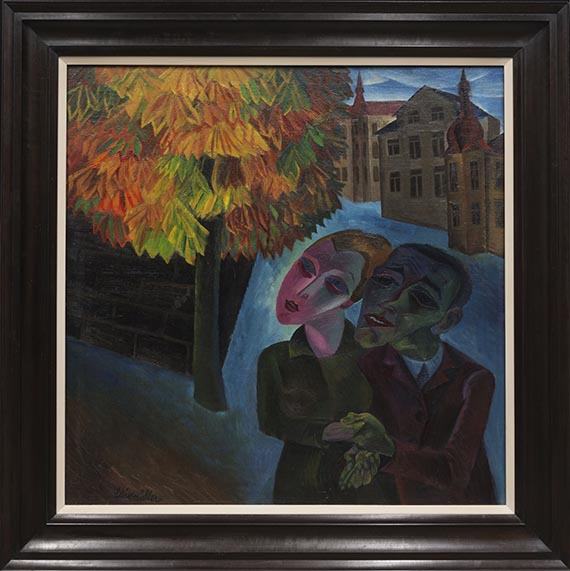
Herbst in Klotzsche / Das eingeschlafene Modell II, 1920/1940.
Oil on canvas
Estimate:
€ 250,000 - 350,000
$ 290,000 - 406,000
Information on buyer's premium, taxation and resale right compensation will be available four weeks before the auction.
126000750
Conrad Felixmüller
Herbst in Klotzsche / Das eingeschlafene Modell II, 1920/1940.
Oil on canvas
Estimate:
€ 250,000 - 350,000
$ 290,000 - 406,000
Information on buyer's premium, taxation and resale right compensation will be available four weeks before the auction.
Conrad Felixmüller
1897 - 1977
Herbst in Klotzsche / Das eingeschlafene Modell II. 1920/1940.
Oil on canvas.
“Herbst in Klotzsche” signed in the lower left; “Das eingeschlafene Modell” is also signed and dated in the lower left. 95 x 95 cm (37.4 x 37.4 in).
The painting “Das eingeschlafene Modell II” on the reverse is listed in Felixmüller’s catalogue raisonné under the number 847. [CH].
• SIGNIFICANT The years after World War I are regarded as the central and finest creative phase in Conrad Felixmüller’s oeuvre.
• CONTEMPORARY HISTORY This is an expressive work in which the artist processes the traumatic experiences of World War I and the existential quest for direction in the postwar period.
• EARLY RECOGNITION Exhibited at the renowned Ludwig Schames Art Salon in Frankfurt am Main and at the Kestner Society in Hanover as early as 1921.
• RARE The figurative compositions from the early interwar years are among the artist’s most sought-after works on the international auction market.
• TWO PAINTINGS Painted on both sides; depicting “Das eingeschlafene Modell II” (The Sleeping Model II) from 1940 on the reverse.
We are grateful to Dr. Mara Wantuch-Thole, LL.M., and Dr. Ewald Volhard, as well as the heirs of Robert Graetz, for their kind support and excellent cooperation.
PROVENANCE: Robert Graetz Collection, Berlin-Grunewald (acquired directly from the artist through an exchange in 1929; held until 1939).
The artist’s studio (returned by the aforementioned owner in 1939; reverse side completed in 1940).
From the collection of Hanns-Conon von der Gabelentz, Poschwitz Palace near Altenburg.
Private collection, Saxony-Anhalt (in the family’s possession since after 1970).
Swiss collection (acquired from the above in 2011, Ketterer Kunst, Munich).
Amicable agreement with the heirs of Robert Graetz (2026).
This work is offered in an amicable agreement with the heirs of Robert Graetz. The work is free of restitution claims.
EXHIBITION: Felixmüller, Kunstsalon Ludwig Schames, Frankfurt am Main, January 1921, cat. no. 22.
44. Ausstellung in zwei Abteilungen. Watercolors by Modern Artists and Paintings by Conrad Felixmüller, Kestner-Gesellschaft, Hanover, Aug. 28–Sept. 25, 1921, cat. no. 214 (subsequently shown in Düsseldorf and Hamburg).
Summer Exhibition. New Works 1920/1921, Graphisches Kabinett I. B. Neumann, Berlin, July/August 1921, cat. no. 6.
LITERATURE: Heinz Spielmann (publ.), Titus Felixmüller (ed.), Conrad Felixmüller. Monograph and Catalogue Raisonné of the Paintings, Cologne 1996, CR no. 223 (color plate 16 on p. 71) and CR no. 847 (color plate 93 on p. 155).
- -
Angelika Enderlein, Der Berliner Kunsthandel in der Weimarer Republik und im NS-Staat. Zum Schicksal der Sammlung Graetz, Berlin 2006, pp. 202, 249.
Angelika Enderlein, Aufbau und Verlust - Die moderne Sammlung Robert Graetz, in: Werke und Werte. Über das Handeln und Sammeln von Kunst im Nationalsozialismus, Berlin 2012, pp. 114ff.
Ketterer Kunst, Munich, 386th Auction, Dec. 10, 2011, lot 79 (with illustration).
Two Sides of an Era: Conrad Felixmüller’s Double Painting and the Fate of the Robert Graetz Collection
Existential Alienation and Early Mastery
The present painting “Herbst in Klotzsche" (Autumn in Klotzsche), created around 1920, ranks among the most expressive works in Conrad Felixmüller’s oeuvre. Executed with wildly untamed brushstrokes in the early 1920s, the work compellingly reflects the turmoil of a young generation of artists seeking to cope with their war trauma. At the center is an intimately embraced couple. Most likely, it is the artist himself with his young wife, Londa. A deep, protective intimacy is palpable in their interlocked hands and the parallel posture of their bowed heads. At the same time, the couple appears strangely isolated against a melancholic, almost desolate suburban landscape. The strikingly Cubist stylization of their facial features lends the composition an existential gravity: The agonizing fundamental question of the early postwar period is condensed in this work: the unresolved “Where to?” in the wake of the global devastation.
The Radical Style Break
With his turn toward New Objectivity, however, Felixmüller made an uncompromising break with his past. He vehemently rejected his early Expressionist phase, intending to eliminate his former expressive style from his entire body of work. As is well known, he specifically demanded the return of early works from collectors and gallery owners so he could paint over or destroy them. When “Herbst in Klotzsche” returned to his studio in 1939, he promptly re-stretched the canvas and, in 1940, completed “Das eingeschlafene Modell” (The Sleeping Model) on the reverse side. The early masterpiece was thus officially deemed to have been erased; in his handwritten catalogue raisonné, the painter crossed out the entry with a red pencil.
On the new front side, Felixmüller designed a masterful interior in the cool style typical of around 1940: the resting female nude is stripped of any provocation, and the bourgeois ideal of beauty seems to prevail. Nevertheless, the masterful refinement asserts itself: the red shoes casually tossed in front of the bed, the parquet floor “flattened into the plane” in the spirit of the avant-garde, the dynamic diagonal of the composition, and the luminous color scheme of the bedding all bear witness to unbroken virtuosity. That Felixmüller merely concealed the early composition—now on the reverse side—under a layer of paint, rather than destroying it, proves a stroke of luck today, for this gave rise to a unique double image: the “best of Felixmüller” on both sides of a single canvas.
Robert Graetz: Patron of Modern Art in Berlin-Grunewald
The man who owned “Herbst in Klotzsche” had two sides to his life until it returned in that fateful year of 1939. He was the Berlin textile magnate Robert Graetz (1878–1945). Together with his partners, Graetz had founded the renowned ladies' coat company “Glass & Graetz” on Berlin’s Hausvogteiplatz in 1907—and in 1929, “Herbst in Klotzsche” also came into his possession in exchange for a coat for Londa Felixmüller. Advised by his brother Hugo, managing director of the revolutionary “November Group,” Robert Graetz began compiling an outstanding collection of modern art in the early 1920s. His Grunewald villa on Erdener Straße housed some 200 masterpieces, including paintings by Karl Schmidt-Rottluff, Max Pechstein, and Käthe Kollwitz, as well as sculptures by Ernst Barlach. Graetz was a cheerful, outgoing figure at the center of Berlin’s cultural life and repeatedly made his treasures available to the Kronprinzen-Palais for exhibitions.
Persecution, Expropriation, and Deportation
With the National Socialists’ rise to power, they began systematically destroying his existence. Anti-Semitic persecution forced the company into liquidation in 1939; crushing compulsory levies eroded his fortune. Graetz was forced to sell real estate below market value and vacate his villa. In February 1941, auction house Gerhard Harms sold the remaining household goods; Graetz had stored his art collection with several moving companies and entrusted it to friends. Graetz himself was confined to a so-called “Judenhaus” in Berlin-Schöneberg. When he went to Grunewald Station on April 14, 1942, to say goodbye to his sister Selma before her deportation, he was arbitrarily arrested by the Gestapo and deported to the Warsaw Ghetto on the “14th East Transport.” Robert Graetz did not survive the Holocaust.
Behind the two sides of Conrad Felixmüller’s two-part work, German history is reflected in all its extreme contradictions: on the one hand, the lively, optimistic spirit of the Weimar Republic and a life-loving collector at the heart of society; on the other, the ostracism and persecution of Nazi terror. Not only did a work of art disappear—a life was lost, too. The fact that “Herbst in Klotzsche / Das eingeschlafene Modell” is offered in amicable agreement with the heirs of Robert Graetz lends this museum-quality work a historical value that transcends its art-historical significance. [AT]

Headquarters
Joseph-Wild-Str. 18
81829 Munich
Phone: +49 89 55 244-0
Fax: +49 89 55 244-177
info@kettererkunst.de
Louisa von Saucken / Undine Schleifer
Holstenwall 5
20355 Hamburg
Phone: +49 40 37 49 61-0
Fax: +49 40 37 49 61-66
infohamburg@kettererkunst.de
Dr. Simone Wiechers / Nane Schlage
Fasanenstr. 70
10719 Berlin
Phone: +49 30 88 67 53-63
Fax: +49 30 88 67 56-43
infoberlin@kettererkunst.de
Cordula Lichtenberg
Gertrudenstraße 24-28
50667 Cologne
Phone: +49 221 510 908-15
infokoeln@kettererkunst.de
Hessen
Rhineland-Palatinate
Miriam Heß
Phone: +49 62 21 58 80-038
Fax: +49 62 21 58 80-595
infoheidelberg@kettererkunst.de
We will inform you in time.