


Sale: 612 / Evening Sale, Dec. 04. 2026 in Munich → Lot 126001214
126001214
Victor Vasarely
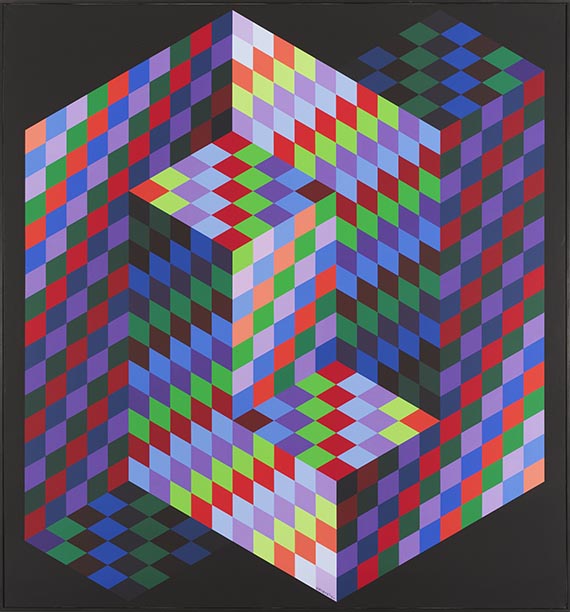
MÉH, 1981-1990.
Acrylic on canvas
Estimate:
€ 150,000 - 200,000
$ 174,000 - 232,000
Information on buyer's premium, taxation and resale right compensation will be available four weeks before the auction.
126001214
Victor Vasarely
MÉH, 1981-1990.
Acrylic on canvas
Estimate:
€ 150,000 - 200,000
$ 174,000 - 232,000
Information on buyer's premium, taxation and resale right compensation will be available four weeks before the auction.
Victor Vasarely
1906 - 1997
MÉH. 1981-1990.
Acrylic on canvas.
Signed in bottom center. Signed twice on the reverse, as well as dated, titled, inscribed “1466” and with the the dimensions. 240 x 225 cm (94.4 x 88.5 in).
[AR].
• MONUMENTAL A psychedelic, illusionistic visual experience in a breathtaking large format.
• OPTICAL ILLUSION Color, format, and forms combine to create Vasarely’s famous optical play.
• PIONEER He is considered one of the co-founders and most important representatives of Op Art.
• MUSEUM QUALITY His works are featured in major museums such as the Guggenheim Museum, New York, the Saint Louis Art Museum, and the Museum of Modern Art, New York.
Accompanied by a certificate of authenticity issued by Victor Vasarely, Annet-sur-Marne, dated February 6, 1990. Here dated “1981–90.”
According to Pierre Vasarely, the work dates from 1989.
PROVENANCE: Private collection, Hesse.
Private collection, Hesse.
“Master of Optical Illusion”
Süddeutsche Zeitung, Dec. 1, 2019
“Master of Deception”
Die Zeit, Mar. 20, 2019
Victor Vasarely—described as the “Master of Optical Illusions” (Süddeutsche Zeitung) or the “Master of Deception” (Die Zeit)—is recognized as a founding figure and leading exponent of Op Art. From the start of his career, he systematically explored human perception and developed a universal visual language, grounded in technology and science, intended to help democratize art. His idea of a visual alphabet, based on specific rules that allow for ever-changing compositions, not only challenged the prevalent notion of the “artist genius” but also aimed to give people access to art through a universally understandable visual language, even without cultural or historical knowledge.
This aspiration and the fundamental principle of his artistic practice are clearly evident in his work “MÉH.” Against a black background that recalls the infinite expanse of the universe, he employs an extremely limited range of colors and forms to achieve the greatest possible effect. The basic geometric shape of the rectangle is maintained and varied strictly according to a few fundamental rules. He deliberately uses color and proportion to create a cube-like structure in the viewer’s eye—one that appears to change shape depending on the viewer's angle, making them an active part of the artwork; an achievement only a few artists had accomplished and one that gained widespread recognition through Op Art.
In psychedelic-illusionistic works like this one, Victor Vasarely perfected his visual language of geometric grids, distorted lines, and contrasting color palettes in the 1980s. His employment of rhombuses, cubes, and hexagons is highly deliberate, designed to create the illusion of three-dimensionality, produce visual effects, and play tricks on the eye. The titles of his works, such as “Dirac” or “Photon,” often reflect his lifelong fascination with physics, astrophysics, and geometry. The title “MÉH,” on the other hand, likely traces back to Vasarely’s Hungarian heritage and his engagement with the natural sciences. Translated into English, it means “bee” and, in the context of the composition, evokes a kind of systematized beehive in which the rules of geometry have taken hold. Vasarely himself, however, would likely counter this comparison by saying: “There are no tangible references to objects in my compositions, yet they radiate light!” (Victor Vasarely, in: Art of the 20th Century, Vol. II, Neuchâtel 1973) [AR]

Headquarters
Joseph-Wild-Str. 18
81829 Munich
Phone: +49 89 55 244-0
Fax: +49 89 55 244-177
info@kettererkunst.de
Louisa von Saucken / Undine Schleifer
Holstenwall 5
20355 Hamburg
Phone: +49 40 37 49 61-0
Fax: +49 40 37 49 61-66
infohamburg@kettererkunst.de
Dr. Simone Wiechers / Nane Schlage
Fasanenstr. 70
10719 Berlin
Phone: +49 30 88 67 53-63
Fax: +49 30 88 67 56-43
infoberlin@kettererkunst.de
Cordula Lichtenberg
Gertrudenstraße 24-28
50667 Cologne
Phone: +49 221 510 908-15
infokoeln@kettererkunst.de
Hessen
Rhineland-Palatinate
Miriam Heß
Phone: +49 62 21 58 80-038
Fax: +49 62 21 58 80-595
infoheidelberg@kettererkunst.de
We will inform you in time.