


Sale: 612 / Evening Sale, Dec. 04. 2026 in Munich → Lot 126000616
Frame image
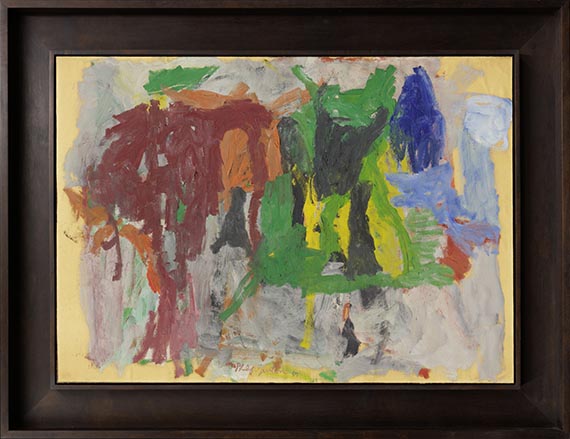
126000616
Philip Guston
Untitled, 1957.
Oil on paper, mounted on fiberboard
Estimate:
€ 250,000 - 350,000
$ 280,000 - 392,000
Information on buyer's premium, taxation and resale right compensation will be available four weeks before the auction.
126000616
Philip Guston
Untitled, 1957.
Oil on paper, mounted on fiberboard
Estimate:
€ 250,000 - 350,000
$ 280,000 - 392,000
Information on buyer's premium, taxation and resale right compensation will be available four weeks before the auction.
Philip Guston
1913 - 1980
Untitled. 1957.
Oil on paper, mounted on fiberboard.
Signed and dated in bottom center. 63.5 x 88.9 cm (25 x 35 in).
[AR].
• PURE EMOTION Powerful strokes in Guston’s unmistakable palette.
• WANTED His abstract works from the 1950s, along with his figurative works from the 1970s, are among the most sought-after works on the international
auction market (source: artprice.com).
ABSTRACT EXPRESSIONISM By 1957, Guston was one of the movement’s leading figures.
• INTERNATIONAL STAGE Participation in documenta II in 1959 and in the Venice Biennale in 1960.
• MUSEUM QUALITY Similar works are at the Museum of Modern Art, New York; the Museum of Contemporary Art, Los Angeles; and the Tate Modern, Londonn.
PROVENANCE: Leo Castelli Gallery, New York.
Private collection, New York (ca. 1958).
Private collection, New York (inherited from the aforementioned).
German collection (acquired from the above, Sotheby’s, New York, private sale).
From a Swiss corporate collection (since 2018, Dorotheum, Vienna).
LITERATURE: Dorotheum, Vienna, Auction Contemporary Art Part I, May 16, 2018, lot 209 (with color illustration).
Philip Guston, 1956, quoted from: exhibition catalog 12 Americans, The Museum of Modern Art, New York 1956, p. 36.
Powerful expression, technical mastery, and a distinctive style: Philip Guston’s abstract works from the 1950s uniquely embody the essence of Abstract Expressionism. This revolutionary movement is widely considered the first American art movement to have international impact. It began to take shape in the late 1940s—even before Pop Art and Minimal Art—and, originating in the United States, went on to conquer the international art world. Although Philip Guston never considered himself an Abstract Expressionist, he ranks alongside Jackson Pollock, Robert Motherwell, Mark Rothko, and Willem de Kooning as one of the most important figures of a movement that was so pivotal to postwar art. Abstract Expressionism set out to find personal expression through a non-representational use of color, making emotions, experiences, and impulses tangible on the canvas. Jackson Pollock’s Action Painting, Mark Rothko’s Color Field Painting, and—last but not least—Philip Guston’s abstractions, often described as lyrical and poetic, embody—in all their formal diversity—this unifying, groundbreaking understanding of art.
In his abstract works of the early 1950s, Philip Guston began to explore the pictorial space, initially using nearly monochromatic hues or shades that varied only slightly within a single color group. Short brushstrokes form grid-like structures, converging at the center and gradually losing density toward the edges of the picture until they dissolve into a pictorial space that generally grows lighter. Over the years, the artist increasingly turned to the pure power of color, using it more intensely and with greater confidence in broad, spirited brushstrokes. Primary colors such as red, green, blue, and yellow increasingly take the lead. At the same time, the peripheral areas of his works, whether on canvas or, as here, on paper, usually remain unpainted. The color gathers in the center of the painting as before, probing the surface with a few runners, as if seeking to discover how far it can penetrate space with its inherent expressive power. In this liminal state—between powerful and delicate sections, between the force of the color and spatial restraint—the special appeal of Philip Guston’s abstract works emerges and ultimately establishes his unique position within Abstract Expressionism. [AR]
In his abstract works of the early 1950s, Philip Guston began to explore the pictorial space, initially using nearly monochromatic hues or shades that varied only slightly within a single color group. Short brushstrokes form grid-like structures, converging at the center and gradually losing density toward the edges of the picture until they dissolve into a pictorial space that generally grows lighter. Over the years, the artist increasingly turned to the pure power of color, using it more intensely and with greater confidence in broad, spirited brushstrokes. Primary colors such as red, green, blue, and yellow increasingly take the lead. At the same time, the peripheral areas of his works, whether on canvas or, as here, on paper, usually remain unpainted. The color gathers in the center of the painting as before, probing the surface with a few runners, as if seeking to discover how far it can penetrate space with its inherent expressive power. In this liminal state—between powerful and delicate sections, between the force of the color and spatial restraint—the special appeal of Philip Guston’s abstract works emerges and ultimately establishes his unique position within Abstract Expressionism. [AR]

Headquarters
Joseph-Wild-Str. 18
81829 Munich
Phone: +49 89 55 244-0
Fax: +49 89 55 244-177
info@kettererkunst.de
Louisa von Saucken / Undine Schleifer
Holstenwall 5
20355 Hamburg
Phone: +49 40 37 49 61-0
Fax: +49 40 37 49 61-66
infohamburg@kettererkunst.de
Dr. Simone Wiechers / Nane Schlage
Fasanenstr. 70
10719 Berlin
Phone: +49 30 88 67 53-63
Fax: +49 30 88 67 56-43
infoberlin@kettererkunst.de
Cordula Lichtenberg
Gertrudenstraße 24-28
50667 Cologne
Phone: +49 221 510 908-15
infokoeln@kettererkunst.de
Hessen
Rhineland-Palatinate
Miriam Heß
Phone: +49 62 21 58 80-038
Fax: +49 62 21 58 80-595
infoheidelberg@kettererkunst.de
We will inform you in time.