


Sale: 612 / Evening Sale, Dec. 04. 2026 in Munich → Lot 126000856
126000856
Lyonel Feininger
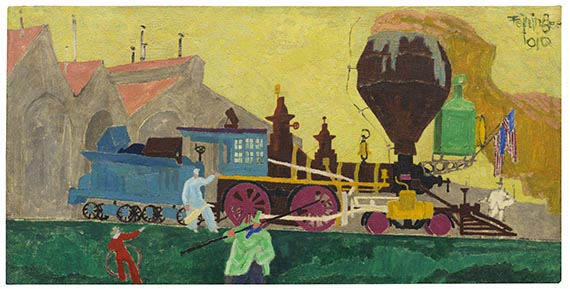
Alte Amerikanische Lokomotive, 1910.
Oil on canvas
Estimate:
€ 600,000 - 900,000
$ 696,000 - 1,044,000
Information on buyer's premium, taxation and resale right compensation will be available four weeks before the auction.
126000856
Lyonel Feininger
Alte Amerikanische Lokomotive, 1910.
Oil on canvas
Estimate:
€ 600,000 - 900,000
$ 696,000 - 1,044,000
Information on buyer's premium, taxation and resale right compensation will be available four weeks before the auction.
Lyonel Feininger
1871 - 1956
Alte Amerikanische Lokomotive. 1910.
Oil on canvas.
Signed and dated in the upper right. Inscribed “Sunday, July 3, 1910” on the reverse of the stretcher. 50 x 100 cm (19.6 x 39.3 in).
With labels of "Serge Sabarsky Gallery", New York, and of "Eugene Victor Thaw", New York,on the reverse. [AR].
• MUSEUM QUALITY Early, large-scale work in vibrant colors, marking Feininger's transition to modernism.
• NEW IMPULSES Locomotives, figures, and movement become sources of inspiration that informed his distinctive aesthetic.
• EXHIBITION In 1911 at the Salon des Indépendants in Paris; in 1966 in one of the first posthumous retrospectives, held in Pasadena, Milwaukee, and Baltimore; and in 1968–69 in a major group exhibition at the Museum of Modern Art in New York.
• COLLECTION Another painting with a locomotive motif from 1910 is in the collection of the Albertina, Vienna.
• WANTED Feininger's figurative works from the 1910s are among the artist's most sought-after pieces on the international auction market (source: artprice.com).
Achim Moeller, Director of the Lyonel Feininger Project, New York–Berlin, has confirmed the authenticity of this work, which is registered in the Lyonel Feininger Project archive under number 2101-09-29-26. The work is accompanied by a Certificate of Authenticity. The painting is listed in Lyonel Feininger: The Catalogue Raisonné of Paintings by Achim Moeller under number 062.
Additional information was provided by Achim Moeller, The Lyonel Feininger Project, New York–Berlin.
PROVENANCE: From the artist's estate.
Julia Feininger, New York.
Private collection, North Rhine-Westphalia.
Private collection, Northern Germany (inherited from the above).
EXHIBITION: 27éme Exposition de la Société des Artistes Indépendants, Salon des Indépendants, Paris, April 21–June 13, 1911, no. 2181 (“La locomotive ancienne”), p. 154.
The Decade of the Armory Show: New Directions in American Art 1910–1920: Sixth Loan Exhibition of the Friends of the Whitney Museum of Art, Whitney Museum of American Art, New York, Feb. 27–Apr. 14, 1963, cat. no. 37 (Old American Locomotive; Collection of Mrs. Lyonel Feininger, with b/w illustration on p. 6), with stops at: City Art Museum of St. Louis, St. Louis, April 1–July 14, 1963; The Cleveland Museum of Art, Cleveland, August 6–September 15, 1963; Pennsylvania Academy of the Fine Arts, Philadelphia, Sept. 30–Oct. 30, 1963; The Art Institute of Chicago, Chicago, Nov. 15–Dec. 29, 1963; Albright-Knox Art Gallery, Jan. 20–Feb. 23, 1964.
Lyonel Feininger 1871–1956: A Memorial Exhibition, Pasadena Art Museum, Pasadena, April 26–May 29, 1966, cat. no. 6 (Old American Locomotive, Mrs. Julia Feininger, with color illustration, no page number, exhibition label on the reverse), with stops at: Milwaukee Art Center, Milwaukee, July 10–August 11, 1966; Baltimore Museum of Art, Baltimore, September 7–October 23, 1966.
The Machine as Seen at the End of the Mechanical Age, The Museum of Modern Art, New York, November 27, 1968–February 9, 1969, p. 46 (Old American Locomotive, Mrs. Julia Feininger, with b/w illustration, on the reverse with a label reading “Museum of Modern Art – LOAN”), with stops at: University of St. Thomas, Houston, March 25–May 18, 1969; San Francisco Museum of Art, San Francisco, June 27–August 24, 1969.
LITERATURE: Achim Moeller, (Alte amerikanische Lokomtive I) / (Old American Locomotive I), 1910 (Moeller 062), in: Lyonel Feininger: The Catalogue Raisonné of Paintings, https://www.feiningerproject.org/catalogue/entry.php?id=63 (accessed September 16, 2026).
Hans Hess, Lyonel Feininger. Mit einem Oeuvre-Katalog von Julia Feininger, Stuttgart 1959, CR no. 53 (illustrated in black and white on p. 253)
- -
Lloyd Goodrich, [Introduction], in: The Decade of the Armory Show: New Directions in American Art 1910–1920, exhibition catalog, New York 1963, pp. 5–89, here p. 5.
Leona E. Prasse, Lyonel Feininger. Das graphische Werk. Etchings, Lithographs, Woodcuts, Berlin/Cleveland 1972, p. 58 (Old American Locomotive).
Donald E. Gordon, Modern Art Exhibitions: 1900–1916. Selected Catalogue Documentation, II, Munich 1974, p. 479 (“La locomotive ancienne”).
Ulrich Luckhardt, Der frühe Feininger und Robert Delaunay, in: Peter-Klaus Schuster (ed.), Delaunay und Deutschland, Cologne 1985, pp. 285–291, here p. 285.
Ulrich Luckhardt, Lyonel Feininger: Die Karikaturen und das zeichnerische Frühwerk. Der Weg zur Selbstfindung zum unabhängigen Künstler, mit einem Exkurs zu den Karikaturen von Emil Nolde und George Grosz, Munich 1987, p. 143.
Galerie Gmurzynska (ed.), Lyonel Feininger, Cologne 1997, p. 40.
Ulrich Luckhardt, Martin Faas (eds.), Lyonel Feininger: The Drawings and Watercolors, Cologne 1998, p. 206.
Martin Faas, Lyonel Feininger und der Kubismus, Europäische Hochschulschriften, series XXVIII, vol. 33, Frankfurt am Main 1999, p. 36 (La locomotive ancienne [Old American Locomotive]).
Anja Breloh, Das verheissungsvollste Geschenk, in: Gerhard Finckh (ed.), Feininger: Frühe Werke und Freunde, Bönen 2006, pp. 112–119, here p. 116.
Björn Egging, Manuela Winter (eds.), Lyonel Feininger: Radierungen und Lithografien, Quedlinburg 2012, p. 108.
The Dawn of Modernism: Lyonel Feininger’s Early Successes as a Painter
Paris in 1911: The Salon des Indépendants opens its doors, and the latest trends in painting are unveiled to the public.
At that time, the spotlight in “Salle 41” was on the Cubist circle, featuring works by, among others, Robert Delaunay, Fernand Léger, Albert Gleizes, and Marie Laurencin. The extensive exhibition, featuring more than 6,000 works, also included Henri Matisse and Wassily Kandinsky, whose innovative work, together with that of the Cubists, shook the art world like an earthquake and ultimately paved the way for an entire generation of artists to embrace a modern understanding of art. The German-American artist Lyonel Feininger also contributes six of his most recent works to the major exhibition, including his “Old American Locomotive” from 1910. As is so typical of his entire body of work, however, Feininger could not be assigned to any group or movement at that time. Although he drew inspiration from modern art movements—especially early in his career—he remained committed to his own artistic pursuits throughout his life, rather than subordinating himself to a program.
Just a few years earlier, Lyonel Feininger—who had worked primarily as a caricaturist and draftsman until then—began to explore painting. It was a path fraught with challenges and uncertainties, one that demanded new approaches not only technically but also intellectually. Feininger himself repeatedly struggled with his progress and wavered between enthusiasm and despair, as his letters from this period reveal. On August 11, 1909, for example, he wrote confidently: “… A future is gradually opening up for me; I will not have lived in vain...” and just four days later, full of disillusionment: “…There are times when I imagine myself to be a real daredevil—and then suddenly I search in vain for a single work that might stand the test of time...”
(Lyonel Feininger, quoted in: Hans Hess, Lyonel Feininger, Stuttgart 1959, p. 47) In 1909, despite all his initial uncertainties, Feininger became a member of the Berlin Secession; he exhibited a painting there in 1910 and, just one year later, presented two of his works in the exhibition. Taking part in the Salon des Indépendants was another important step toward his success. As is well known from numerous artist biographies of the turn of the century, Feininger, too, initially encountered mixed reactions, rejection, and a lack of understanding. However, at this first major public appearance in Paris, Feininger is said to have received prominent, positive acclaim, as the American writer Charlotte Teller recalled Henri Matisse’s reaction to Lyonel Feininger’s 1909 painting “Green Bridge”: “Matisse had come in to hang one of his paintings in the room next door. For a long time, he stood motionless in front of Feininger’s canvas. Then he turned around and took his painting with him. Taken aside by his astonished followers, he explained that he had to rework his painting before it could stand the comparison with Feininger’s. And so he did.” (Charlotte Teller, Feininger-Fantasist, in: The International Studio, LXIII, Nov. 1917, No. 249, p. XXVI).
Feininger’s works from this early creative period between 1908 and 1912/13 are particularly characterized by a figurative imagery that, despite its realistic depictions, is imbued with a distinct sense of otherworldliness and fantasy. Painted mostly in vibrant colors and featuring the elongated forms typical of Feininger, his paintings are filled with shadowy, bizarre figures of all kinds whose actions remain inscrutable—figures whose colorful antics the viewer must decipher. Strong, at times discordant color contrasts remove his scenes from reality, though they remain anchored in the real world through their often urban settings. His figurative compositions almost seem to play out in a parallel realm, unfolding in the shadow of reality and revealing themselves only to attentive observers. It is a time of self-discovery and, at the same time, clearly the dawn of Modernism, unfolding in Feininger’s work of these years.
Between Fascination with Technology and Surreal Fantasy: Lyonel Feininger’s “Old American Locomotive”
Lyonel Feininger’s 1910 work “Old American Locomotive” undoubtedly belongs to this early creative phase. Set against a bright yellow sky and lush green grass, he placed an American eight-wheeler locomotive with a funnel-shaped chimney, a conical firebox, and a four-axle tender at the center of the composition. The two U.S. flags at the front of the train refer, on the one hand, to the locomotive’s origin, but also, of course, to the US-born artist's biography. When he was a child in the 1870s and 1880s, he discovered his fascination for these imposing, billowing means of transportation at Grand Central Station in New York—a fascination he would later recall as “half terrifying and wholly fascinating” (Lyonel Feininger, 1944, quoted from: Moeller Fine Art, Lyonel Feininger’s Locomotives and Trains, online: www.moellerfineart.com—accessed October 15, 2026).
Although the historic locomotive is not traveling at full speed, the thick smoke coming from the chimney and the hint of a train station in the background still suggest that the journey might begin soon or may have just ended—but in any case, the locomotive—despite its somewhat quaint appearance—is still very much alive. Next to the cab, a mechanic can be seen; in front of him stands a small figure dressed entirely in red—possibly a child—holding a hoop, as well as a striking gentleman dressed in bright green, wearing a top hat and carrying a long staff over his shoulder, who can likely also be identified as one of the track or train workers. In the background, beneath the American flag, a fourth, highly stylized figure in white can be faintly discerned; dressed in a top hat and suit—so typical of Feininger—this figure does not quite fit the scene of the railroad workers and seems to observe it from a distance.
A comparison with the painting “The Locomotive with the Large Wheel,” created in the same year—in which all figures can be clearly identified as workers—shows quite clearly that there is more to “Old American Locomotive” than a mere depiction of the railway workers’ daily tasks. Above all, the white gentleman in the background, along with the childlike figure in red in the foreground, creates moments of dissonance that cast the hustle and bustle of the train station in a new light. As was typical for the time, Feininger also used bright, vivid colors, thereby giving the old locomotive an almost unnaturally modern, colorful appearance. It almost seems as though the increasingly self-confident painter is deliberately creating unexpected dissonances here—both in the composition and in his choice of colors—causing the scene, which initially appears realistic, to threaten to vanish into unreal and fantastical realms. Although the figures do not actually interact and move in different directions, they are still connected by the locomotive within a shared narrative and, in conjunction with Feininger’s endeavor to visualize movement, become the central artistic impulse from which the aspiring painter shaped his unmistakable, fascinating visual language—one that continues to tempt us to speculate about the true nature of his half-real, half-fantastical worlds. [AR]

Headquarters
Joseph-Wild-Str. 18
81829 Munich
Phone: +49 89 55 244-0
Fax: +49 89 55 244-177
info@kettererkunst.de
Louisa von Saucken / Undine Schleifer
Holstenwall 5
20355 Hamburg
Phone: +49 40 37 49 61-0
Fax: +49 40 37 49 61-66
infohamburg@kettererkunst.de
Dr. Simone Wiechers / Nane Schlage
Fasanenstr. 70
10719 Berlin
Phone: +49 30 88 67 53-63
Fax: +49 30 88 67 56-43
infoberlin@kettererkunst.de
Cordula Lichtenberg
Gertrudenstraße 24-28
50667 Cologne
Phone: +49 221 510 908-15
infokoeln@kettererkunst.de
Hessen
Rhineland-Palatinate
Miriam Heß
Phone: +49 62 21 58 80-038
Fax: +49 62 21 58 80-595
infoheidelberg@kettererkunst.de
We will inform you in time.