


Sale: 612 / Evening Sale, Dec. 04. 2026 in Munich → Lot 126001076
126001076
Max Beckmann
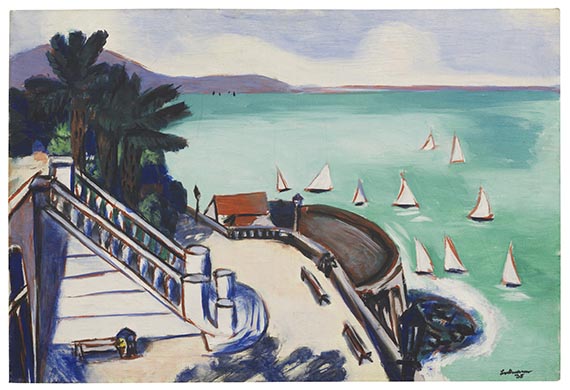
Blick von der Terrasse in Monte Carlo, 1935.
Oil on canvas
Estimate:
€ 600,000 - 800,000
$ 672,000 - 896,000
Information on buyer's premium, taxation and resale right compensation will be available four weeks before the auction.
126001076
Max Beckmann
Blick von der Terrasse in Monte Carlo, 1935.
Oil on canvas
Estimate:
€ 600,000 - 800,000
$ 672,000 - 896,000
Information on buyer's premium, taxation and resale right compensation will be available four weeks before the auction.
Max Beckmann
1884 - 1950
Blick von der Terrasse in Monte Carlo. 1935.
Oil on canvas.
Signed and dated in the lower right. 65 x 95.5 cm (25.5 x 37.5 in).
According to Göpel, Beckmann painted this work in Berlin from memory, as there is no evidence that the artist stayed on the French Riviera in either 1934 or 1935. The work is mentioned on the MB List, the artist’s handwritten list, with the title: “View from the Terrace in Monte” for 1934. However, as indicated by the date, the painting was not completed before the following year. [JS]
Additional works from the Kropatscheck Collection are offered in our Day Sale on Saturday, December 5, 2026; in our Rare Books auction on Monday, November 23, 2026; and in our Online Sale from January 15 through February 15, 2027.
• LONGING Beckmann’s dream of a free and carefree life.
• BEST ERA Created in Berlin at the same time as the first triptych “Departure” (MoMA, New York).
• INNER EXILE Dismissed from his teaching post in 1933, Beckmann lived a reclusive life in Berlin until his emigration to Amsterdam in 1937.
• EXHIBITIONS Most recently featured in “Max Beckmann: Die Landschaften” at the Kunstmuseum Basel in 2011/12.
• EXCELLENT PROVENANCE Sold directly by the artist to his friend and publisher Reinhard Piper, Munich, in 1936.
PROVENANCE: From the artist’s studio (until 1936).
Reinhard Piper Collection, Munich (Beckmann’s friend and publisher, acquired directly from the artist in 1936, in the family collection until 2000, Sotheby's, London).
Fritz Eugen and Hannemarie Kropatscheck Collection, Hamburg (acquired from the above).
EXHIBITION: Max Beckmann: In Memoriam 1884–1950, Haus der Kunst, Munich; Charlottenburg Palace, Berlin; Stedelijk Museum, Amsterdam, June 8–August 5, 1951.
Bayerische Staatsgemäldesammlungen, Munich (on the stretcher with the label, on extended loan from the Piper family collection, 1970–1972).
Max Beckmann. Menschen am Meer, Bucerius Kunstforum, Hamburg, Nov. 9, 2003–Feb. 1, 2004, cat. no. 14, p. 50 (with illu. on p. 51)
Max Beckmann. Die Landschaften, Kunstmuseum Basel, September 4, 2011–January 22, 2012, cat. no. 43, p. 148 (with ill. on p. 149).
Kunsthalle Hamburg (permanent loan from the Kropatscheck Collection, 2020–2026).
LITERATURE: Anja Tiedemann, Kaldewei Cultural Foundation (ed.), Max Beckmann: Catalogue Raisonné of Paintings, Frankfurt am Main, Online CR no. MB-G 413 (with illu.), https://max-beckmann.org/mb/g/413 (accessed Oct. 10, 2026).
Barbara and Erhard Göpel, Max Beckmann. Catalog of Paintings, vol. 1, Bern 1976, catalog no. 413 (with illu. on plate 141).
Benno Reifenberg and Wilhelm Hausenstein, Max Beckmann, Munich 1949, CR no. 350 (listed here under the title “Südliche Landschaft (Riviera)”).
-
Reinhard Piper, Nachmittag. Erinnerungen eines Verlegers, Munich 1950, pp. 47–48.
Galerie Wolfgang Ketterer, Munich, Inventory Catalog, Nov. 1972, p. 1 (with illu.).
Klaus Gallwitz, Uwe Schneede, Stephan von Wiese (eds.), Max Beckmann, Briefe. 1925–1937, vol. II, Munich/Zurich 1994, p. 263.
Sotheby’s, London, German & Austrian Art Auction, Oct. 18, 2000, lot 243 (with illu.).
Barbara Strehle-Akhtar, Wunschträume. Max Beckmann and the Côte d’Azur, in: Exhibition catalog Max Beckmann. Menschen am Meer, Bucerius Kunstforum, Hamburg 2003, pp. 126–135.
- -
Further documentation:
Nicola Graef, Max Beckmann—A Traveler, TV feature, Arte 2022, https://www.youtube.com/watch?v=YC-E6fo3ZkM (accessed Oct. 5, 2026).
Christiane Zeiller, Max-Beckmann Archive, quoted from: Exhibition catalog Max Beckmann. Departure, Munich 2022, p. 151.
Between World Theater and Soulscape: Max Beckmann’s View of the Riviera
Max Beckmann’s artwork is legendary: To this day, his scenic compositions, the complex and often enigmatic allegories of human existence, which Beckmann recognized in all its absurdity and tragedy and experienced so intensely, exert a mysterious appeal. Since the 1920s, Beckmann repeatedly cast himself in the tragicomic role of the clown at the center of his captivating pictorial "World Theatre" and, increasingly - as in his “Self-Portrait with a Glass Ball” from 1936, one year before the painter was to leave Germany for good under increasing political pressure from the Nazis - as the pensive prophet looking anxiously toward the future of both himself and humanity. Beckmann was strong, both physically and in character, yet highly sensitive—a compelling combination that lends his painting its unmistakable expressiveness. Beckmann’s Riviera Landscapes, created from 1930 through the later years of his exile in Amsterdam (1937–1947), are equally emotionally intense.
Beckmann, professor at the Städelschule in Frankfurt since 1925 and honored with a first retrospective at the Kunsthalle Mannheim in 1928, was at the height of public recognition around 1930. In 1929, he rented an apartment with a large studio on Boulevard Brune in Paris, from where he traveled to Cap Martin for the first time in 1930. That year and the following, Beckmann painted his first views of the Côte d’Azur—a subject that remains one of his most famous motifs today and one that would decisively shape his work well into the second half of the 1940s. Drawing on his memories of this happy time, Beckmann—even after his exile in Amsterdam and shortly before his long-awaited flight to New York—painted the evening view of the illuminated “Promenade des Anglais in Nice” from a hotel balcony (1947, Museum Folkwang, Essen). The female figure, seen from behind, gazes wistfully at the sea and the lively scene on the illuminated, palm-lined boardwalk: a farewell image, a nostalgic reminder of earlier, carefree times, of the beauty, lightness, and freedom of Europe—which he had to leave behind once and for all with great courage. When Beckmann finally received the long-awaited exit permit for the United States on January 10, 1946—though it initially allowed only his works to leave the country, while he and his wife Quappi were not to follow until late summer 1947—he euphorically noted in his list of paintings: “The world begins anew for me where it ended in late fall 1932 in Frankfurt am Main. 14 years in exile and condemned / now free again—let’s see what happens next.” (quoted from: Exhibition catalog Max Beckmann. Departure, Munich 2022, p. 158).
A Symbol of Inner Emigration: “View from the Terrace in Monte Carlo” (1935) and the Dream of a Carefree Life
Max Beckmann had already mentioned this wide panorama, “View from the Terrace in Monte Carlo” (1935), in his list of paintings as early as 1934, marking it as a work in progress. Beckmann completed, signed, and dated this Southern French landscape a year later, also in Berlin, in 1935—the same year as Beckmann’s internationally renowned triptych “Departure” (1932–1935, Museum of Modern Art, New York). In the 2022 exhibition catalog titled “Departure,” Oliver Kase and Christiane Zeiller wrote: “To this day, no other work has been more instrumental to Beckmann’s fame in the U.S. than this triptych. No other work has shaped the reception of the painter—in the genuine interplay of myth and reality, the juxtaposition of scenarios of redemption and horror—as much as this painting. No other work elevates Beckmann's artistic-philosophical ideas of departure and the journey into transcendence so directly into a powerful pictorial vision […] as this painting does. The stages of its creation—Frankfurt and Berlin in 1932 and 1933— and finally the painting’s transfer to Amsterdam and its “departure” and reunion with the artist in New York become biographical cornerstones and fixed points in a life marked by retreat and artistic renewal, by exile and a new departure during the Nazi era.” (quoted from: Exhibition catalog Max Beckmann, Departure, Munich 2022, p. 33)
As early as February 1932, the Weimar Republic was in a deep crisis, and Adolf Hitler announced his official candidacy for the Reich presidential election in March. That same month, Beckmann wrote to his publisher and friend Reinhard Piper, owner of “View from the Terrace in Monte Carlo” (1935), from 1936: “Dear Mr. Piper, [….] I really enjoyed seeing you again and catching up. After all, we belong together in some way—that’s just how it is. I’m trying to get past the idle madness of the times by working as intensely as possible. – In the long run, all this political gangsterism becomes so ridiculously indifferent, and one feels most at home on the island of one’s soul. But it’s nice when, from time to time, one can wink at the other from one’s own private star. And hopefully we’ll do that more often. [...] Yours always, Beckmann.” (Max Beckmann, Briefe, 1925–1937, vol. II, Munich 1994, letter 582, p. 212) After Hitler’s rise to power and Beckmann’s dismissal as a professor at the Städelschule (1933), Beckmann wrote to Piper from Berlin in 1934: “Dear Mr. Piper, Thank you very much for your congratulations. It was very nice to hear from you again and reminded me of the old days. – The devil of painting still rages within me; indeed, he may even grow stronger with the passing years—especially now—and despite all that. […]” (Max Beckmann, Briefe, 1925–1937, vol. II, Munich 1994, letter 624, p. 241)
During his second time in Berlin (1933–1937), Beckmann—unlike around 1930 in Frankfurt, when he was still a successful artist whose works were in high demand and a well-paid academy professor—could no longer travel to the south of France, partly for financial reasons, but the feeling of the South, the vastness of the sea, and the boundless freedom of summer—which he had absorbed back then—lives on within Beckmann and burst out from his memory like a dream of a free and untroubled life, finding its way onto the canvas. In a creative blend of nostalgia, longing, and anger, Beckmann brought this profound, positive sentiment to light from his memory and, despite all the difficulties of his personal situation, rendered it visible in “View from the Terrace in Monte Carlo” (1935). Beckmann’s composition is based on a contemporary postcard motif of Monte Carlo, which the artist presumably had brought back from one of his earlier stays on the Côte d’Azur—and which suddenly recalled this memory in the gray city of Berlin. “View from the Terrace in Monte Carlo” (1935) becomes a fascinating metaphor for Beckmann’s inner exile during this phase of his life in Berlin. It is Beckmann’s deep longing for the lost lightheartedness of those bygone, glamorous, and utterly carefree summer days on the Côte d’Azur that he captured in “View from the Terrace in Monte Carlo” (1935)—two years before he would leave Germany for good, and just a few days before the opening of the “Degenerate Art” exhibition, which featured numerous Beckmann paintings confiscated from German museums. “[…] if you want to get to know the invisible, surrender yourself wholeheartedly to the visible,” Max Beckmann wrote in his famous letter to his New York gallerist Curt Valentin in December 1945. Unlike Kandinsky, Beckmann believed that abstraction was not the key; rather, a radical, intense immersion in the real world made it possible to capture the invisible and the transcendent in art.
Provenance – From the Collection of Publisher and Beckmann Expert Reinhard Piper
The fact that Max Beckmann sold or gave this painting to his longtime friend and publisher Reinhard Piper in 1936—one year after it was painted and one year before he went into exile in Amsterdam—is further evidence of the special significance that Beckmann himself must have attached to this particular landscape composition. For Piper was not only a close confidant of the artist but also a true expert on his work. As early as 1922, Piper Verlag published Beckmann’s famous portfolio of prints, “Der Jahrmarkt,” followed two years later by the important Max Beckmann monograph (1924), featuring contributions from the most prominent art historians and art critics of the time. And on February 29, 1932, Beckmann wrote to Piper from Frankfurt: “[…] I hope to create something soon and will definitely send you some prints. On March 5, Flechtheim will open an exhibition of my new paintings, and on May 1, Bing will do the same in Paris. It’s a shame—I would have liked to show them to you in my studio, since you are among the few people I enjoy showing my paintings to. – Well, maybe it’ll work out some other time. In any case, I hope to see you again soon, whether here or in Munich. […] Yours always, Beckmann.” (Max Beckmann, Briefe, 1925–1937, vol. II, Munich 1994, letter 585, p. 215)
Over the years of collaboration and friendship, the Munich-based publisher compiled one of the most extensive private collections of the artist’s prints and is therefore regarded—apparently not least by the artist himself—as a distinguished expert and patron of his work. In his 1950 memoirs, Piper gives an impressive account of how, during a visit to the studio, he discovered “View from the Terrace in Monte Carlo” (1935) among the new paintings alongside Beckmann’s magnum opus, the triptych “Departure” (1932–1935; Museum of Modern Art, New York), and acquired it for his Beckmann collection. In July 1936, Beckmann wrote a postcard to Piper from Berlin, referring to “View from the Terrace in Monte Carlo” (1935): “Dear Mr. Piper, I am currently working my way through Pantagruel for our purposes. I will write you in detail immediately. It’s a shame we missed your son, but I’m glad you’re enjoying the painting. Yours, B.” (Max Beckmann, Briefe, 1925–1937, vol. II, Munich 1994, letter 647, p. 263)
Just three years after Beckmann—who died of a heart attack while strolling through Central Park in New York, his long-awaited new home, in 1950—the famous publisher Reinhard Piper passed away in Munich in 1953. This Beckmann painting, “View from the Terrace in Monte Carlo” (1935), did not leave Piper’s estate until 1957, when it entered another private collection. Eventually, it moved into a Northern German private collection through a 2000 auction in London and is now offered in our Evening Sale. [JS]
On Max Beckmann's painting “Blick von der Terrasse in Monte Carlo” (1935) and the watercolor “Die Hunde werden größer” (1947) – by Dr. Christiane Zeiller, Max Beckmann Archive, Munich
The painting “Blick von der Terrasse in Monte Carlo” was created in Beckmann’s Berlin studio, yet it depicts a view of the Côte d’Azur—a fact we will discuss in more detail later. The painting shows the view from a terrace in Monte Carlo, with the so-called “Tir aux Pigeons”—a pigeon house that allowed spa and resort guests to pass the time by shooting pigeons—visible below. Beckmann and his second wife, Mathilde “Quappi,” had been visiting the French Riviera regularly since 1930, staying in Bandol, Menton, Cap Martin, and, of course, Monaco. Like many others, they were enchanted by the light, the mild climate, and the luxurious amenities that attracted visitors: elegant hotels and splendid casinos, beach promenades, and champagne bars—the setting the painter sought and where he found inspiration for his works.
At the same time, the political situation in Germany grew increasingly dire, and by the time Hitler was appointed Reich Chancellor in 1933, power having been seized by the National Socialists, the climate had become precarious for Beckmann as well; his dismissal from the Städelschule and his move to Berlin bear witness to this, as does the fact that, for financial reasons, he had already given up his “pied-à-terre” in Paris the previous year—a place he had maintained since 1929. Even before the propaganda “Degenerate Art” exhibition opened in Munich, the Beckmanns had already decided to leave Germany. (See Christiane Zeiller, Die Beckmanns in Berlin, 1933 bis 1937. Quellen aus dem Max-Beckmann-Archiv, in: Legende und Realität. Max Beckmann im Nationalsozialismus, Berlin 2025, pp. 31ff.
When Max Beckmann created this painting in 1935, he was also working on his first triptych, “Departure,” which contrasts the horror and violence depicted on the side panels with the departing boat on the peaceful, light-blue sea as an expression of hope. “Blick von der Terrasse in Monte Carlo” (View from the Terrace in Monte Carlo) was created precisely within this field of tension between anticipation and departure; it was not painted on site in the spirit of leisure, but in Beckmann’s Berlin studio based on a postcard. It is the first work in an entire series of Riviera paintings for which a postcard as a direct reference can be verified. At the same time, it marks the beginning of his “Landscapes of Longing,” many of which were created in exile and which were inspired by postcards from his beloved region on the Mediterranean. For the painter, they served as small escapes—windows into the cheerful, peaceful world of the Côte d’Azur, which he visited for the last time in 1939, just before the outbreak of war.
Just a few months after Beckmann’s first trip to the United States, he created the watercolor “Die Hunde werden größer.” Shortly after Christmas 1947, Max Beckmann revisited some watercolors he had believed were finished, “corrected” them, and completed “The Dogs Are Getting Bigger,” which he had begun a month earlier (diary entry from December 27, 1947). Both the title and the depiction remain enigmatic; the work shows a screaming female figure at the center who is attacked by a huge dog baring its teeth. Behind her, at the right edge of the picture, a second large dog raises its head, mouth open. In the background, other people can be seen reacting in very different ways to the immediate threat, yet they do not intervene. The depiction is clearly marked by sexual allusions: the screaming woman’s exposed breast and the dogs, with their masculine connotations, driven by “animalistic” instincts. The title may thus also allude to the painter himself, who frequently used an “X” in his diary entries as a code for various types of sexual experiences.
The diaries also reveal that a dog lived in the building where the Beckmanns resided in St. Louis; it was often left alone and terrorized the couple with its incessant howling. It is possible that such a circumstance inspired Beckmann to create this watercolor—not least because the presence of this dog must have reminded him of his own beloved Pekingese, Butchy, who had to stay with acquaintances in Amsterdam during the couple’s first trip to the U.S. and was only allowed to accompany them to their new home the following year.
When he painted this watercolor, Max Beckmann had already been living in the United States for three months. His first impressions upon arriving in New York and his walks through downtown St. Louis had evidently already influenced the color palette of his works: it was increasingly characterized by bright “pop” colors, similar to those typical of the new Technicolor films, which Max Beckmann—a passionate moviegoer—watched in large numbers in the New World. What is unusual is that a variant of this watercolor was created almost simultaneously, the whereabouts of which are unknown (see MB-A/P 134a).
The watercolor “Die Hunde werden größer” (1947) by Max Beckmann is also offered in our Evening Sale on Friday, December 4, 2026.On Max Beckmann's painting “Blick von der Terrasse in Monte Carlo” (1935) and the watercolor “Die Hunde werden größer” (1947) – by Dr. Christiane Zeiller, Max Beckmann Archive, Munich
The painting “Blick von der Terrasse in Monte Carlo” was created in Beckmann’s Berlin studio, yet it depicts a view of the Côte d’Azur—a fact we will discuss in more detail later. The painting shows the view from a terrace in Monte Carlo, with the so-called “Tir aux Pigeons”—a pigeon house that allowed spa and resort guests to pass the time by shooting pigeons—visible below. Beckmann and his second wife, Mathilde “Quappi,” had been visiting the French Riviera regularly since 1930, staying in Bandol, Menton, Cap Martin, and, of course, Monaco. Like many others, they were enchanted by the light, the mild climate, and the luxurious amenities that attracted visitors: elegant hotels and splendid casinos, beach promenades, and champagne bars—the setting the painter sought and where he found inspiration for his works.
At the same time, the political situation in Germany grew increasingly dire, and by the time Hitler was appointed Reich Chancellor in 1933, power having been seized by the National Socialists, the climate had become precarious for Beckmann as well; his dismissal from the Städelschule and his move to Berlin bear witness to this, as does the fact that, for financial reasons, he had already given up his “pied-à-terre” in Paris the previous year—a place he had maintained since 1929. Even before the propaganda “Degenerate Art” exhibition opened in Munich, the Beckmanns had already decided to leave Germany. (See Christiane Zeiller, Die Beckmanns in Berlin, 1933 bis 1937. Quellen aus dem Max-Beckmann-Archiv, in: Legende und Realität. Max Beckmann im Nationalsozialismus, Berlin 2025, pp. 31ff.
When Max Beckmann created this painting in 1935, he was also working on his first triptych, “Departure,” which contrasts the horror and violence depicted on the side panels with the departing boat on the peaceful, light-blue sea as an expression of hope. “Blick von der Terrasse in Monte Carlo” (View from the Terrace in Monte Carlo) was created precisely within this field of tension between anticipation and departure; it was not painted on site in the spirit of leisure, but in Beckmann’s Berlin studio based on a postcard. It is the first work in an entire series of Riviera paintings for which a postcard as a direct reference can be verified. At the same time, it marks the beginning of his “Landscapes of Longing,” many of which were created in exile and which were inspired by postcards from his beloved region on the Mediterranean. For the painter, they served as small escapes—windows into the cheerful, peaceful world of the Côte d’Azur, which he visited for the last time in 1939, just before the outbreak of war.
Just a few months after Beckmann’s first trip to the United States, he created the watercolor “Die Hunde werden größer.” Shortly after Christmas 1947, Max Beckmann revisited some watercolors he had believed were finished, “corrected” them, and completed “The Dogs Are Getting Bigger,” which he had begun a month earlier (diary entry from December 27, 1947). Both the title and the depiction remain enigmatic; the work shows a screaming female figure at the center who is attacked by a huge dog baring its teeth. Behind her, at the right edge of the picture, a second large dog raises its head, mouth open. In the background, other people can be seen reacting in very different ways to the immediate threat, yet they do not intervene. The depiction is clearly marked by sexual allusions: the screaming woman’s exposed breast and the dogs, with their masculine connotations, driven by “animalistic” instincts. The title may thus also allude to the painter himself, who frequently used an “X” in his diary entries as a code for various types of sexual experiences.
The diaries also reveal that a dog lived in the building where the Beckmanns resided in St. Louis; it was often left alone and terrorized the couple with its incessant howling. It is possible that such a circumstance inspired Beckmann to create this watercolor—not least because the presence of this dog must have reminded him of his own beloved Pekingese, Butchy, who had to stay with acquaintances in Amsterdam during the couple’s first trip to the U.S. and was only allowed to accompany them to their new home the following year.
When he painted this watercolor, Max Beckmann had already been living in the United States for three months. His first impressions upon arriving in New York and his walks through downtown St. Louis had evidently already influenced the color palette of his works: it was increasingly characterized by bright “pop” colors, similar to those typical of the new Technicolor films, which Max Beckmann—a passionate moviegoer—watched in large numbers in the New World. What is unusual is that a variant of this watercolor was created almost simultaneously, the whereabouts of which are unknown (see MB-A/P 134a).
The watercolor “Die Hunde werden größer” (1947) by Max Beckmann is also offered in our Evening Sale on Friday, December 4, 2026.

Headquarters
Joseph-Wild-Str. 18
81829 Munich
Phone: +49 89 55 244-0
Fax: +49 89 55 244-177
info@kettererkunst.de
Louisa von Saucken / Undine Schleifer
Holstenwall 5
20355 Hamburg
Phone: +49 40 37 49 61-0
Fax: +49 40 37 49 61-66
infohamburg@kettererkunst.de
Dr. Simone Wiechers / Nane Schlage
Fasanenstr. 70
10719 Berlin
Phone: +49 30 88 67 53-63
Fax: +49 30 88 67 56-43
infoberlin@kettererkunst.de
Cordula Lichtenberg
Gertrudenstraße 24-28
50667 Cologne
Phone: +49 221 510 908-15
infokoeln@kettererkunst.de
Hessen
Rhineland-Palatinate
Miriam Heß
Phone: +49 62 21 58 80-038
Fax: +49 62 21 58 80-595
infoheidelberg@kettererkunst.de
We will inform you in time.