


Sale: 612 / Evening Sale, Dec. 04. 2026 in Munich → Lot 126001131
Frame image
126001131
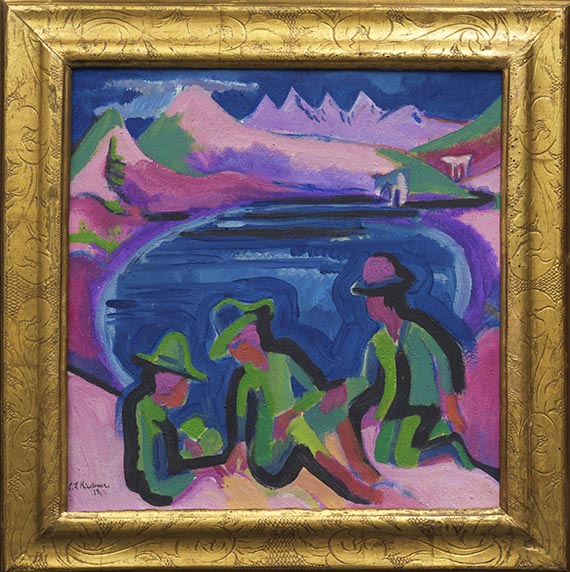
Ernst Ludwig Kirchner
Am Bergsee, 1919.
Oil on canvas
Estimate:
€ 150,000 - 200,000
$ 174,000 - 232,000
Information on buyer's premium, taxation and resale right compensation will be available four weeks before the auction.
126001131
Ernst Ludwig Kirchner
Am Bergsee, 1919.
Oil on canvas
Estimate:
€ 150,000 - 200,000
$ 174,000 - 232,000
Information on buyer's premium, taxation and resale right compensation will be available four weeks before the auction.
Ernst Ludwig Kirchner
1880 - 1938
Am Bergsee. 1919.
Oil on canvas.
Signed and dated in the lower left. Titled “Bergsee” on the reverse of the canvas. 49.7 x 50 cm (19.5 x 19.6 in).
In the original frame that was presumably selected by Dr. Frédéric Bauer in consultation with Kirchner. A photograph of the painting in the frame, which was shot by the artist, is on display at the Kirchner Museum in Davos. [CH].
• MODERN With broad brushstrokes, highly simplified forms, and vibrant, rich colors, Kirchner created a scene of great expressiveness and radically modern aesthetics.
• INSPIRATION The idyllic Swiss mountain landscape served as a major source of inspiration for Kirchner during these years.
• PROVENANCE Part of a German private collection for 70 years; prior to that, it had long been owned by Dr. Frédéric Bauer of Davos, Kirchner’s physician, patron, and close confidant.
• EXHIBITION Shown as part of a retrospective traveling exhibition in 1952, including stops at the Haus der Kunst in Munich and the Haus am Waldsee in Berlin.
This work is documented in the Ernst Ludwig Kirchner Archive in Wichtrach, Bern.
PROVENANCE: Collection of Dr. Frédéric Bauer (1883–1957), Davos.
Collection of Prof. Dr. Horst Ludwig Wullstein, Würzburg (acquired in 1957).
In the family’s possession ever since.
EXHIBITION: Ernst Ludwig Kirchner, Kunstverein Winterthur, June 22–July 13, 1924.
Ernst Ludwig Kirchner. Gemälde und Graphik der Sammlung F. Bauer, Davos (traveling exhibition), Haus der Kunst, Munich, Oct. 25–Dec. 14, 1952; Haus am Waldsee, Berlin, June 19–Aug. 19, 1953; Kunsthalle Nürnberg Fränkische Galerie, Nuremberg, etc., cat. no. 20 (titled “Bergsee bei Davos”).
LITERATURE: Donald E. Gordon, Ernst Ludwig Kirchner, Munich 1968, p. 356, CR no. 562 (with black-and-white illustration).
- -
Harry Joelson, Das ungewohnte Neue: Briefwechsel zwischen Ernst Ludwig Kirchner und Georg Reinhart, Zurich 2002, no. 54 (see no. 6 “Wallensee” and footnote I).
Refuge and a New Beginning: E. L. Kirchner in Switzerland
World War I marked a radical turning point for Ernst Ludwig Kirchner, just as it did for all of Europe. Military service and the fear of being sent to the front took a severe toll on his mental health. Beginning in 1916, he sought treatment at various sanatoriums. In 1917, he traveled to Switzerland to undergo therapy with Dr. Frédéric Bauer, among others, the chief physician at the Davos Park Sanatorium.
Dr. Frédéric Bauer later acquired his first painting by E. L. Kirchner and, in the years that followed, compiled one of the largest private collections of his works, totaling nearly 400 pieces, including 29 paintings—one of which is the work offered here.
Davos: “A Rich Field for My Work”
In 1919, Kirchner lived in Davos-Frauenkirch in the house “In den Lärchen” (In the Larch Trees) and enjoyed a simple life, far away from the hustle and bustle of the big city. Sources of inspiration included, for example, the hard-working lives of farming families and the impressive Alpine landscape. In a letter from that time, he stated with conviction: “I have a rich field for my work here […]. This little patch of earth is inexhaustible.” (Letters to Helene Spengler, July 3 and August 25, 1919)
Light Blue, Violet-Blue, Pink: “Colors As Fresh As Can Be”
In midsummer, the artist headed up to the so-called “Stafelalp”. From August 1919, Kirchner spent several weeks up on the mountain pasture with the farmers and their animals: “Just work, work, and think of nothing else—colors so fresh […]” (E. L. Kirchner, August 4, 1919, quoted from: Lothar Grisebach, *Davoser Tagebuch*, Ostfildern 1997, p. 41).
He observed the farmers’ daily routines and the animals’ ascent to the alpine pastures, capturing the mountainous landscape with its unique play of light. His focus was particularly on developing distinctive forms and the effective use of color contrasts: “Lots of ideas […]. Painting in violet tempts me immensely right now. […] A wonderful walk in the afternoon almost all the way to the Kummeralp. [...] Colors: light blue, violet-blue, pink […].” (July 11 and July 22, 1919, quoted from: ibid., pp. 31 and 36)
“The Paintings Become Ecstatic” – The Dawn of a New Creative Period
With this painting, Kirchner created a particularly expressive composition in which a greater degree of abstraction prevails. He distributes color in larger areas across the canvas, leaving little room for minute details; his forms become geometrically simplified, and the landscape is transformed into a cohesive, stage-like scene. “And it seems to be working out again,” Kirchner noted delightedly, “the paintings are filled with ecstasy.” (July 16, 1919, quoted from: ibid., p. 34)
In the seclusion of the Swiss mountains, Kirchner could put his mental torment behind him—at least for a short time—and devote himself entirely to his art. He was still struggling, but, after a long and arduous journey, the struggle finally seemed a little easier here: “Life is difficult. But up here, the mountains are magnificent and beautiful.” (E. L. Kirchner, Aug. 7, 1919, quoted from: ibid., p. 42) [CH]

Headquarters
Joseph-Wild-Str. 18
81829 Munich
Phone: +49 89 55 244-0
Fax: +49 89 55 244-177
info@kettererkunst.de
Louisa von Saucken / Undine Schleifer
Holstenwall 5
20355 Hamburg
Phone: +49 40 37 49 61-0
Fax: +49 40 37 49 61-66
infohamburg@kettererkunst.de
Dr. Simone Wiechers / Nane Schlage
Fasanenstr. 70
10719 Berlin
Phone: +49 30 88 67 53-63
Fax: +49 30 88 67 56-43
infoberlin@kettererkunst.de
Cordula Lichtenberg
Gertrudenstraße 24-28
50667 Cologne
Phone: +49 221 510 908-15
infokoeln@kettererkunst.de
Hessen
Rhineland-Palatinate
Miriam Heß
Phone: +49 62 21 58 80-038
Fax: +49 62 21 58 80-595
infoheidelberg@kettererkunst.de
We will inform you in time.