


Sale: 612 / Evening Sale, Dec. 04. 2026 in Munich → Lot 126001135
Frame image
126001135
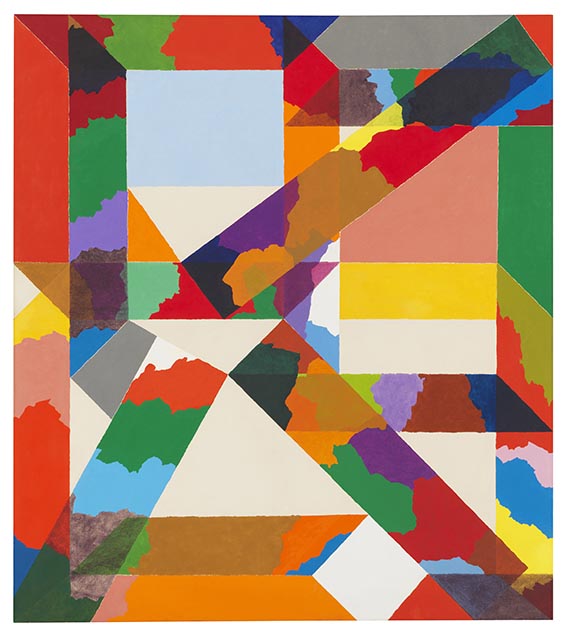
Piero Dorazio
Puzzle II, 1968.
Oil on canvas
Estimate:
€ 130,000 - 150,000
$ 150,800 - 174,000
Information on buyer's premium, taxation and resale right compensation will be available four weeks before the auction.
126001135
Piero Dorazio
Puzzle II, 1968.
Oil on canvas
Estimate:
€ 130,000 - 150,000
$ 150,800 - 174,000
Information on buyer's premium, taxation and resale right compensation will be available four weeks before the auction.
Piero Dorazio
1927 - 2005
Puzzle II. 1968.
Oil on canvas.
Signed, dated, and titled on the reverse of the canvas. 170 x 150 cm (66.9 x 59 in). [AW].
• PROTAGONIST Color in an expressive composition of space, light, and form.
• TURNING POINT A decisive transition from the dense “Reticoli” grids to open-plan Color Field Painting.
• PUZZLE Interlocking color fields create a fluid, almost architectural sense of depth and dynamism.
• SIGNIFICANT BERLIN PERIOD: A monumental work created as part of the DAAD Artists-in-Residence Program.
• MUSEUM QUALITY Another work from 1968 is in the Nationalgalerie Berlin.
PROVENANCE: The Owens-Corning Collection, Toledo, Ohio.
Private collection, Southern Germany (acquired from the above).
EXHIBITION: Piero Dorazio, Marlborough Galleria d’Arte, Rome, Nov./Dec. 1968 (with illustration; exhibition label on the reverse of the stretcher).
Piero Dorazio, Marlborough-Gerson Gallery, New York, Feb. 1969 (with illustration).
The Owens-Corning Fiberglass Corporation Art Collections, Toledo Museum of Art, Toledo, Ohio, March 13–April 10, 1977.
Piero Dorazio—A Retrospective, Albright Knox Gallery, Buffalo, New York, 1979–80, cat. no. 42 (with an exhibition label on the reverse of the stretcher).
LITERATURE: Marisa Volpi Orlandini, Jacques Lassaigne, and Giorgio Crisafi, Dorazio, Milan 1977 / Stuttgart 1978, CR no. 1060 (with illustration).
The 1968 painting “Puzzle II” marks a pivotal phase in Piero Dorazio’s “la nuova pittura”—a work that illustrates a programmatic shift in his oeuvre. Dorazio, who co-founded the pioneering group “Forma 1” in Rome in 1947 and championed autonomous, non-representational art early on, distanced himself from Italian Futurism after 1945 because of conflicting political views. Through a critical engagement with the history of painting since Impressionism, he explored new paths toward abstraction in European art. Following stays in the United States in the 1950s, during which he became acquainted with Abstract Expressionist artists and Marc Rothko’s Color Field Painting, he was appointed to a teaching post at the University of Pennsylvania in 1959 and exhibited at documenta in Kassel in both 1959 and 1964. As a bridge between European formal discipline and American color experiments, he played a key role on the international stage.
While Dorazio’s imagery remained defined by the “Reticoli”—net-like structures composed of fine colored stripes—until 1963, he gradually began to open up his pictorial spaces starting in 1963. The works from this period distinguish themselves from the reductive approaches of visual art studies and systemic painting, as well as from trends in media-based visual reflection. When he worked in West Berlin in 1968— on a DAAD fellowship at the age of 41—he entered “a particularly fruitful creative period” (Thomas Kempas, Peter Nestler, foreword to the exhibition at the Haus am Waldsee in 1969). In Berlin, the artist devised sophisticated systems consisting of parallel bands of color, curved wave motifs, and puzzle pieces reminiscent of inlays.
“Puzzle II” exemplifies this principle: Instead of dense grid structures, monochromatic color fields interlock like puzzle pieces. The chromatic segments overlap and intertwine to form rhythmic structures of increasing scale, creating a fluid, architectural spatial order. Through the deliberate juxtaposition of pure primary colors, the painting unfolds vibrant dynamics: Dorazio redefines the supremacy of color as a formative force and fulfills his maxim that color is a fundamental spatial and expressive value in painting (Dorazio, in: Exhibition catalog, Galerie im Erker 1966, no page).
In this sense, “Puzzle II” epitomizes the moment when a compact grid structure gives way to an open, rhythmic composition of color fields. The work underscores Piero Dorazio’s status as a defining innovator of European abstraction. [AW]

Headquarters
Joseph-Wild-Str. 18
81829 Munich
Phone: +49 89 55 244-0
Fax: +49 89 55 244-177
info@kettererkunst.de
Louisa von Saucken / Undine Schleifer
Holstenwall 5
20355 Hamburg
Phone: +49 40 37 49 61-0
Fax: +49 40 37 49 61-66
infohamburg@kettererkunst.de
Dr. Simone Wiechers / Nane Schlage
Fasanenstr. 70
10719 Berlin
Phone: +49 30 88 67 53-63
Fax: +49 30 88 67 56-43
infoberlin@kettererkunst.de
Cordula Lichtenberg
Gertrudenstraße 24-28
50667 Cologne
Phone: +49 221 510 908-15
infokoeln@kettererkunst.de
Hessen
Rhineland-Palatinate
Miriam Heß
Phone: +49 62 21 58 80-038
Fax: +49 62 21 58 80-595
infoheidelberg@kettererkunst.de
We will inform you in time.