


Sale: 612 / Evening Sale, Dec. 04. 2026 in Munich → Lot 126001148
Frame image
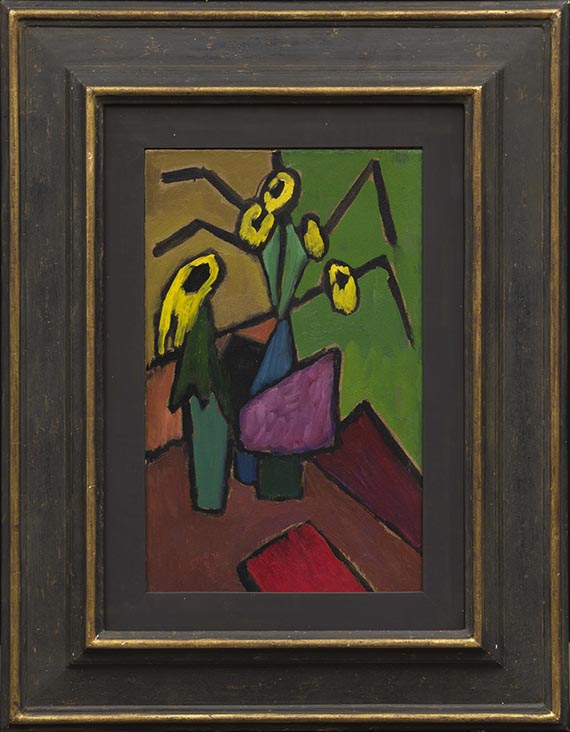
Raumbeispiel
126001148
Gabriele Münter
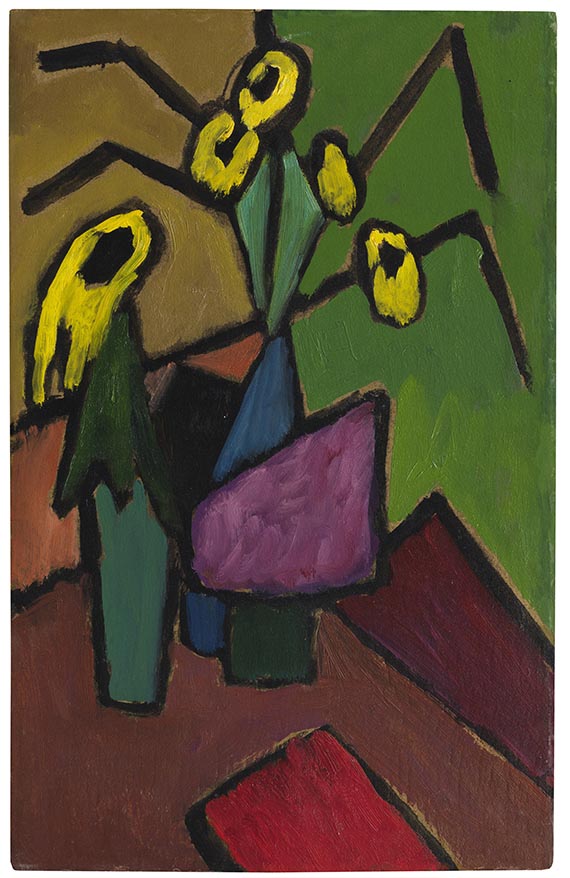
Stilleben mit Sonnenblumen, Um 1910.
Oil on cardboard
Estimate:
€ 120,000 - 180,000
$ 139,200 - 208,800
Information on buyer's premium, taxation and resale right compensation will be available four weeks before the auction.
126001148
Gabriele Münter
Stilleben mit Sonnenblumen, Um 1910.
Oil on cardboard
Estimate:
€ 120,000 - 180,000
$ 139,200 - 208,800
Information on buyer's premium, taxation and resale right compensation will be available four weeks before the auction.
Gabriele Münter
1877 - 1962
Stilleben mit Sonnenblumen. Um 1910.
Oil on cardboard.
With the estate stamp and an adhesive label with the estate number “B 293” (partly handwritten, partly stamped), as well as a label with the stamped number “833”. 41.1 x 26 cm (16.1 x 10.2 in). [AW].
• PROGRESSIVE Still life of exceptional cohesion, composition, and lines.
• SURFACE PAINTING A significant characteristic of the early Murnau works.
• IMPORTANT CREATIVE PHASE From 1909 to 1914, Münter spent inspiring and happy years with Kandinsky at the “Russenhaus” in Murnau.
• MUSEUM COLLECTIONS: Still lifes from the same year are at, among others, the Lenbachhaus in Munich and the Vatican Museums in Rome.
PROVENANCE: From the artist’s estate.
Galerie Gunzenhauser, Munich.
Private collection, North Rhine-Westphalia (acquired from the above in 1984).
In the family’s possession ever since.
Gabriele Münter’s creations from around 1910 are characterized by a fundamental stylistic renewal. Together with Wassily Kandinsky, she found a place in Murnau where her creativity could flourish. Impressions of her surroundings and intense exchanges within the circle of artists led to an increasingly independent conception of form and color. In 1909, Münter bought a house in Murnau that became known as the “Russenhaus” (Russian House) and gave the artist couple an important place to live and work. Their stable living situation and joint work fostered new means of expression. That same year, Münter and Kandinsky, along with Marianne von Werefkin and Alexej von Jawlensky, founded the “New Artists’ Association of Munich.” Between her stays in Murnau, Münter frequently worked in her Munich apartment, where she created numerous still lifes in 1910. Following tensions within the artists’ association, Münter, Kandinsky, Franz Marc, and other artists founded the “Blue Rider” in 1911. This marked an important, formative, and productive creative phase that lasted until the outbreak of war in 1914.
Against this backdrop, the “Still Life with Sunflowers” stands as a striking testament to Münter’s creative breakthrough. The painting, which can be dated to around 1910, impresses with its high degree of abstraction. In the highly stylized, almost geometric composition, the few still-life objects are barely recognizable. The highly abstracted sunflowers are reduced to their basic form and can be identified only on that basis. The flowers are arranged in two vases, which in turn consist solely of blocks of blue. They are set on a color field resembling a table, which, together with the background behind the arrangement, narrows to a point, thereby creating a unique spatial effect that oscillates between an implied and a dissolved space. The color fields stand side by side as equals and exert an immediate impact. In this still life, Münter not only plays with geometric planes but also with their contrasts. This impression is reinforced by the bold black outlines, which can certainly be understood as a reminiscence of her reverse-glass painting. With these contours, she creates a powerful composition characterized by great cohesion and heightened expression.
In this work, Gabriele Münter pursues her expressive style with particular consistency. The surfaces are strictly arranged, the contrasts sharpened, and the sunflowers reduced to their essence. The motif is not merely simplified but increasingly dematerialized. With a sure sense of form, color, and surface, the artist transforms a familiar subject into an independent, highly expressive visual composition. [AW]

Headquarters
Joseph-Wild-Str. 18
81829 Munich
Phone: +49 89 55 244-0
Fax: +49 89 55 244-177
info@kettererkunst.de
Louisa von Saucken / Undine Schleifer
Holstenwall 5
20355 Hamburg
Phone: +49 40 37 49 61-0
Fax: +49 40 37 49 61-66
infohamburg@kettererkunst.de
Dr. Simone Wiechers / Nane Schlage
Fasanenstr. 70
10719 Berlin
Phone: +49 30 88 67 53-63
Fax: +49 30 88 67 56-43
infoberlin@kettererkunst.de
Cordula Lichtenberg
Gertrudenstraße 24-28
50667 Cologne
Phone: +49 221 510 908-15
infokoeln@kettererkunst.de
Hessen
Rhineland-Palatinate
Miriam Heß
Phone: +49 62 21 58 80-038
Fax: +49 62 21 58 80-595
infoheidelberg@kettererkunst.de
We will inform you in time.