


Sale: 612 / Evening Sale, Dec. 04. 2026 in Munich → Lot 126001191
Raumbeispiel
126001191
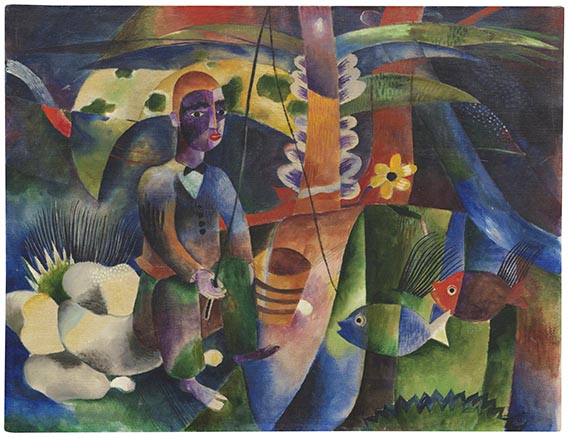
Heinrich Campendonk
Der Angler, 1920.
Oil on canvas
Estimate:
€ 500,000 - 700,000
$ 560,000 - 784,000
Information on buyer's premium, taxation and resale right compensation will be available four weeks before the auction.
126001191
Heinrich Campendonk
Der Angler, 1920.
Oil on canvas
Estimate:
€ 500,000 - 700,000
$ 560,000 - 784,000
Information on buyer's premium, taxation and resale right compensation will be available four weeks before the auction.
Heinrich Campendonk
1889 - 1957
Der Angler. 1920.
Oil on canvas.
Monogrammed “C” and dated in the lower right. 72 x 92 cm (28.3 x 36.2 in).
[JS].
• CREATIVE PERIOD Paintings from this period are among the artist’s most sought-after works.
• SOLITUDE From 1916 to 1921, Campendonk withdrew to the village of Seeshaupt on Lake Starnberg.
• ENIGMATIC Did Campendonk leave us a self-portrait in this harmonious depiction of humanity and nature?
• SIZE One of the largest Campendonk paintings ever offered on the international auction market.
• DOCUMENTED Mentioned in Campendonk literature in 1921 and exhibited at Flechtheim and at the Kestner Society in Hanover in 1920 and 1921.
• MUSEUM QUALITY Paintings from this period can be found at, among other places, the Städtische Galerie im Lenbachhaus, the Kunsthalle Basel, and the Stedelijk Museum in Amsterdam.
We are grateful to Gisela Geiger, Penzberg, and Thomas Lensch, Augsburg, for their kind expert advice.
PROVENANCE: Zingler’s Kabinett, Frankfurt am Main (directly from the artist; with a label on the reverse; on display in Hanover until at least 1921).
Private collection, Germany/South America (acquired in the early 1930s; in the family through inheritance until 2000, Grisebach).
Swiss art trade Switzerland (acquired from the above)
Galerie Thomas, Munich (from the above; with a label on the back of the frame)
Eva Mollet-Jäggli, Bottmingen, Switzerland
Private collection, Switzerland (inherited from the above).
EXHIBITION: Galerie Flechtheim Düsseldorf, Heinrich Campendonk. From Pentecost through June 12, 1920, cat. no. 51.
Heinrich Campendonk – Carl Hofer. Paintings, 42nd Special Exhibition of the Kestner Society, Hanover, April 20–May 18, 1921, cat. no. 18.
LITERATURE: Andrea Firmenich, Heinrich Campendonk 1889–1957. Leben und expressionistisches Werk, with a catalog of his paintings, Recklinghausen 1989, CR no. 791 (with b&w ill., listed here under 1919) and CR no. 820 (without ill.).
-
Georg Biermann, “Heinrich Campendonk,” in: Junge Kunst, vol. 17, Leipzig 1921 (with black-and-white illustration, erroneously listed here with the year “1919”).
Grisebach, Berlin, Auction 79, Selected Works, May 26, 2000, lot 39 (with color illustration).
“I arrived in Munich at seven in the morning and met up with [Helmuth] Macke an hour later. In the afternoon, we visited Kandinsky, where we saw some magnificent works […]. On Monday we were at Salon Thannhauser and the Pinakothek [..]. In the evening we drove to Penzberg with Macke’s cousin [August], where Mr. [Franz] Marc picked us up in his car, and we trotted on to Sindelsdorf.”
Heinrich Campendok, October 7, 1911, letter to Adda Deichmann
Heinrich Campendonk—The Young Talent of the “Blue Rider”
In October 1911, 21-year-old Heinrich Campendonk—who would soon join the ranks of the young talents associated with the “Blue Rider”—traveled to Munich at Franz Marc's invitation. Together with Helmuth Macke, he met the group's central driving forces for the first time: Wassily Kandinsky, Kandinsky’s partner Gabriele Münter, and August Macke. On the balcony of Kandinsky’s city apartment, the artists posed for a now-famous group picture before Campendonk went to the idyllic village of Sindelsdorf, where, at the time, Franz and Maria Marc, as well as August, Elisabeth, and Helmuth Macke, lived. Campendonk shared accommodation and a studio with Helmuth Macke, with whom he had previously studied at the Krefeld School of Applied Arts. Kandinsky and Münter lived just a few kilometers away in Murnau. Campendonk eventually took part in the first two “Blue Rider” exhibitions in 1911 and 1912 and became a member of this progressive artists’ group in 1912, which had separated from the New Munich Artists’ Association a year earlier. The outbreak of World War I, however, divided the members of the “Blue Rider”; some, such as Franz Marc and August and Helmuth Macke, were soon swept up in the early euphoria surrounding the war and volunteered. Like many other artists and intellectuals, they initially hoped the war would have a purifying or even healing effect on “a sick Europe” . Others, such as the Russian Kandinsky, were forced to leave Germany. Campendonk, on the other hand, refused military service and was discharged on medical grounds shortly after his draft in the spring of 1915; he returned to Sindelsdorf to be with his wife Ada and Maria Marc, who lived in the immediate neighborhood. Franz Marc’s initial enthusiasm, too, soon gave way to growing concern and fear. When he received a postcard with his famous “Animal Destinies” (1913, Kunstmuseum Basel), he wrote to his wife Maria on March 17, 1915: “At the sight of this, I was completely shaken and moved. It was a premonition of this war, gruesome and poignant; I can hardly imagine that I painted that!” (Susanna Partsch: Marc, p. 76; in: Klaus Lankheit and Uwe Steffen (eds.): Franz Marc: Briefe aus dem Feld. Munich 1986, p. 50). Eventually selected for the roster of Germany’s most prominent artists in 1916 and exempted from military service, Franz Marc should nevertheless lose his life not far from Verdun on his final day of combat in March 1916. Campendonk was deeply shaken by the news of his friend and artistic colleague’s death; he subsequently left Sindelsdorf and moved with Ada to a farmhouse in Seeshaupt on Lake Starnberg, where he lived a very secluded life and tried to suppress the horrors of the war.
From Sindelsdorf to Seeshaupt—Creative Energy in Solitude and the Trauma of World War I
In Seeshaupt on Lake Starnberg, Campendonk decisively broke with the “Blue Rider” style and found a poetic, ethereal imagery that carried him into radiant, almost transcendent realms of color and light. The unity of man and nature, rendered in a paradisiacal manner, is the central subject of these paintings. Yet the lack of connection and isolation among the figures in these compositions—created in Seeshaupt between 1916 and 1921—constantly conveys an invisible, latent threat, dramatically intensified by the use of dark colors, thereby indirectly continuing to address the horrors of war. The striking composition “The Angler” demonstrates, both in terms of technique and style, Campendonk’s shared artistic influence with Franz Marc, while also reflecting his intense engagement with the work of his French contemporaries—from Marc Chagall and Robert Delaunay to Henri Rousseau, who was a generation his senior—and, like “Shepherdess with Cows” (Städtische Galerie im Lenbachhaus, Munich) and “Interior” (1919, Kunsthalle Basel)—among the major works of this important creative phase, during which Campendonk led an extremely reclusive, even isolated life in nature. Campendonk expert Gisela Geiger states: “The ecstatic creative process demanded a place outside the world that took isolation to the extreme: the studio. Despite the large house in Seeshaupt and his much-lamented financial straits, Campendonk rented a separate studio where the ecstatic creative process could develop undisturbed [...]” (G. Geiger, in: Heinrich Campendonk, Penzberg 2007, p. 63). Parallels in content and composition are also evident, among other works, in the 1917 self-portrait “The Painter in the Countryside", today at the Von der Heydt Museum in Wuppertal, which likewise places the solitary artist or protagonist in relation to a stylized nature. Did Campendonk perhaps also capture his own complex emotional state during those years at Lake Starnberg in this Expressionist self-portrait with its enigmatic, dreamlike quality—a painting listed in the literature under the title “The Angler”? Even though the biographical references in this outstanding composition are unmistakable, this will certainly remain a mystery for the future. [JS]

Headquarters
Joseph-Wild-Str. 18
81829 Munich
Phone: +49 89 55 244-0
Fax: +49 89 55 244-177
info@kettererkunst.de
Louisa von Saucken / Undine Schleifer
Holstenwall 5
20355 Hamburg
Phone: +49 40 37 49 61-0
Fax: +49 40 37 49 61-66
infohamburg@kettererkunst.de
Dr. Simone Wiechers / Nane Schlage
Fasanenstr. 70
10719 Berlin
Phone: +49 30 88 67 53-63
Fax: +49 30 88 67 56-43
infoberlin@kettererkunst.de
Cordula Lichtenberg
Gertrudenstraße 24-28
50667 Cologne
Phone: +49 221 510 908-15
infokoeln@kettererkunst.de
Hessen
Rhineland-Palatinate
Miriam Heß
Phone: +49 62 21 58 80-038
Fax: +49 62 21 58 80-595
infoheidelberg@kettererkunst.de
We will inform you in time.