


Video
Frame image
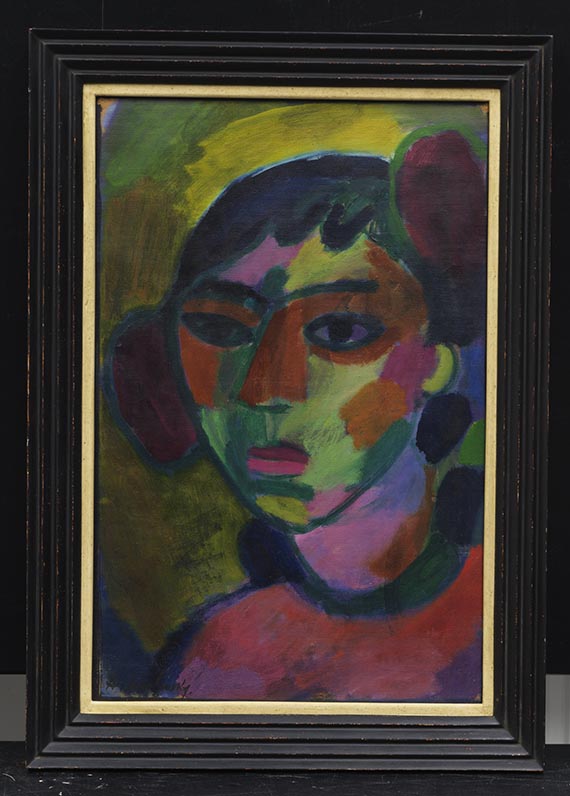
27
Alexej von Jawlensky
Portrait, Um 1916.
Oil on linen-structured paper
Estimate:
€ 400,000 / $ 464,000 Sold:
€ 516,000 / $ 598,560 (incl. surcharge)
27
Alexej von Jawlensky
Portrait, Um 1916.
Oil on linen-structured paper
Estimate:
€ 400,000 / $ 464,000 Sold:
€ 516,000 / $ 598,560 (incl. surcharge)
Alexej von Jawlensky
1864 - 1941
Portrait. Um 1916.
Oil on linen-structured paper.
Signed in the lower left. Dated by Lisa Kümmel on the reverse and inscribed "No. 8" by a hand other than that of the artist. 51.7 x 33.9 cm (20.3 x 13.3 in).
Up until July 20, 2026, the Norton Simon Museum in Pasadena hosts the Jawlensky exhibition “Dear Little Friend: Impressions of Galka Scheyer”, which puts focus on Jawlensky's "heads" from after 1915. [CH].
• Expressive and in vibrant colors: a spectacular culmination of the Expressionist heads from the pre-war years.
• A vivid testament to a pivotal point in Jawlensky's oeuvre.
• Bold contrasts culminate in an intense color rush.
• The inscrutable gaze of the figures and the clouds of color surrounding them create an enigmatic, fascinating visual effect.
• Significant provenance: owned by Jawlensky’s close confidante Lisa Kümmel during his lifetime.
PROVENANCE: Lisa Kümmel Collection, Wiesbaden (acquired directly from the artist).
Karl-Heinz Kümmel Collection, Wiesbaden (inherited from the above in 1944).
Private collection, Switzerland/Northern Germany (acquired between 1994 and 1996).
Galerie Thomas, Munich (acquired in 2015).
Private collection, Southern Germany (acquired from the above).
EXHIBITION: Alexej von Jawlensky, Galerie Thomas, Munich 2015/2016 (illustrated on pp. 35 and 109).
Meisterwerke VIII, catalog 139, Galerie Thomas, Munich 2020/2021 (illustrated on pp. 17 and 19).
Figures 2021, catalog 141, Galerie Thomas, Munich 2021 (illustrated on pp. 19 and 21).
LITERATURE: Maria Jawlensky, Lucia Pieroni-Jawlensky, Angelica Jawlensky, Alexej Jawlensky. Catalogue Raisonné of the Oil Paintings, vol. II: 1914-1933, Munich 1992, p. 119, CR no. 751 (illustrated in color on p. 98).
1864 - 1941
Portrait. Um 1916.
Oil on linen-structured paper.
Signed in the lower left. Dated by Lisa Kümmel on the reverse and inscribed "No. 8" by a hand other than that of the artist. 51.7 x 33.9 cm (20.3 x 13.3 in).
Up until July 20, 2026, the Norton Simon Museum in Pasadena hosts the Jawlensky exhibition “Dear Little Friend: Impressions of Galka Scheyer”, which puts focus on Jawlensky's "heads" from after 1915. [CH].
• Expressive and in vibrant colors: a spectacular culmination of the Expressionist heads from the pre-war years.
• A vivid testament to a pivotal point in Jawlensky's oeuvre.
• Bold contrasts culminate in an intense color rush.
• The inscrutable gaze of the figures and the clouds of color surrounding them create an enigmatic, fascinating visual effect.
• Significant provenance: owned by Jawlensky’s close confidante Lisa Kümmel during his lifetime.
PROVENANCE: Lisa Kümmel Collection, Wiesbaden (acquired directly from the artist).
Karl-Heinz Kümmel Collection, Wiesbaden (inherited from the above in 1944).
Private collection, Switzerland/Northern Germany (acquired between 1994 and 1996).
Galerie Thomas, Munich (acquired in 2015).
Private collection, Southern Germany (acquired from the above).
EXHIBITION: Alexej von Jawlensky, Galerie Thomas, Munich 2015/2016 (illustrated on pp. 35 and 109).
Meisterwerke VIII, catalog 139, Galerie Thomas, Munich 2020/2021 (illustrated on pp. 17 and 19).
Figures 2021, catalog 141, Galerie Thomas, Munich 2021 (illustrated on pp. 19 and 21).
LITERATURE: Maria Jawlensky, Lucia Pieroni-Jawlensky, Angelica Jawlensky, Alexej Jawlensky. Catalogue Raisonné of the Oil Paintings, vol. II: 1914-1933, Munich 1992, p. 119, CR no. 751 (illustrated in color on p. 98).
The Dawn of the Modern Era
After the turn of the century, and shortly before the outbreak of World War I, the European avant-garde set out in search of entirely new forms of artistic expression. Influenced by Vincent van Gogh and the French pioneers of Modernism, including Henri Matisse and Paul Cézanne, artists began to explore radically new approaches. Jawlensky had already become acquainted with the painting of Matisse and Gauguin during a trip to France in 1906. The works of these French role models exerted a decisive influence on his painting and that of his fellow artists, particularly through a more powerful use of color and a compositional approach that combined multiple color fields. At the same time, the “Brücke” artists' group was founded in Dresden, and in Berlin, the “Neue Secession” was established in 1910–11, soon followed by the “Freie Secession.” In Munich, following joint painting retreats in Murnau with Wassily Kandinsky, Gabriele Münter, and Marianne von Werefkin, Jawlensky was among the founding members of the “Neue Künstlervereinigung München” in 1909. In the same year, Galerie Thannhauser presented the group’s legendary first exhibition. Due to their highly progressive style—already strikingly liberal and far removed from natural models—and their bold use of color, the works on display were met with harsh criticism in the press. The “Münchener Neueste Nachrichten” described the paintings as “coloristic orgies” and perceived the artistic detachment from nature as a detachment from “truthfulness and all sound craftsmanship” (Fritz von Ostini, Dec. 9, 1909, cited in: Annegret Hoberg / Helmut Friedel, Der Blaue Reiter und das Neue Bild, Munich/London/New York 1999, p. 33). After internal disputes with the moderate members, Wassily Kandinsky, Franz Marc, and Gabriele Münter left the group in 1911 and founded the “Blue Rider.” Jawlensky’s works were exhibited alongside those of fellow “Blue Rider” artists, although he never officially joined the group until its dissolution in the summer of 1914.
Artistic refinement
In the years that followed, Jawlensky pursued his own progressive artistic path, breaking free from the conventions of the time. His painting now focused in particular on the motif of the human head. Around 1911–12, he created his powerful, expressive portraits—or “colorful heads”—in the typical square format, as well as the “Self-Portrait” from 1912 (Museum Wiesbaden).
When World War I broke out in 1914, Jawlensky was expelled from Germany as an enemy alien. Together with his family and Marianne von Werefkin, he moved to Saint-Prex, a small town on Lake Geneva, and ultimately lived in Switzerland until 1921. The once-close ties to his circle of friends and fellow artists in Munich had been cut off. This upheaval marked a decisive turning point not only in his personal life but also in his art. Jawlensky wrote in his memoirs: “My soul had been transformed by much suffering, and this called for me to find new forms and colors to express the things that moved my soul.” (A. v. Jawlensky, Memoirs, quoted in: C. Weiler, Alexej Jawlensky, Hanau 1970, p. 116) From 1915 onward, he returned to painting the heads of young women and also created his equally well-known “Variations,” as well as occasional still lifes—a fact beautifully reflected in the colorful sketch on the reverse of our work, which depicts a still life with fruits and flowers. Jawlensky’s primary focus, however, remained on the motif of the female head.
He increasingly abandoned individualized portraits, instead employing standardized physiognomies as if from a “modular system”—darkly contoured faces with almond-shaped eyes, lined mouths, and clearly defined nasal bridges and brows rendered with simple lines. This allowed Jawlensky to create simplified, stylized, yet highly expressive heads. In his quest for artistic experimentation, he develops a visual language all his own and, at the same time, a method of serial production that essentially anticipates the later artistic endeavors of Josef Albers and Andy Warhol. He is no longer concerned with representational accuracy, but rather with de-individualization through simple, recurring forms and an expression of spiritual-emotional sensibility—enhanced by the bold color palette—leading toward an expressive color entirely liberated from any reference to reality. In the present “Portrait,” the artist bathes the flesh tones of the female head in iridescent green and bold pink, while the bridge of the nose and the eye area appear in warm terracotta, applying the paint onto the unprimed canvas in bold, daring strokes. This expressive play of colors is framed by the deep black of the hair and various light yellow-green areas that embrace the face like a ray of light.
From the portrait to the stylized “mood head” created from color
Our “Portrait” marks a pivotal point in Jawlensky’s career, as it captures the transition from the powerful female heads of the pre-war years to the “Mystical Heads” of 1917 and beyond—a series he continued to develop after moving to Zurich, alongside his “Saviors’ Faces” and, shortly thereafter, his “Abstract Heads.” The hair ornament alone alludes to some of the artist’s earlier works, such as the series of “Spanish Women” created around 1911 (e.g., Städtische Galerie im Lenbachhaus, Munich), “Egyptian Woman” (1913, Saint Louis Art Museum), “Russian Woman” (1911, Kunsthalle Bielefeld), or “Woman’s Head with Flowers in Her Hair” (circa 1913), for in the work shown here as well, the subject’s black hair—slightly wavy above the forehead—is adorned with two lush, circular blossoms. The connection to the female heads of the pre-war years is evident, particularly in works such as “Barbarian Princess” (Karl Ernst Osthaus Museum, Hagen), “Feather Hat” (Norton Simon Museum, The Galka Scheyer Collection, Pasadena), and “Spanish Woman” (1913, Lenbachhaus, Munich). Many of these female heads are no longer conceived as personal portraits, but rather as expressive, iconic representations that attest to Jawlensky’s attempt to move from the individual to the universal—to standardize the form of the heads, beginning around 1911. In this endeavor, Jawlensky has already made significant progress. Following his move to Switzerland, Jawlensky increasingly abandoned the portrait-like quality and individuality of his subjects, both of which were still clearly evident in his earlier works: contour lines and stylized physiognomies now merely form the framework for a completely free interplay of form and color, which emphasizes the inner mood of the subjects rather than any physical resemblance. A new, even more abstract variant of the head motif arose, which later, with precisely this same radicalism and progressiveness, culminated in the entirely “Abstract Heads” and ultimately in the “Meditations”, the most abstract works in the artist’s oeuvre. Through this stylization, the simplification of motifs, and formal reduction, the “Portrait” thus constitutes a defining key moment on Jawlensky’s programmatic path between figuration and abstraction—an intermediary space that continues to underpin the distinctiveness and extraordinary modernity of Jawlensky’s unique painting to this day.
A fascinating example of expressionist painting
In his finest works, Jawlensky always accomplished his goal through color. Vivid, rich, and expressive, it is also used here in deliberately placed yet free forms. These forms, set close together and combined with strong, defining lines, coalesce into an expressive face. Introspective, yet self-assured and determined, the serious yet deeply sensual gaze passes right past the viewer. Jawlensky demonstrates his incomparable, intuitive sense of tonality and dynamic composition. Colors and forms are rhythmically offset against one another. Through a sophisticated interplay of dissonance, harmony, and contrast, he juxtaposes light and dark color fields. Warm and cool tones are placed side by side directly. He combines a somber mood with a blaze of color. Diagonals, free forms, and strong contours add drama. A somber mood pairs with youthful hair adornments. The result is a dramaturgically sophisticated example of Expressionist painting, marked by great intensity and a mysterious aura that inevitably captivates the viewer. Jawlensky created a female face emancipated from its natural model. He used a variety of colors and reduced the form to simple elements. Perhaps this work is a unique link between the powerful, world-famous female heads of the pre-war years and the later series of the 'Mystical Heads'.
“An artist who is a very close friend of mine and [...] who also has a deep understanding of my art.”
The “Portrait” likely came into the possession of the Wiesbaden painter Lisa Kümmel (1898–1944) as a gift; she remained an extremely important confidante to Alexej von Jawlensky for many years. “In 1927, I met Lisa Kümmel, an artist with whom I have been very close friends ever since and who helped me organize my work; she also understands my art very well, from my earliest works to my latest, and loves it dearly.” (Alexej von Jawlensky, quoted from: Memoirs, in: Clemens Weiler (ed.), Alexej Jawlensky, Heads - Faces - Meditations, Hanau 1970, p. 120) Until his death in 1941, she handled all organizational matters related to his work. “I am his friend in the best sense of the word and have known him for 12 years; I handle all his business correspondence, and also his personal affairs, I take care of his paintings, and keep everything in order […].” (Lisa Kümmel in a letter to Ada and Emil Nolde, October 18, 1938, quote from: Helga Lukowsky, Jawlenskys Abendsonne. Der Maler und die Künstlerin Lisa Kümmel, Königstein i. Taunus 2000, p. 105)
From the late 1920s onward, Jawlensky suffered from chronic polyarthritis, which led to his complete paralysis in the final years of his life. Thus, in the late 1930s, Lisa Kümmel spent almost every evening at Jawlensky’s apartment on Beethovenstraße 9, cleaning his palette and brushes, putting away the “Meditations” he had created during the day, and mounting new canvases onto the easel. She organized, cataloged, categorized, and varnished or waxed the works in consultation with the artist, mounted them on cardboard, labeled and numbered them, and framed them for sale and exhibition. In 1936–37, Jawlensky dictated his memoirs to her and compiled the so-called studio inventory, a list of all works then present in the artist’s studio (revised by Clemens Weiler in the 1960s and published only in 1970).
In addition to the extraordinary care and support provided by his family—his wife Helene and son Andreas—Lisa Kümmel’s help and devotion to Jawlensky during these years was invaluable. As a token of gratitude, Jawlensky repeatedly gifted her some of his works over the years, including the “Portrait” offered here. After his death in 1941, Kümmel took charge of the estate, but survived Jawlensky by only a few years. She died in 1944 in an air raid on the city of Wiesbaden. [CH]
After the turn of the century, and shortly before the outbreak of World War I, the European avant-garde set out in search of entirely new forms of artistic expression. Influenced by Vincent van Gogh and the French pioneers of Modernism, including Henri Matisse and Paul Cézanne, artists began to explore radically new approaches. Jawlensky had already become acquainted with the painting of Matisse and Gauguin during a trip to France in 1906. The works of these French role models exerted a decisive influence on his painting and that of his fellow artists, particularly through a more powerful use of color and a compositional approach that combined multiple color fields. At the same time, the “Brücke” artists' group was founded in Dresden, and in Berlin, the “Neue Secession” was established in 1910–11, soon followed by the “Freie Secession.” In Munich, following joint painting retreats in Murnau with Wassily Kandinsky, Gabriele Münter, and Marianne von Werefkin, Jawlensky was among the founding members of the “Neue Künstlervereinigung München” in 1909. In the same year, Galerie Thannhauser presented the group’s legendary first exhibition. Due to their highly progressive style—already strikingly liberal and far removed from natural models—and their bold use of color, the works on display were met with harsh criticism in the press. The “Münchener Neueste Nachrichten” described the paintings as “coloristic orgies” and perceived the artistic detachment from nature as a detachment from “truthfulness and all sound craftsmanship” (Fritz von Ostini, Dec. 9, 1909, cited in: Annegret Hoberg / Helmut Friedel, Der Blaue Reiter und das Neue Bild, Munich/London/New York 1999, p. 33). After internal disputes with the moderate members, Wassily Kandinsky, Franz Marc, and Gabriele Münter left the group in 1911 and founded the “Blue Rider.” Jawlensky’s works were exhibited alongside those of fellow “Blue Rider” artists, although he never officially joined the group until its dissolution in the summer of 1914.
Artistic refinement
In the years that followed, Jawlensky pursued his own progressive artistic path, breaking free from the conventions of the time. His painting now focused in particular on the motif of the human head. Around 1911–12, he created his powerful, expressive portraits—or “colorful heads”—in the typical square format, as well as the “Self-Portrait” from 1912 (Museum Wiesbaden).
When World War I broke out in 1914, Jawlensky was expelled from Germany as an enemy alien. Together with his family and Marianne von Werefkin, he moved to Saint-Prex, a small town on Lake Geneva, and ultimately lived in Switzerland until 1921. The once-close ties to his circle of friends and fellow artists in Munich had been cut off. This upheaval marked a decisive turning point not only in his personal life but also in his art. Jawlensky wrote in his memoirs: “My soul had been transformed by much suffering, and this called for me to find new forms and colors to express the things that moved my soul.” (A. v. Jawlensky, Memoirs, quoted in: C. Weiler, Alexej Jawlensky, Hanau 1970, p. 116) From 1915 onward, he returned to painting the heads of young women and also created his equally well-known “Variations,” as well as occasional still lifes—a fact beautifully reflected in the colorful sketch on the reverse of our work, which depicts a still life with fruits and flowers. Jawlensky’s primary focus, however, remained on the motif of the female head.
He increasingly abandoned individualized portraits, instead employing standardized physiognomies as if from a “modular system”—darkly contoured faces with almond-shaped eyes, lined mouths, and clearly defined nasal bridges and brows rendered with simple lines. This allowed Jawlensky to create simplified, stylized, yet highly expressive heads. In his quest for artistic experimentation, he develops a visual language all his own and, at the same time, a method of serial production that essentially anticipates the later artistic endeavors of Josef Albers and Andy Warhol. He is no longer concerned with representational accuracy, but rather with de-individualization through simple, recurring forms and an expression of spiritual-emotional sensibility—enhanced by the bold color palette—leading toward an expressive color entirely liberated from any reference to reality. In the present “Portrait,” the artist bathes the flesh tones of the female head in iridescent green and bold pink, while the bridge of the nose and the eye area appear in warm terracotta, applying the paint onto the unprimed canvas in bold, daring strokes. This expressive play of colors is framed by the deep black of the hair and various light yellow-green areas that embrace the face like a ray of light.
From the portrait to the stylized “mood head” created from color
Our “Portrait” marks a pivotal point in Jawlensky’s career, as it captures the transition from the powerful female heads of the pre-war years to the “Mystical Heads” of 1917 and beyond—a series he continued to develop after moving to Zurich, alongside his “Saviors’ Faces” and, shortly thereafter, his “Abstract Heads.” The hair ornament alone alludes to some of the artist’s earlier works, such as the series of “Spanish Women” created around 1911 (e.g., Städtische Galerie im Lenbachhaus, Munich), “Egyptian Woman” (1913, Saint Louis Art Museum), “Russian Woman” (1911, Kunsthalle Bielefeld), or “Woman’s Head with Flowers in Her Hair” (circa 1913), for in the work shown here as well, the subject’s black hair—slightly wavy above the forehead—is adorned with two lush, circular blossoms. The connection to the female heads of the pre-war years is evident, particularly in works such as “Barbarian Princess” (Karl Ernst Osthaus Museum, Hagen), “Feather Hat” (Norton Simon Museum, The Galka Scheyer Collection, Pasadena), and “Spanish Woman” (1913, Lenbachhaus, Munich). Many of these female heads are no longer conceived as personal portraits, but rather as expressive, iconic representations that attest to Jawlensky’s attempt to move from the individual to the universal—to standardize the form of the heads, beginning around 1911. In this endeavor, Jawlensky has already made significant progress. Following his move to Switzerland, Jawlensky increasingly abandoned the portrait-like quality and individuality of his subjects, both of which were still clearly evident in his earlier works: contour lines and stylized physiognomies now merely form the framework for a completely free interplay of form and color, which emphasizes the inner mood of the subjects rather than any physical resemblance. A new, even more abstract variant of the head motif arose, which later, with precisely this same radicalism and progressiveness, culminated in the entirely “Abstract Heads” and ultimately in the “Meditations”, the most abstract works in the artist’s oeuvre. Through this stylization, the simplification of motifs, and formal reduction, the “Portrait” thus constitutes a defining key moment on Jawlensky’s programmatic path between figuration and abstraction—an intermediary space that continues to underpin the distinctiveness and extraordinary modernity of Jawlensky’s unique painting to this day.
A fascinating example of expressionist painting
In his finest works, Jawlensky always accomplished his goal through color. Vivid, rich, and expressive, it is also used here in deliberately placed yet free forms. These forms, set close together and combined with strong, defining lines, coalesce into an expressive face. Introspective, yet self-assured and determined, the serious yet deeply sensual gaze passes right past the viewer. Jawlensky demonstrates his incomparable, intuitive sense of tonality and dynamic composition. Colors and forms are rhythmically offset against one another. Through a sophisticated interplay of dissonance, harmony, and contrast, he juxtaposes light and dark color fields. Warm and cool tones are placed side by side directly. He combines a somber mood with a blaze of color. Diagonals, free forms, and strong contours add drama. A somber mood pairs with youthful hair adornments. The result is a dramaturgically sophisticated example of Expressionist painting, marked by great intensity and a mysterious aura that inevitably captivates the viewer. Jawlensky created a female face emancipated from its natural model. He used a variety of colors and reduced the form to simple elements. Perhaps this work is a unique link between the powerful, world-famous female heads of the pre-war years and the later series of the 'Mystical Heads'.
“An artist who is a very close friend of mine and [...] who also has a deep understanding of my art.”
The “Portrait” likely came into the possession of the Wiesbaden painter Lisa Kümmel (1898–1944) as a gift; she remained an extremely important confidante to Alexej von Jawlensky for many years. “In 1927, I met Lisa Kümmel, an artist with whom I have been very close friends ever since and who helped me organize my work; she also understands my art very well, from my earliest works to my latest, and loves it dearly.” (Alexej von Jawlensky, quoted from: Memoirs, in: Clemens Weiler (ed.), Alexej Jawlensky, Heads - Faces - Meditations, Hanau 1970, p. 120) Until his death in 1941, she handled all organizational matters related to his work. “I am his friend in the best sense of the word and have known him for 12 years; I handle all his business correspondence, and also his personal affairs, I take care of his paintings, and keep everything in order […].” (Lisa Kümmel in a letter to Ada and Emil Nolde, October 18, 1938, quote from: Helga Lukowsky, Jawlenskys Abendsonne. Der Maler und die Künstlerin Lisa Kümmel, Königstein i. Taunus 2000, p. 105)
From the late 1920s onward, Jawlensky suffered from chronic polyarthritis, which led to his complete paralysis in the final years of his life. Thus, in the late 1930s, Lisa Kümmel spent almost every evening at Jawlensky’s apartment on Beethovenstraße 9, cleaning his palette and brushes, putting away the “Meditations” he had created during the day, and mounting new canvases onto the easel. She organized, cataloged, categorized, and varnished or waxed the works in consultation with the artist, mounted them on cardboard, labeled and numbered them, and framed them for sale and exhibition. In 1936–37, Jawlensky dictated his memoirs to her and compiled the so-called studio inventory, a list of all works then present in the artist’s studio (revised by Clemens Weiler in the 1960s and published only in 1970).
In addition to the extraordinary care and support provided by his family—his wife Helene and son Andreas—Lisa Kümmel’s help and devotion to Jawlensky during these years was invaluable. As a token of gratitude, Jawlensky repeatedly gifted her some of his works over the years, including the “Portrait” offered here. After his death in 1941, Kümmel took charge of the estate, but survived Jawlensky by only a few years. She died in 1944 in an air raid on the city of Wiesbaden. [CH]

Headquarters
Joseph-Wild-Str. 18
81829 Munich
Phone: +49 89 55 244-0
Fax: +49 89 55 244-177
info@kettererkunst.de
Louisa von Saucken / Undine Schleifer
Holstenwall 5
20355 Hamburg
Phone: +49 40 37 49 61-0
Fax: +49 40 37 49 61-66
infohamburg@kettererkunst.de
Dr. Simone Wiechers / Nane Schlage
Fasanenstr. 70
10719 Berlin
Phone: +49 30 88 67 53-63
Fax: +49 30 88 67 56-43
infoberlin@kettererkunst.de
Cordula Lichtenberg
Gertrudenstraße 24-28
50667 Cologne
Phone: +49 221 510 908-15
infokoeln@kettererkunst.de
Hessen
Rhineland-Palatinate
Miriam Heß
Phone: +49 62 21 58 80-038
Fax: +49 62 21 58 80-595
infoheidelberg@kettererkunst.de
We will inform you in time.