


Frame image
64
Richard Artschwager
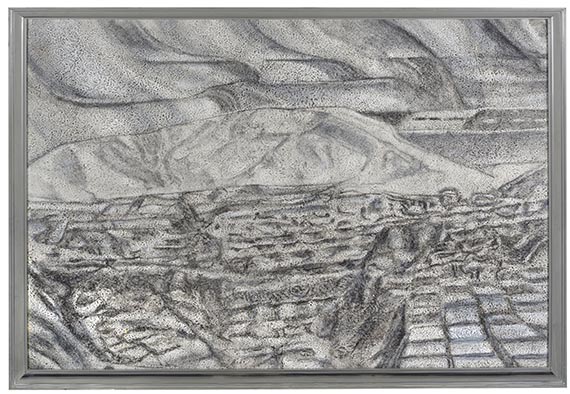
Pastoral V, 2000.
Charcoal, Acrylic on embossed synthetic resin p...
Post auction sale: € 100,000 / $ 114,000
64
Richard Artschwager
Pastoral V, 2000.
Charcoal, Acrylic on embossed synthetic resin p...
Post auction sale: € 100,000 / $ 114,000
Richard Artschwager
1923 - 2013
Pastoral V. 2000.
Charcoal, Acrylic on embossed synthetic resin panel.
Signed, dated, and titled on the reverse. In the artist's original frame 130 x 171 x 6 cm (51.1 x 67.3 x 2.3 in).
In the original metal frame. [CH].
• From the “Pastorals” series (1991–1999): Artschwager transforms landscape into an enigmatic interplay of texture, blur, and materiality.
• Between painting and sculpture: The relief-like surface makes the work almost tangible.
• Master of Ambivalence: Familiar landscapes tip into an unsettling, almost surreal visual world.
• Richard Artschwager is one of the most influential American artists of the postwar period—represented at the documenta and the Venice Biennale.
• Works from this creative phase are part of international museum collections, including the Art Institute of Chicago, the Museum of Modern Art, and the Whitney Museum of American Art, New York.
PROVENANCE: Gagosian Gallery, New York.
Galerie Philomene Magers, Munch, and Galerie Monika Sprüth, Cologne.
Private collection, Northern Germany (acquired from the above).
EXHIBITION: Richard Artschwager, Galerie Xavier Hufkens, Brussels, June 11-August 10, 2000 (with the gallery label on the reverse).
LITERATURE: Silke S. Sommer, Richard Artschwager. Werkverzeichnis der Gemälde und Objekte (PhD thesis), Berlin 2004, CR no. SV 2000.888 (illustrated, with different dimensions).
"Sculpture is for the touch, painting is for the eye. I wanted to make a sculpture for the eye and a painting for the touch."
Richard Artschwager, quoted from: Ken Johnson, Richard Artschwager, Painter and Sculptor, Dies at 89, in: New York Times, February 10, 2013, https://www.nytimes.com/2013/02/11/arts/design/richard-artschwager-painter-and-sculptor
-dies-at-89.html
1923 - 2013
Pastoral V. 2000.
Charcoal, Acrylic on embossed synthetic resin panel.
Signed, dated, and titled on the reverse. In the artist's original frame 130 x 171 x 6 cm (51.1 x 67.3 x 2.3 in).
In the original metal frame. [CH].
• From the “Pastorals” series (1991–1999): Artschwager transforms landscape into an enigmatic interplay of texture, blur, and materiality.
• Between painting and sculpture: The relief-like surface makes the work almost tangible.
• Master of Ambivalence: Familiar landscapes tip into an unsettling, almost surreal visual world.
• Richard Artschwager is one of the most influential American artists of the postwar period—represented at the documenta and the Venice Biennale.
• Works from this creative phase are part of international museum collections, including the Art Institute of Chicago, the Museum of Modern Art, and the Whitney Museum of American Art, New York.
PROVENANCE: Gagosian Gallery, New York.
Galerie Philomene Magers, Munch, and Galerie Monika Sprüth, Cologne.
Private collection, Northern Germany (acquired from the above).
EXHIBITION: Richard Artschwager, Galerie Xavier Hufkens, Brussels, June 11-August 10, 2000 (with the gallery label on the reverse).
LITERATURE: Silke S. Sommer, Richard Artschwager. Werkverzeichnis der Gemälde und Objekte (PhD thesis), Berlin 2004, CR no. SV 2000.888 (illustrated, with different dimensions).
"Sculpture is for the touch, painting is for the eye. I wanted to make a sculpture for the eye and a painting for the touch."
Richard Artschwager, quoted from: Ken Johnson, Richard Artschwager, Painter and Sculptor, Dies at 89, in: New York Times, February 10, 2013, https://www.nytimes.com/2013/02/11/arts/design/richard-artschwager-painter-and-sculptor
-dies-at-89.html
Richard Artschwager described curiosity as his most defining personal trait. This helps explain, to some extent, his rather unconventional artistic biography, his entirely independent artistic thinking, and, in particular, the versatility of an oeuvre spanning half a century. Although he showed a keen interest in visual arts from a young age, Artschwager initially studied mathematics and natural sciences. After World War II, he and his brother started a furniture workshop. It wasn’t until the 1960s that he began his artistic journey, building on his craftsmanship and creating a series of his own sculptures. Inspired by a black-and-white photograph, he finally ventured into painting a year later.
Success was not long in coming: he was soon represented by the legendary Leo Castelli Gallery, and his works were exhibited alongside those of Jasper Johns, Roy Lichtenstein, and Andy Warhol, as well as in numerous solo exhibitions from 1965 onward. In the decades that followed, his work consistently captured the spirit of the times: in 1968, 1972, 1982, 1987, and 1992, Artschwager was represented at documenta 4, 5, 7, 8, and IX in Kassel, as well as at the Venice Biennale in 1976 and 1980. In 1988–89, the Whitney Museum of American Art in Washington, D.C., presented his first comprehensive retrospective. His fascinating, witty, and contradictory oeuvre encompasses sculptures, installations, paintings, drawings, prints, photography, and furniture design (including for Vitra), through which he challenges viewers’ existing aesthetic and spatial perceptions.
Artschwager also liked to play with unusual materials in his paintings. From the 1960s on, he mostly painted on Celotex, a type of hardboard increasingly used in the construction industry. The rough surface gave his two-dimensional works a relief-like, tactile quality. The artist put his mostly monochromatic paintings in very striking frames made of painted wood or reflective metal: they are part of the artwork and, as is the case with the present work, provide an appealing contrast between the highly polished surface and the coarse texture of the monochromatic painting, emphasizing the three-dimensionality of the artwork as a whole. This was exactly the artist’s goal: the meticulously constructed ambiguity between painting and sculpture. He creates paintings that, in their physical presence, approximate objects and sculptures, thereby creating an ambivalence—a fluid transition between the boundaries of both genres.
Artschwager also likes to play with a certain ambiguity in his choice of subjects. In his “Pastorals” series, the titles alone suggest that we are looking at a landscape. However, these purported landscapes are devoid of color, and it seems as though Artschwager draped a white cloth over objects that can only be sensed through touch.
“Nothing is ever just one thing with Artschwager,” remarks David Frankel, former senior editor at the Museum of Modern Art in New York (quoted in: Curtain Call. The Art of Richard Artschwager, in: Artforum, November 2000, vol. 39, no. 3). This is why Artschwager’s work is sometimes classified as Pop Art, sometimes as Minimal Art, and at other times as Conceptual Art, even though the artist’s primary aim was to blur the boundaries of art and its categories. [CH]
Success was not long in coming: he was soon represented by the legendary Leo Castelli Gallery, and his works were exhibited alongside those of Jasper Johns, Roy Lichtenstein, and Andy Warhol, as well as in numerous solo exhibitions from 1965 onward. In the decades that followed, his work consistently captured the spirit of the times: in 1968, 1972, 1982, 1987, and 1992, Artschwager was represented at documenta 4, 5, 7, 8, and IX in Kassel, as well as at the Venice Biennale in 1976 and 1980. In 1988–89, the Whitney Museum of American Art in Washington, D.C., presented his first comprehensive retrospective. His fascinating, witty, and contradictory oeuvre encompasses sculptures, installations, paintings, drawings, prints, photography, and furniture design (including for Vitra), through which he challenges viewers’ existing aesthetic and spatial perceptions.
Artschwager also liked to play with unusual materials in his paintings. From the 1960s on, he mostly painted on Celotex, a type of hardboard increasingly used in the construction industry. The rough surface gave his two-dimensional works a relief-like, tactile quality. The artist put his mostly monochromatic paintings in very striking frames made of painted wood or reflective metal: they are part of the artwork and, as is the case with the present work, provide an appealing contrast between the highly polished surface and the coarse texture of the monochromatic painting, emphasizing the three-dimensionality of the artwork as a whole. This was exactly the artist’s goal: the meticulously constructed ambiguity between painting and sculpture. He creates paintings that, in their physical presence, approximate objects and sculptures, thereby creating an ambivalence—a fluid transition between the boundaries of both genres.
Artschwager also likes to play with a certain ambiguity in his choice of subjects. In his “Pastorals” series, the titles alone suggest that we are looking at a landscape. However, these purported landscapes are devoid of color, and it seems as though Artschwager draped a white cloth over objects that can only be sensed through touch.
“Nothing is ever just one thing with Artschwager,” remarks David Frankel, former senior editor at the Museum of Modern Art in New York (quoted in: Curtain Call. The Art of Richard Artschwager, in: Artforum, November 2000, vol. 39, no. 3). This is why Artschwager’s work is sometimes classified as Pop Art, sometimes as Minimal Art, and at other times as Conceptual Art, even though the artist’s primary aim was to blur the boundaries of art and its categories. [CH]

Buyer's premium, taxation and resale right compensation for Richard Artschwager "Pastoral V"
This lot can be purchased subject to differential or regular taxation, artist‘s resale right compensation is due.
Differential taxation:
Hammer price up to 2,000,000 €: herefrom 34 % premium.
The share of the hammer price exceeding 2,000,000 € is subject to a premium of 29 % and is added to the premium of the share of the hammer price up to 2,000,000 €.
The share of the hammer price exceeding 4,000,000 € is subject to a premium of 22 % and is added to the premium of the share of the hammer price up to 4,000,000 €.
The buyer's premium contains VAT, however, it is not shown.
Regular taxation:
Hammer price up to 2,000,000 €: herefrom 29 % premium.
The share of the hammer price exceeding 2,000,000 € is subject to a premium of 23% and is added to the premium of the share of the hammer price up to 2,000,000 €.
The share of the hammer price exceeding 4,000,000 € is subject to a premium of 15% and is added to the premium of the share of the hammer price up to 4,000,000 €.
The statutory VAT of currently 7 % is levied to the sum of hammer price and premium.
We kindly ask you to notify us before invoicing if you wish to be subject to regular taxation.
Calculation of artist‘s resale right compensation:
For works by living artists, or by artists who died less than 70 years ago, a artist‘s resale right compensation is levied in accordance with Section 26 UrhG:
4 % of hammer price from 400.00 euros up to 50,000 euros,
another 3 % of the hammer price from 50,000.01 to 200,000 euros,
another 1 % for the part of the sales proceeds from 200,000.01 to 350,000 euros,
another 0.5 % for the part of the sale proceeds from 350,000.01 to 500,000 euros and
another 0.25 % of the hammer price over 500,000 euros.
The maximum total of the resale right fee is EUR 12,500.
The artist‘s resale right compensation is VAT-exempt.
Differential taxation:
Hammer price up to 2,000,000 €: herefrom 34 % premium.
The share of the hammer price exceeding 2,000,000 € is subject to a premium of 29 % and is added to the premium of the share of the hammer price up to 2,000,000 €.
The share of the hammer price exceeding 4,000,000 € is subject to a premium of 22 % and is added to the premium of the share of the hammer price up to 4,000,000 €.
The buyer's premium contains VAT, however, it is not shown.
Regular taxation:
Hammer price up to 2,000,000 €: herefrom 29 % premium.
The share of the hammer price exceeding 2,000,000 € is subject to a premium of 23% and is added to the premium of the share of the hammer price up to 2,000,000 €.
The share of the hammer price exceeding 4,000,000 € is subject to a premium of 15% and is added to the premium of the share of the hammer price up to 4,000,000 €.
The statutory VAT of currently 7 % is levied to the sum of hammer price and premium.
We kindly ask you to notify us before invoicing if you wish to be subject to regular taxation.
Calculation of artist‘s resale right compensation:
For works by living artists, or by artists who died less than 70 years ago, a artist‘s resale right compensation is levied in accordance with Section 26 UrhG:
4 % of hammer price from 400.00 euros up to 50,000 euros,
another 3 % of the hammer price from 50,000.01 to 200,000 euros,
another 1 % for the part of the sales proceeds from 200,000.01 to 350,000 euros,
another 0.5 % for the part of the sale proceeds from 350,000.01 to 500,000 euros and
another 0.25 % of the hammer price over 500,000 euros.
The maximum total of the resale right fee is EUR 12,500.
The artist‘s resale right compensation is VAT-exempt.
Headquarters
Joseph-Wild-Str. 18
81829 Munich
Phone: +49 89 55 244-0
Fax: +49 89 55 244-177
info@kettererkunst.de
Louisa von Saucken / Undine Schleifer
Holstenwall 5
20355 Hamburg
Phone: +49 40 37 49 61-0
Fax: +49 40 37 49 61-66
infohamburg@kettererkunst.de
Dr. Simone Wiechers / Nane Schlage
Fasanenstr. 70
10719 Berlin
Phone: +49 30 88 67 53-63
Fax: +49 30 88 67 56-43
infoberlin@kettererkunst.de
Cordula Lichtenberg
Gertrudenstraße 24-28
50667 Cologne
Phone: +49 221 510 908-15
infokoeln@kettererkunst.de
Hessen
Rhineland-Palatinate
Miriam Heß
Phone: +49 62 21 58 80-038
Fax: +49 62 21 58 80-595
infoheidelberg@kettererkunst.de
We will inform you in time.