


66
Erich Heckel
6. Jahresmappe der Künstlergruppe ”Brücke”, gewidmet Erich Heckel, 1911.
The portfolio comprising a Woodcut, a lithograp...
Post auction sale: € 90,000 / $ 102,600
66
Erich Heckel
6. Jahresmappe der Künstlergruppe ”Brücke”, gewidmet Erich Heckel, 1911.
The portfolio comprising a Woodcut, a lithograp...
Post auction sale: € 90,000 / $ 102,600
Erich Heckel
1883 - 1970
6. Jahresmappe der Künstlergruppe ”Brücke”, gewidmet Erich Heckel. 1911.
The portfolio comprising a Woodcut, a lithograph and an etching by Erich Heckel, as well as with a woodcut on the dust jacket by Hermann Max Pechstein.
The minimum print run is based on the number of passive “Brücke” members; at that time, there were 68 members. Dust jacket (sheet): 57.8 x 43.9 cm (22.7 x 17.2 in).
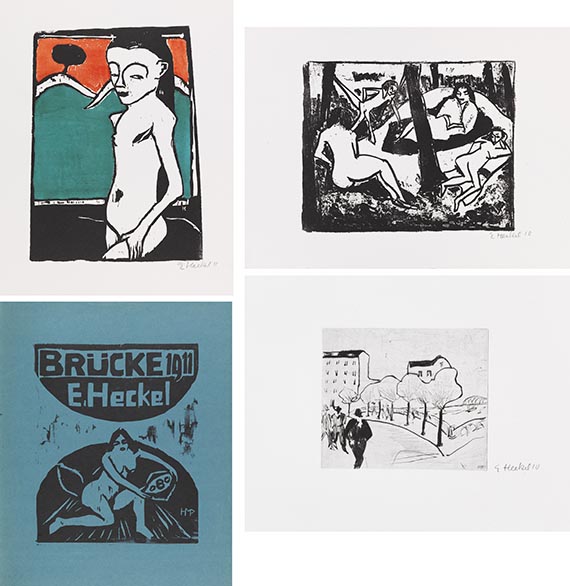
Contains: Hermann Max Pechstein. Dust jacket with “Kniender Akt mit Schale”. 1911. Woodcut. Monogrammed in the block. On blue wove paper (double sheet). 37.4 x 31 cm (14.8 x 12.3 in). Sheet: 57.8 x 43.9 cm (22.7 x 17.3 in).
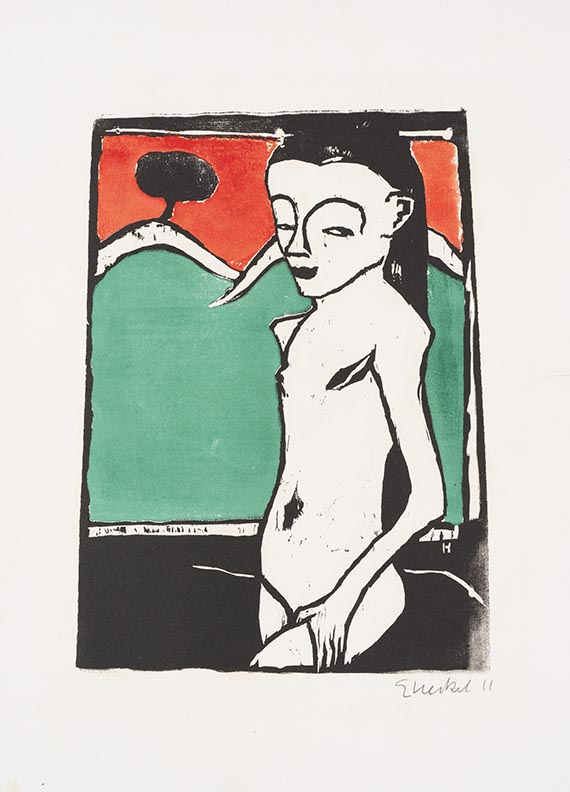
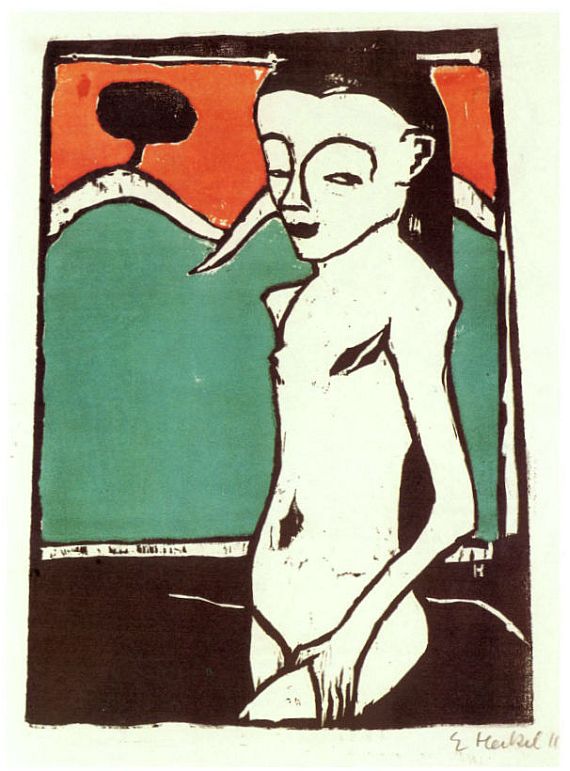
Erich Heckel. “Stehendes Kind (Fränzi stehend). 1910/11. Woodcut in black, green, and red. Signed, dated, and monogrammed in the block. On firm wove paper. 37.5 x 27.5 cm (14.8 x 10.8 in). Sheet: 53.8 x 39.7 cm (21.3 x 15.8 in).
Erich Heckel. “Szene im Wald”. 1910. Chalk and brush lithograph. Signed and dated. On firm laid paper. 27.9 x 34 cm (11 x 13.5 in). Sheet: 40 x 54 cm (15.8 x 21.3 in).Erich Heckel. “Strasse am Hafen (Hamburger Hafen/Strasse mit Brücke).” 1910. Drypoint etching. Signed, dated, and monogrammed and dated on the plate. On firm laid paper. 17 x 20 cm (6.8 x 7.8 in). Sheet: 40.1 x 53.8 cm (15.8 x 21.3 in).
Complete 6th annual portfolio.
• Extremely rare, complete portfolio from the heyday of the “Brücke” group.
• Three prints in different techniques of masterful execution.
• “Fränzi Stehend” is one of Erich Heckel’s most notable color woodcuts.
• The annual portfolios were distributed among the passive members of the group.
• Part of a major German private collection for over 30 years.
• Works from this portfolio are in renowned museum collections such as the Städel Museum, Frankfurt, the Saint Louis Art Museum, Missouri, and the Los Angeles County Museum of Art (LACMA).
PROVENANCE: Private collection, New York.
Olbricht Collection, Essen/Berlin (acquired from the above in 1995, Galerie Kornfeld, Bern).
EXHIBITION: Künstlergruppe Brücke. Annual Portfolios 1909–1912, Galerie Utermann, Dortmund, Nov. 23–Dec. 23, 1994, illustrated in color (presumably a different copy).
100 Jahre Brücke. Expressionismus aus Berlin, Kunsthalle Hypo-Kulturstiftung, Munich, Feb. 24–May 21, 2006, no. VI. 60–63, illustrated in color (presumably a different copy).
Lebenslust & Totentanz. Olbricht Collection, Kunsthalle Krems, July 18–November 7, 2010 (only “Stehendes Kind (Fränzi stehend)").
LITERATURE: Annemarie and Wolf-Dieter Dube, Erich Heckel. Das graphische Werk, vol. 1: Holzschnitte, New York 1964:
Erich Heckel, “Stehendes Kind (Fränzi stehend)”, 1910/11: CR no. H 204 B 2 (of B 2).
Annemarie and Wolf-Dieter Dube, Erich Heckel: Das graphische Werk, vol. 2: Radierungen, Lithographien, New York 1965:
Erich Heckel, “Szene im Wald”, 1910: CR no. L 153.
Erich Heckel, “Strasse am Hafen (Hamburger Hafen/Strasse mit Brücke)”, 1910: CR no. R 91.
Renate Ebner, Andreas Gabelmann, Erich Heckel. Catalogue Raisonné of Prints, vol. 1: 1903–1913, Munich 2021:
Erich Heckel, “Stehendes Kind (Fränzi stehend)”, 1910/11: CR no. 423 H B 1 (of B 2), illustrated in color.
Erich Heckel, “Szene im Wald”, 1910: CR no. 451 L II (of II), illustrated.
Erich Heckel, “Strasse am Hafen (Hamburger Hafen/Strasse mit Brücke)”, 1910: CR no. 485 R II (of II), illustrated.
Günter Krüger, Das druckgraphische Werk Max Pechsteins, Hamburg 1988:
Hermann Max Pechstein, dust jacket with “Kniender Akt mit Schale,” 1911: CR no. H 132, (illustrated).
- -
Hans Bolliger, E. W. Kornfeld, Exhibition: Künstlergruppe Brücke. Annual Portfolios 1906–12, Bern 1958, pp. 20–21, nos. 21–24 (probably a different copy).
Magdalena M. Moeller (ed.), Exhibition catalog The Annual Portfolios of “Brücke” 1906–1912, Brücke Museum Berlin, archive volume 17/1989, cat. nos. 21–24, with full-page color illustrations, pp. 87–91 (different copy).
Gerhart Söhn (ed.), Handbuch der Original-Graphik in deutschen Zeitschriften, Mappenwerken, Kunstbüchern und Katalogen (HDO) 1890–1933, vol. II, Düsseldorf 1990, nos. 216-1–4, illustrated (probably a different copy).
Heinz Spielmann (ed.), Die Maler der Brücke. Hermann Gerlinger Collection, Stuttgart 1995, pp. 116–117, SHG nos. 72–75, nos. 72–73 with color plates (different copy).
Galerie Kornfeld, Bern, 215th Auction, Kunst des 19. und 20. Jahrhunderts, Teil I, June 23, 1995, lot 27 (illustrated)
Hermann Gerlinger, Katja Schneider (eds.), Die Maler der Brücke. Inventory Catalog of the Hermann Gerlinger Collection, Halle (Saale) 2005, pp. 178–179, SHG nos. 399–401; p. 398, SHG no. 869, illustrated in color (different copy).
Magdalena M. Moeller (ed.), Exhibition catalog: Dokumente der Künstlergruppe Brücke, Brücke Archive 22/2007, Munich 2007, cat. no. 32 (a–d), illustrated in color (different copy).
1883 - 1970
6. Jahresmappe der Künstlergruppe ”Brücke”, gewidmet Erich Heckel. 1911.
The portfolio comprising a Woodcut, a lithograph and an etching by Erich Heckel, as well as with a woodcut on the dust jacket by Hermann Max Pechstein.
The minimum print run is based on the number of passive “Brücke” members; at that time, there were 68 members. Dust jacket (sheet): 57.8 x 43.9 cm (22.7 x 17.2 in).
Contains: Hermann Max Pechstein. Dust jacket with “Kniender Akt mit Schale”. 1911. Woodcut. Monogrammed in the block. On blue wove paper (double sheet). 37.4 x 31 cm (14.8 x 12.3 in). Sheet: 57.8 x 43.9 cm (22.7 x 17.3 in).
Erich Heckel. “Stehendes Kind (Fränzi stehend). 1910/11. Woodcut in black, green, and red. Signed, dated, and monogrammed in the block. On firm wove paper. 37.5 x 27.5 cm (14.8 x 10.8 in). Sheet: 53.8 x 39.7 cm (21.3 x 15.8 in).
Erich Heckel. “Szene im Wald”. 1910. Chalk and brush lithograph. Signed and dated. On firm laid paper. 27.9 x 34 cm (11 x 13.5 in). Sheet: 40 x 54 cm (15.8 x 21.3 in).Erich Heckel. “Strasse am Hafen (Hamburger Hafen/Strasse mit Brücke).” 1910. Drypoint etching. Signed, dated, and monogrammed and dated on the plate. On firm laid paper. 17 x 20 cm (6.8 x 7.8 in). Sheet: 40.1 x 53.8 cm (15.8 x 21.3 in).
Complete 6th annual portfolio.
• Extremely rare, complete portfolio from the heyday of the “Brücke” group.
• Three prints in different techniques of masterful execution.
• “Fränzi Stehend” is one of Erich Heckel’s most notable color woodcuts.
• The annual portfolios were distributed among the passive members of the group.
• Part of a major German private collection for over 30 years.
• Works from this portfolio are in renowned museum collections such as the Städel Museum, Frankfurt, the Saint Louis Art Museum, Missouri, and the Los Angeles County Museum of Art (LACMA).
PROVENANCE: Private collection, New York.
Olbricht Collection, Essen/Berlin (acquired from the above in 1995, Galerie Kornfeld, Bern).
EXHIBITION: Künstlergruppe Brücke. Annual Portfolios 1909–1912, Galerie Utermann, Dortmund, Nov. 23–Dec. 23, 1994, illustrated in color (presumably a different copy).
100 Jahre Brücke. Expressionismus aus Berlin, Kunsthalle Hypo-Kulturstiftung, Munich, Feb. 24–May 21, 2006, no. VI. 60–63, illustrated in color (presumably a different copy).
Lebenslust & Totentanz. Olbricht Collection, Kunsthalle Krems, July 18–November 7, 2010 (only “Stehendes Kind (Fränzi stehend)").
LITERATURE: Annemarie and Wolf-Dieter Dube, Erich Heckel. Das graphische Werk, vol. 1: Holzschnitte, New York 1964:
Erich Heckel, “Stehendes Kind (Fränzi stehend)”, 1910/11: CR no. H 204 B 2 (of B 2).
Annemarie and Wolf-Dieter Dube, Erich Heckel: Das graphische Werk, vol. 2: Radierungen, Lithographien, New York 1965:
Erich Heckel, “Szene im Wald”, 1910: CR no. L 153.
Erich Heckel, “Strasse am Hafen (Hamburger Hafen/Strasse mit Brücke)”, 1910: CR no. R 91.
Renate Ebner, Andreas Gabelmann, Erich Heckel. Catalogue Raisonné of Prints, vol. 1: 1903–1913, Munich 2021:
Erich Heckel, “Stehendes Kind (Fränzi stehend)”, 1910/11: CR no. 423 H B 1 (of B 2), illustrated in color.
Erich Heckel, “Szene im Wald”, 1910: CR no. 451 L II (of II), illustrated.
Erich Heckel, “Strasse am Hafen (Hamburger Hafen/Strasse mit Brücke)”, 1910: CR no. 485 R II (of II), illustrated.
Günter Krüger, Das druckgraphische Werk Max Pechsteins, Hamburg 1988:
Hermann Max Pechstein, dust jacket with “Kniender Akt mit Schale,” 1911: CR no. H 132, (illustrated).
- -
Hans Bolliger, E. W. Kornfeld, Exhibition: Künstlergruppe Brücke. Annual Portfolios 1906–12, Bern 1958, pp. 20–21, nos. 21–24 (probably a different copy).
Magdalena M. Moeller (ed.), Exhibition catalog The Annual Portfolios of “Brücke” 1906–1912, Brücke Museum Berlin, archive volume 17/1989, cat. nos. 21–24, with full-page color illustrations, pp. 87–91 (different copy).
Gerhart Söhn (ed.), Handbuch der Original-Graphik in deutschen Zeitschriften, Mappenwerken, Kunstbüchern und Katalogen (HDO) 1890–1933, vol. II, Düsseldorf 1990, nos. 216-1–4, illustrated (probably a different copy).
Heinz Spielmann (ed.), Die Maler der Brücke. Hermann Gerlinger Collection, Stuttgart 1995, pp. 116–117, SHG nos. 72–75, nos. 72–73 with color plates (different copy).
Galerie Kornfeld, Bern, 215th Auction, Kunst des 19. und 20. Jahrhunderts, Teil I, June 23, 1995, lot 27 (illustrated)
Hermann Gerlinger, Katja Schneider (eds.), Die Maler der Brücke. Inventory Catalog of the Hermann Gerlinger Collection, Halle (Saale) 2005, pp. 178–179, SHG nos. 399–401; p. 398, SHG no. 869, illustrated in color (different copy).
Magdalena M. Moeller (ed.), Exhibition catalog: Dokumente der Künstlergruppe Brücke, Brücke Archive 22/2007, Munich 2007, cat. no. 32 (a–d), illustrated in color (different copy).
The sixth annual portfolio of the “Brücke” group, released in the spring of 1911, occupies a central position both within the group’s collective artistic output and in the broader development of Expressionism. Founded in 1905 by Erich Heckel, Ernst Ludwig Kirchner, Karl Schmidt-Rottluff, and Fritz Bleyl, the artists’ group sought to create a direct, unadulterated visual language that transcended academic conventions. The annual portfolios, published between 1906 and 1912, were intended as exclusive gifts for the supporting “passive” members and played a key role in this endeavor. They fostered a direct relationship between artists and collectors while simultaneously serving as a testing ground for printmaking, which the group regarded as equal in status to painting.
The 1911 portfolio, created by Erich Heckel, comprises three prints from the years 1910–1911, a peak in the work of “Die Brücke”, not least against the backdrop of the exhibition at Galerie Arnold in Dresden. The prints illustrate the group's central themes: expressive figuration, the unity of man and nature, and scenes of modern city life. Among the most striking works is the vivid woodcut “Stehendes Kind (Fränzi stehend)” executed in black, red, and green.
The boldly contoured figure stands out against a minimalist landscape, reflecting Heckel’s exploration of the so-called “Etruscan art” during his 1909 trip to Italy. In contrast to Kirchner’s more painterly approach to color woodcuts, Heckel emphasized clearly defined areas of color, avoided overlaps, and deliberately incorporated blank areas of the paper into the composition. The model, Lina Franziska Fehrmann (1900–1950), known as “Fränzi”, exudes a self-assured presence and embodies the ideal of an immediate expression. The lithograph “Szene im Wald” (Forest Scene), inspired by the lakeside landscape of Moritzburg near Dresden, shows nudes outdoors and evokes the notion of a primal unity between man and nature, another central idea of the “Brücke” movement. The motif of free, uninhibited nudity points to the broader ideal of a “primitive,” simpler life liberated from social constraints, and becomes a leitmotif of the group’s most productive years. In contrast, the etching “Strasse am Hafen (Hamburger Hafen/Strasse mit Brücke)” introduces an urban subject: a bustling street scene along a curved shoreline highlights the energy and anonymity of modern city life and extends the portfolio’s scope of themes.
The portfolio's cover, Hermann Max Pechstein’s woodcut “Kniender Akt mit Schale” (Kneeling Nude with Bowl), ultimately underscores the collaborative nature of the project. Through simplified, gently curved forms and a subdued blue-violet hue, Pechstein subtly references Heckel’s formal language. The 6th annual portfolio unites Heckel’s individual artistic profile with the collective ideals of the group: expressive condensation, the tension between urban experience and an ideal of nature, and the pioneering recognition of printmaking as a modern form of artistic expression. [KA]
The 1911 portfolio, created by Erich Heckel, comprises three prints from the years 1910–1911, a peak in the work of “Die Brücke”, not least against the backdrop of the exhibition at Galerie Arnold in Dresden. The prints illustrate the group's central themes: expressive figuration, the unity of man and nature, and scenes of modern city life. Among the most striking works is the vivid woodcut “Stehendes Kind (Fränzi stehend)” executed in black, red, and green.
The boldly contoured figure stands out against a minimalist landscape, reflecting Heckel’s exploration of the so-called “Etruscan art” during his 1909 trip to Italy. In contrast to Kirchner’s more painterly approach to color woodcuts, Heckel emphasized clearly defined areas of color, avoided overlaps, and deliberately incorporated blank areas of the paper into the composition. The model, Lina Franziska Fehrmann (1900–1950), known as “Fränzi”, exudes a self-assured presence and embodies the ideal of an immediate expression. The lithograph “Szene im Wald” (Forest Scene), inspired by the lakeside landscape of Moritzburg near Dresden, shows nudes outdoors and evokes the notion of a primal unity between man and nature, another central idea of the “Brücke” movement. The motif of free, uninhibited nudity points to the broader ideal of a “primitive,” simpler life liberated from social constraints, and becomes a leitmotif of the group’s most productive years. In contrast, the etching “Strasse am Hafen (Hamburger Hafen/Strasse mit Brücke)” introduces an urban subject: a bustling street scene along a curved shoreline highlights the energy and anonymity of modern city life and extends the portfolio’s scope of themes.
The portfolio's cover, Hermann Max Pechstein’s woodcut “Kniender Akt mit Schale” (Kneeling Nude with Bowl), ultimately underscores the collaborative nature of the project. Through simplified, gently curved forms and a subdued blue-violet hue, Pechstein subtly references Heckel’s formal language. The 6th annual portfolio unites Heckel’s individual artistic profile with the collective ideals of the group: expressive condensation, the tension between urban experience and an ideal of nature, and the pioneering recognition of printmaking as a modern form of artistic expression. [KA]

Buyer's premium, taxation and resale right compensation for Erich Heckel "6. Jahresmappe der Künstlergruppe ”Brücke”, gewidmet Erich Heckel"
This lot can be purchased subject to differential or regular taxation, artist‘s resale right compensation is due.
Differential taxation:
Hammer price up to 2,000,000 €: herefrom 34 % premium.
The share of the hammer price exceeding 2,000,000 € is subject to a premium of 29 % and is added to the premium of the share of the hammer price up to 2,000,000 €.
The share of the hammer price exceeding 4,000,000 € is subject to a premium of 22 % and is added to the premium of the share of the hammer price up to 4,000,000 €.
The buyer's premium contains VAT, however, it is not shown.
Regular taxation:
Hammer price up to 2,000,000 €: herefrom 29 % premium.
The share of the hammer price exceeding 2,000,000 € is subject to a premium of 23% and is added to the premium of the share of the hammer price up to 2,000,000 €.
The share of the hammer price exceeding 4,000,000 € is subject to a premium of 15% and is added to the premium of the share of the hammer price up to 4,000,000 €.
The statutory VAT of currently 7 % is levied to the sum of hammer price and premium.
We kindly ask you to notify us before invoicing if you wish to be subject to regular taxation.
Calculation of artist‘s resale right compensation:
For works by living artists, or by artists who died less than 70 years ago, a artist‘s resale right compensation is levied in accordance with Section 26 UrhG:
4 % of hammer price from 400.00 euros up to 50,000 euros,
another 3 % of the hammer price from 50,000.01 to 200,000 euros,
another 1 % for the part of the sales proceeds from 200,000.01 to 350,000 euros,
another 0.5 % for the part of the sale proceeds from 350,000.01 to 500,000 euros and
another 0.25 % of the hammer price over 500,000 euros.
The maximum total of the resale right fee is EUR 12,500.
The artist‘s resale right compensation is VAT-exempt.
Differential taxation:
Hammer price up to 2,000,000 €: herefrom 34 % premium.
The share of the hammer price exceeding 2,000,000 € is subject to a premium of 29 % and is added to the premium of the share of the hammer price up to 2,000,000 €.
The share of the hammer price exceeding 4,000,000 € is subject to a premium of 22 % and is added to the premium of the share of the hammer price up to 4,000,000 €.
The buyer's premium contains VAT, however, it is not shown.
Regular taxation:
Hammer price up to 2,000,000 €: herefrom 29 % premium.
The share of the hammer price exceeding 2,000,000 € is subject to a premium of 23% and is added to the premium of the share of the hammer price up to 2,000,000 €.
The share of the hammer price exceeding 4,000,000 € is subject to a premium of 15% and is added to the premium of the share of the hammer price up to 4,000,000 €.
The statutory VAT of currently 7 % is levied to the sum of hammer price and premium.
We kindly ask you to notify us before invoicing if you wish to be subject to regular taxation.
Calculation of artist‘s resale right compensation:
For works by living artists, or by artists who died less than 70 years ago, a artist‘s resale right compensation is levied in accordance with Section 26 UrhG:
4 % of hammer price from 400.00 euros up to 50,000 euros,
another 3 % of the hammer price from 50,000.01 to 200,000 euros,
another 1 % for the part of the sales proceeds from 200,000.01 to 350,000 euros,
another 0.5 % for the part of the sale proceeds from 350,000.01 to 500,000 euros and
another 0.25 % of the hammer price over 500,000 euros.
The maximum total of the resale right fee is EUR 12,500.
The artist‘s resale right compensation is VAT-exempt.
Headquarters
Joseph-Wild-Str. 18
81829 Munich
Phone: +49 89 55 244-0
Fax: +49 89 55 244-177
info@kettererkunst.de
Louisa von Saucken / Undine Schleifer
Holstenwall 5
20355 Hamburg
Phone: +49 40 37 49 61-0
Fax: +49 40 37 49 61-66
infohamburg@kettererkunst.de
Dr. Simone Wiechers / Nane Schlage
Fasanenstr. 70
10719 Berlin
Phone: +49 30 88 67 53-63
Fax: +49 30 88 67 56-43
infoberlin@kettererkunst.de
Cordula Lichtenberg
Gertrudenstraße 24-28
50667 Cologne
Phone: +49 221 510 908-15
infokoeln@kettererkunst.de
Hessen
Rhineland-Palatinate
Miriam Heß
Phone: +49 62 21 58 80-038
Fax: +49 62 21 58 80-595
infoheidelberg@kettererkunst.de
We will inform you in time.