


Video
Raumbeispiel
65
Lyonel Feininger
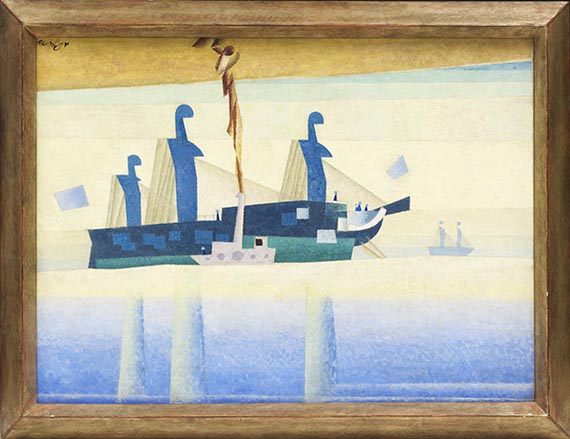
Hulks, 1923.
Oil on canvas
Estimate:
€ 400,000 / $ 464,000 Sold:
€ 567,600 / $ 658,416 (incl. surcharge)
65
Lyonel Feininger
Hulks, 1923.
Oil on canvas
Estimate:
€ 400,000 / $ 464,000 Sold:
€ 567,600 / $ 658,416 (incl. surcharge)
Lyonel Feininger
1871 - 1956
Hulks. 1923.
Oil on canvas.
Signed in the upper left. Titled, dated, and once more signed on the reverse of the stretcher. 39.3 x 53.4 cm (15.4 x 21 in).
[AR].
• An exceptionally dynamic and atmospheric seascape by the great Bauhaus master.
• Boasting an impressive exhibition history, both during the artist's lifetime and posthumously.
• A painterly manifestation of light and matter: an ethereal inner glow meets the geometric form of the ship's hull.
• A play of opposites: horizontal and vertical, movement and stillness, spherical lightness and strong contrasts.
• From the early Bauhaus period in Weimar, one year before the founding of the “Blue Four” (Feininger, Kandinsky, Klee, Jawlensky).
• From the artist’s estate, for a long time in the possession of the Feininger family.
• Offered on the international auction market for the first time.
Achim Moeller, Director of the Lyonel Feininger Project, New York–Berlin, has confirmed the authenticity of this work. It is registered in the archive of the Lyonel Feininger Project under the number 1927-05-17-24. The painting is mentioned in 'Lyonel Feininger: The Catalogue Raisonné of Paintings' by Achim Moeller under the number 243. The work is accompanied by a Certificate of Authenticity.
Additional information was provided by Achim Moeller, The Lyonel Feininger Project, New York - Berlin.
PROVENANCE: Estate of the artist, New York.
Andreas Feininger, New York (inherited).
In possession of the artist's family (inherited).
EXHIBITION: Lyonel Feininger, Galerie Dr. Goldschmidt - Dr. Wallerstein, Berlin, November 22, 1925 - undated, cat. no. 8.
Lyonel Feininger und O. Th. W. Stein, Kunsthütte Chemnitz, Chemnitz, October 17–November 14, 1926, cat. no. 6.
Lyonel Feininger, Erich Heckel: Gemälde, Aquarelle, Zeichnungen. Ewald Mataré: Plastik, Gesellschaft der Kunstfreunde Breslau, Silesian Museum of Fine Arts (“Altes Generalkommando”), Wroclaw, Jan. 20–Feb. 20, 1929, cat. no. 17, p. 2.
Bauhaus Dessau: J. Albers, L. Feininger, W. Kandinsky, P. Klee, O. Schlemmer, Kunsthalle Basel, Basel, April 20–May 9, 1929, cat. no. 24.
Special Exhibition: The Blue Four: Lyonel Feininger, A. Jawlensky, W. Kandinsky, Paul Klee, Galerie Ferdinand Möller, October 3–October 10, 1929 – undated, cat. no. 1, p. 7.
Special Exhibition: Lyonel Feininger, Kunstverein für Böhmen, Prague, December 28, 1929–January 19, 1930, cat. no. 16, p. 3.
Lyonel Feininger, Museum Folkwang, Essen, June 21–August 23, 1931 (checklist).
Lyonel Feininger, Nationalgalerie, Kronprinzenpalais, Berlin, September 19, 1931–January 31, 1932, cat. no. 78, p. 28 (with b/w ill.), and p. 30.
Lyonel Feininger, Kestner-Gesellschaft, Hanover, Jan. 28–Mar. 6, 1932, cat. no. 30, n.p. (with b/w ill.).
The Blue Four: Feininger, Jawlensky, Kandinsky, Paul Klee, Los Angeles, Los Angeles Museum of Art, October 1933, cat. no. 3.
Exhibition Lyonel Feininger, Mills College Art Gallery, Oakland, June 1–August 22, 1936, San Francisco Museum of Art, San Francisco, Aug. 22–Sept. 15, 1936, Henry Art Gallery, University of Washington, Seattle, Oct. 5, 1936 – undated, cat. no. 9 (verso with label “Mills College Art Gallery”).
Lyonel Feininger: Exhibition of Oil, Watercolor Paintings, and Prints in the Faulkner Memorial Art Gallery, Faulkner Memorial Art Gallery, Free Public Library, Santa Barbara, Jan. 5–17, 1937, cat. no. 5.
Die Maler am Bauhaus (organized by the Bavarian State Painting Collections), Haus der Kunst, Munich, Munich, May–June 1950; Berlin, Die Maler am Bauhaus (on the occasion of the 1950 Berlin Industrial Exhibition at Charlottenburg Palace), Charlottenburg Palace, Berlin, Sept. 29–Oct. 29, 1950, cat. no. 272 (supplementary list; exhibited only in Berlin).
Die Blaue Vier: Feininger, Jawlensky, Kandinsky, Klee in der Neuen Welt, Kunstmuseum Bern, Bern, Dec. 5, 1997–March 1, 1998, Kunstsammlung Nordrhein-Westfalen, Düsseldorf, March 28–June 28, 1998, cat. no. 9, p. 172 (illustrated in color) and p. 337 (with an exhibition label on the reverse).
Lyonel Feininger and the City at the Edge / German Expressionism and Masters of the Bauhaus, Achim Moeller Fine Art, New York, Fall 2001–February 2002, cat. no. 9 (checklist).
20th Century European and American Masters: From Arp, Beckmann, and Feininger to Tobey, Guston, and Rauschenberg, Achim Moeller Fine Art, New York, undated – April 24, 2004, cat. no. 17 (checklist).
LITERATURE: Achim Moeller, “Hulks / (Ship Hulls), 1923 (Moeller 243).” Lyonel Feininger: The Catalogue Raisonné of Paintings, http://www.feiningerproject.org/catalogue/ (accessed April 9, 2024), (with color ill.).
Hans Hess, Lyonel Feininger. With a catalogue raisonné by Julia Feininger, Stuttgart 1959, CR no. 229 (illustrated in b/w on p. 269).
- -
Erwin Redslob, Het werk van Lyonel Feininger, Wendingen 10/7 (1929), pp. 2–18 and p. 5 (Scheepjes).
Werner Timm, Lyonel Feininger: Erlebnis und Vision. Die Reisen an die Ostsee 1892–1935, Regensburg 1992, p. 192.
Jörn Grabowski, Lyonel Feininger und die Sammlung der Moderne im Kronprinzenpalais 1919–1937, in: Roland März (ed.), Lyonel Feininger: Von Gelmeroda nach Manhattan, Berlin 1998, pp. 329–335, p. 331 (dated here to 1924).
Hans Schulz-Vanselow, Lyonel Feininger und Pommern, Kiel 1999, p. 316.
“[..] I have truly been fascinated with the sea since I was a child”
Lyonel Feininger, 1926
“Each individual work serves as an expression of our most intimate state of mind [..]”
Lyonel Feininger, 1917
1871 - 1956
Hulks. 1923.
Oil on canvas.
Signed in the upper left. Titled, dated, and once more signed on the reverse of the stretcher. 39.3 x 53.4 cm (15.4 x 21 in).
[AR].
• An exceptionally dynamic and atmospheric seascape by the great Bauhaus master.
• Boasting an impressive exhibition history, both during the artist's lifetime and posthumously.
• A painterly manifestation of light and matter: an ethereal inner glow meets the geometric form of the ship's hull.
• A play of opposites: horizontal and vertical, movement and stillness, spherical lightness and strong contrasts.
• From the early Bauhaus period in Weimar, one year before the founding of the “Blue Four” (Feininger, Kandinsky, Klee, Jawlensky).
• From the artist’s estate, for a long time in the possession of the Feininger family.
• Offered on the international auction market for the first time.
Achim Moeller, Director of the Lyonel Feininger Project, New York–Berlin, has confirmed the authenticity of this work. It is registered in the archive of the Lyonel Feininger Project under the number 1927-05-17-24. The painting is mentioned in 'Lyonel Feininger: The Catalogue Raisonné of Paintings' by Achim Moeller under the number 243. The work is accompanied by a Certificate of Authenticity.
Additional information was provided by Achim Moeller, The Lyonel Feininger Project, New York - Berlin.
PROVENANCE: Estate of the artist, New York.
Andreas Feininger, New York (inherited).
In possession of the artist's family (inherited).
EXHIBITION: Lyonel Feininger, Galerie Dr. Goldschmidt - Dr. Wallerstein, Berlin, November 22, 1925 - undated, cat. no. 8.
Lyonel Feininger und O. Th. W. Stein, Kunsthütte Chemnitz, Chemnitz, October 17–November 14, 1926, cat. no. 6.
Lyonel Feininger, Erich Heckel: Gemälde, Aquarelle, Zeichnungen. Ewald Mataré: Plastik, Gesellschaft der Kunstfreunde Breslau, Silesian Museum of Fine Arts (“Altes Generalkommando”), Wroclaw, Jan. 20–Feb. 20, 1929, cat. no. 17, p. 2.
Bauhaus Dessau: J. Albers, L. Feininger, W. Kandinsky, P. Klee, O. Schlemmer, Kunsthalle Basel, Basel, April 20–May 9, 1929, cat. no. 24.
Special Exhibition: The Blue Four: Lyonel Feininger, A. Jawlensky, W. Kandinsky, Paul Klee, Galerie Ferdinand Möller, October 3–October 10, 1929 – undated, cat. no. 1, p. 7.
Special Exhibition: Lyonel Feininger, Kunstverein für Böhmen, Prague, December 28, 1929–January 19, 1930, cat. no. 16, p. 3.
Lyonel Feininger, Museum Folkwang, Essen, June 21–August 23, 1931 (checklist).
Lyonel Feininger, Nationalgalerie, Kronprinzenpalais, Berlin, September 19, 1931–January 31, 1932, cat. no. 78, p. 28 (with b/w ill.), and p. 30.
Lyonel Feininger, Kestner-Gesellschaft, Hanover, Jan. 28–Mar. 6, 1932, cat. no. 30, n.p. (with b/w ill.).
The Blue Four: Feininger, Jawlensky, Kandinsky, Paul Klee, Los Angeles, Los Angeles Museum of Art, October 1933, cat. no. 3.
Exhibition Lyonel Feininger, Mills College Art Gallery, Oakland, June 1–August 22, 1936, San Francisco Museum of Art, San Francisco, Aug. 22–Sept. 15, 1936, Henry Art Gallery, University of Washington, Seattle, Oct. 5, 1936 – undated, cat. no. 9 (verso with label “Mills College Art Gallery”).
Lyonel Feininger: Exhibition of Oil, Watercolor Paintings, and Prints in the Faulkner Memorial Art Gallery, Faulkner Memorial Art Gallery, Free Public Library, Santa Barbara, Jan. 5–17, 1937, cat. no. 5.
Die Maler am Bauhaus (organized by the Bavarian State Painting Collections), Haus der Kunst, Munich, Munich, May–June 1950; Berlin, Die Maler am Bauhaus (on the occasion of the 1950 Berlin Industrial Exhibition at Charlottenburg Palace), Charlottenburg Palace, Berlin, Sept. 29–Oct. 29, 1950, cat. no. 272 (supplementary list; exhibited only in Berlin).
Die Blaue Vier: Feininger, Jawlensky, Kandinsky, Klee in der Neuen Welt, Kunstmuseum Bern, Bern, Dec. 5, 1997–March 1, 1998, Kunstsammlung Nordrhein-Westfalen, Düsseldorf, March 28–June 28, 1998, cat. no. 9, p. 172 (illustrated in color) and p. 337 (with an exhibition label on the reverse).
Lyonel Feininger and the City at the Edge / German Expressionism and Masters of the Bauhaus, Achim Moeller Fine Art, New York, Fall 2001–February 2002, cat. no. 9 (checklist).
20th Century European and American Masters: From Arp, Beckmann, and Feininger to Tobey, Guston, and Rauschenberg, Achim Moeller Fine Art, New York, undated – April 24, 2004, cat. no. 17 (checklist).
LITERATURE: Achim Moeller, “Hulks / (Ship Hulls), 1923 (Moeller 243).” Lyonel Feininger: The Catalogue Raisonné of Paintings, http://www.feiningerproject.org/catalogue/ (accessed April 9, 2024), (with color ill.).
Hans Hess, Lyonel Feininger. With a catalogue raisonné by Julia Feininger, Stuttgart 1959, CR no. 229 (illustrated in b/w on p. 269).
- -
Erwin Redslob, Het werk van Lyonel Feininger, Wendingen 10/7 (1929), pp. 2–18 and p. 5 (Scheepjes).
Werner Timm, Lyonel Feininger: Erlebnis und Vision. Die Reisen an die Ostsee 1892–1935, Regensburg 1992, p. 192.
Jörn Grabowski, Lyonel Feininger und die Sammlung der Moderne im Kronprinzenpalais 1919–1937, in: Roland März (ed.), Lyonel Feininger: Von Gelmeroda nach Manhattan, Berlin 1998, pp. 329–335, p. 331 (dated here to 1924).
Hans Schulz-Vanselow, Lyonel Feininger und Pommern, Kiel 1999, p. 316.
“[..] I have truly been fascinated with the sea since I was a child”
Lyonel Feininger, 1926
“Each individual work serves as an expression of our most intimate state of mind [..]”
Lyonel Feininger, 1917
“Hulks” – An atmospheric seascape by the Bauhaus master
"[...] ‘I have truly been fascinated with the sea since I was a child’, is how the Bauhaus teacher Lyonel Feininger described his lifelong love of maritime motifs in 1926. Ultimately, this passion gave rise to his iconic seascapes (Lyonel Feininger, March 18, 1926, quoted from Johannes Langner, Lyonel Feininger. Segelschiffe, Stuttgart 1962, p. 26). The stilistic and thematic diversity of this key work group not only reveals the artist’s deep passion for ships of all kinds, but also expresses the central theme of his artistic pursuit, which he summarized as early as 1917 with the following words: “ Each work serves as an expression of our innermost state of mind and the undeniable, imperative necessity of liberation through appropriate artistic form: in rhythm, form, color, and the overall mood of the painting”. (Lyonel Feininger, 1917, quoted from: Lothar-Günther Buchheim, Die Künstlergemeinschaft Brücke, Feldafing 1956, p. 30)
Feininger s seascapes are far more than mere descriptions or depictions of different types of ships or maritime landscapes. Instead, they often show a quiet, almost ethereal world in which all the elements come together to form a unique balance between reality and artistic vision. His ships frequently appear as vessels symbolizing movement and orientation within a light-filled environment. Feininger transforms real models of ships and impressions of nature into his distinctive visual language, in which lines and geometric planes seem to penetrate and reorganize the material world. In this way, the ships become mediators between figuration and abstraction—floating between reality and vision, firmly anchored in the pictorial space yet carried away into a spiritual realm.
The 1923 work “Hulks” is also part of this group of motifs, which playfully navigates the line between materiality and immateriality, juxtaposing ethereal lightness with strong color contrasts and distinct horizontal arrangements with vertical counterparts. The small work, with its strong atmospheric presence, was shown in many exhibitions, both during the artist’s lifetime and posthumously, including the 1936 exhibition at Mills College in California, where Lyonel Feininger was a visiting lecturer for six weeks that same year.
As the title suggests, Feininger's ”Hulks” showcases a very special group of boats, in the broadest sense, all kinds of junked ships that are towed near the coast for their final destination or to be scrapped, where they usually lie at anchor for an extended period. Yet here, too, Feininger depicts more than just a specific type of ship. In front of the large, dark-blue “hulk” in the center of the picture—which is clearly at anchor and seems to have already lost part of its rigging—a second, smaller ship can be spotted. With a silvery-gray hull and an impressive brown cloud of smoke rising from its large chimney into the equally brown-hued sky at the top of the picture, it moves in the opposite direction of the massive “hulk". It appears to be a kind of tugboat, which may have towed the disused ship to its berth or is being used to transport the crew, as suggested by the small figures.
Whether Feininger observed this scene himself on the Baltic Sea or drew inspiration from historical seascapes, such as William Turner’s “The Fighting Temeraire” from 1839, can only be assumed. It is, however, a proven fact that he was fascinated with the work of the British Romantic. Apart from the thematic reference to William Turner’s painting, the affinity with his ethereal, luminous style is also clearly evident in Feininger’s small painting, with its bright glow emanating from the depths of the pictorial space. Feininger’s depiction of the scrapped ships, which he arranged in the undefined, pale yellow space between sky and sea—or, figuratively speaking, in a kind of liminal space between this world and the next—testifies to Feininger’s remarkable ability to imbue his works with a soul of their own. In this sense, “Hulks” represents a quiet symbol of transition and transience—and at the same time an impressive reflection on the relationship between external reality and inner perception. [AR]
"[...] ‘I have truly been fascinated with the sea since I was a child’, is how the Bauhaus teacher Lyonel Feininger described his lifelong love of maritime motifs in 1926. Ultimately, this passion gave rise to his iconic seascapes (Lyonel Feininger, March 18, 1926, quoted from Johannes Langner, Lyonel Feininger. Segelschiffe, Stuttgart 1962, p. 26). The stilistic and thematic diversity of this key work group not only reveals the artist’s deep passion for ships of all kinds, but also expresses the central theme of his artistic pursuit, which he summarized as early as 1917 with the following words: “ Each work serves as an expression of our innermost state of mind and the undeniable, imperative necessity of liberation through appropriate artistic form: in rhythm, form, color, and the overall mood of the painting”. (Lyonel Feininger, 1917, quoted from: Lothar-Günther Buchheim, Die Künstlergemeinschaft Brücke, Feldafing 1956, p. 30)
Feininger s seascapes are far more than mere descriptions or depictions of different types of ships or maritime landscapes. Instead, they often show a quiet, almost ethereal world in which all the elements come together to form a unique balance between reality and artistic vision. His ships frequently appear as vessels symbolizing movement and orientation within a light-filled environment. Feininger transforms real models of ships and impressions of nature into his distinctive visual language, in which lines and geometric planes seem to penetrate and reorganize the material world. In this way, the ships become mediators between figuration and abstraction—floating between reality and vision, firmly anchored in the pictorial space yet carried away into a spiritual realm.
The 1923 work “Hulks” is also part of this group of motifs, which playfully navigates the line between materiality and immateriality, juxtaposing ethereal lightness with strong color contrasts and distinct horizontal arrangements with vertical counterparts. The small work, with its strong atmospheric presence, was shown in many exhibitions, both during the artist’s lifetime and posthumously, including the 1936 exhibition at Mills College in California, where Lyonel Feininger was a visiting lecturer for six weeks that same year.
As the title suggests, Feininger's ”Hulks” showcases a very special group of boats, in the broadest sense, all kinds of junked ships that are towed near the coast for their final destination or to be scrapped, where they usually lie at anchor for an extended period. Yet here, too, Feininger depicts more than just a specific type of ship. In front of the large, dark-blue “hulk” in the center of the picture—which is clearly at anchor and seems to have already lost part of its rigging—a second, smaller ship can be spotted. With a silvery-gray hull and an impressive brown cloud of smoke rising from its large chimney into the equally brown-hued sky at the top of the picture, it moves in the opposite direction of the massive “hulk". It appears to be a kind of tugboat, which may have towed the disused ship to its berth or is being used to transport the crew, as suggested by the small figures.
Whether Feininger observed this scene himself on the Baltic Sea or drew inspiration from historical seascapes, such as William Turner’s “The Fighting Temeraire” from 1839, can only be assumed. It is, however, a proven fact that he was fascinated with the work of the British Romantic. Apart from the thematic reference to William Turner’s painting, the affinity with his ethereal, luminous style is also clearly evident in Feininger’s small painting, with its bright glow emanating from the depths of the pictorial space. Feininger’s depiction of the scrapped ships, which he arranged in the undefined, pale yellow space between sky and sea—or, figuratively speaking, in a kind of liminal space between this world and the next—testifies to Feininger’s remarkable ability to imbue his works with a soul of their own. In this sense, “Hulks” represents a quiet symbol of transition and transience—and at the same time an impressive reflection on the relationship between external reality and inner perception. [AR]

Headquarters
Joseph-Wild-Str. 18
81829 Munich
Phone: +49 89 55 244-0
Fax: +49 89 55 244-177
info@kettererkunst.de
Louisa von Saucken / Undine Schleifer
Holstenwall 5
20355 Hamburg
Phone: +49 40 37 49 61-0
Fax: +49 40 37 49 61-66
infohamburg@kettererkunst.de
Dr. Simone Wiechers / Nane Schlage
Fasanenstr. 70
10719 Berlin
Phone: +49 30 88 67 53-63
Fax: +49 30 88 67 56-43
infoberlin@kettererkunst.de
Cordula Lichtenberg
Gertrudenstraße 24-28
50667 Cologne
Phone: +49 221 510 908-15
infokoeln@kettererkunst.de
Hessen
Rhineland-Palatinate
Miriam Heß
Phone: +49 62 21 58 80-038
Fax: +49 62 21 58 80-595
infoheidelberg@kettererkunst.de
We will inform you in time.