


Frame image
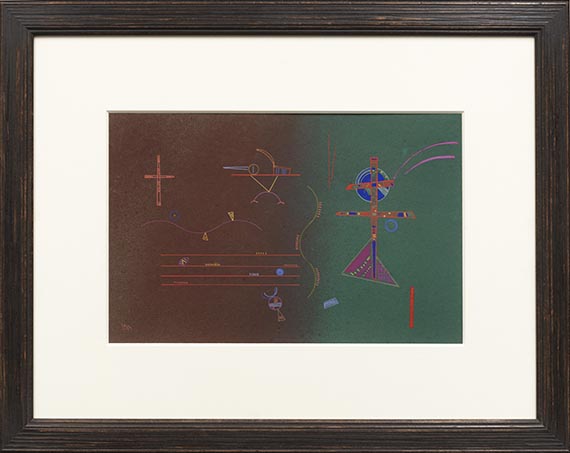
56
Wassily Kandinsky
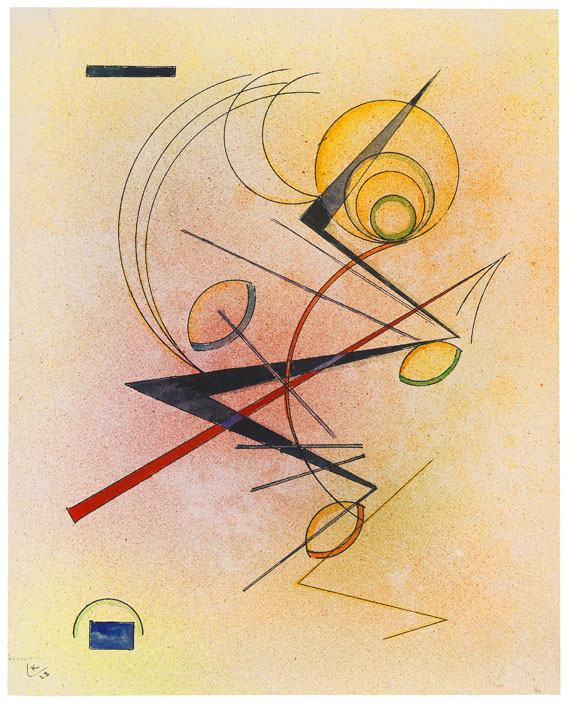
Sachte, 1929.
Watercolor and gouache on paper, originally lam...
Post auction sale: € 250,000 / $ 285,000
56
Wassily Kandinsky
Sachte, 1929.
Watercolor and gouache on paper, originally lam...
Post auction sale: € 250,000 / $ 285,000
Wassily Kandinsky
1866 - 1944
Sachte. 1929.
Watercolor and gouache on paper, originally laminated on cardboard.
Monogrammed and dated “K/29” in the lower left corner. Inscribed “no340 / 1929 / ‘Sachte’” on the reverse. 26.4 x 40.1 cm (10.3 x 15.7 in).
In the artist’s handwritten list, the work is recorded among the watercolors for March 1929 as “iii 1929, 340, Sachte”. [JS].
• The strictly geometric compositions from the Bauhaus years are considered the artist’s most sought-after paper works on the international auction market.
• Point, Line, and Plane: “Sachte” exemplifies Kandinsky’s abstract art theory “Point and Line to Plane” (1926) in an outstanding manner.
• Rarity: one of the rare watercolors executed in a painterly style with a two-tone background.
• Perfect compositional balance between the two sides of the image: stillness and movement, warmth and coolness, lines and planes.
• For the first time on the international auction market: part of a German private collection for nearly 60 years.
• Museum quality: watercolors from this creative period are found in the world’s most important collections, including the Museum of Modern Art and the Guggenheim Museum in New York, as well as the Centre Pompidou in Paris.
PROVENANCE: Rudolf Probst, Mannheim (according to a note in the artist’s handwritten list, presumbaly on consignment).
Nina Kandinsky Collection, Paris.
Karl Flinker, Paris (1962).
Heinz Berggruen, Paris (1962).
Roman Norbert Ketterer, Campione d’Italia (1968).
Private collection, North Rhine-Westphalia (acquired from the above in 1968).
In the family’s possession ever since.
EXHIBITION: Wassily Kandinsky, November Exhibition, Kunsthaus Zürich, Nov. 5–Dec. 9, 1931, no. 69.
Wassily Kandinsky. Ausstelung mit Werken von 1918 bis 1933, Galerie Otto Stangl, July 25–September 4, 1962 (illustrated, no p.).
LITERATURE: Vivian Endicott Barnett, Kandinsky: Catalogue Raisonné of Watercolors, vol. 2: 1922–1944, Munich 1994, cat. no. 931 (with b/w ill.).
- -
Roman Norbert Ketterer, Modern Art V, Campione d'Italia, 1968, no. 63.
"Thus, composition is nothing more than the precise, regular orientation of the living forces enclosed in the elements in the form of tensions. [.] Therefore, the general harmony of a composition can consist of several complexes that rise to the highest degree of contrast. These contrasts may even have a disharmonious character, and yet their proper use will not have a negative effect on the overall harmony and will elevate the work to the highest harmonious essence."
Wassily Kandinsky, Punkt und Linie zu Fläche, Bauhausbücher 9, Munich 1926, p. 86.
1866 - 1944
Sachte. 1929.
Watercolor and gouache on paper, originally laminated on cardboard.
Monogrammed and dated “K/29” in the lower left corner. Inscribed “no340 / 1929 / ‘Sachte’” on the reverse. 26.4 x 40.1 cm (10.3 x 15.7 in).
In the artist’s handwritten list, the work is recorded among the watercolors for March 1929 as “iii 1929, 340, Sachte”. [JS].
• The strictly geometric compositions from the Bauhaus years are considered the artist’s most sought-after paper works on the international auction market.
• Point, Line, and Plane: “Sachte” exemplifies Kandinsky’s abstract art theory “Point and Line to Plane” (1926) in an outstanding manner.
• Rarity: one of the rare watercolors executed in a painterly style with a two-tone background.
• Perfect compositional balance between the two sides of the image: stillness and movement, warmth and coolness, lines and planes.
• For the first time on the international auction market: part of a German private collection for nearly 60 years.
• Museum quality: watercolors from this creative period are found in the world’s most important collections, including the Museum of Modern Art and the Guggenheim Museum in New York, as well as the Centre Pompidou in Paris.
PROVENANCE: Rudolf Probst, Mannheim (according to a note in the artist’s handwritten list, presumbaly on consignment).
Nina Kandinsky Collection, Paris.
Karl Flinker, Paris (1962).
Heinz Berggruen, Paris (1962).
Roman Norbert Ketterer, Campione d’Italia (1968).
Private collection, North Rhine-Westphalia (acquired from the above in 1968).
In the family’s possession ever since.
EXHIBITION: Wassily Kandinsky, November Exhibition, Kunsthaus Zürich, Nov. 5–Dec. 9, 1931, no. 69.
Wassily Kandinsky. Ausstelung mit Werken von 1918 bis 1933, Galerie Otto Stangl, July 25–September 4, 1962 (illustrated, no p.).
LITERATURE: Vivian Endicott Barnett, Kandinsky: Catalogue Raisonné of Watercolors, vol. 2: 1922–1944, Munich 1994, cat. no. 931 (with b/w ill.).
- -
Roman Norbert Ketterer, Modern Art V, Campione d'Italia, 1968, no. 63.
"Thus, composition is nothing more than the precise, regular orientation of the living forces enclosed in the elements in the form of tensions. [.] Therefore, the general harmony of a composition can consist of several complexes that rise to the highest degree of contrast. These contrasts may even have a disharmonious character, and yet their proper use will not have a negative effect on the overall harmony and will elevate the work to the highest harmonious essence."
Wassily Kandinsky, Punkt und Linie zu Fläche, Bauhausbücher 9, Munich 1926, p. 86.
Wassily Kandinsky is regarded as the most important pioneer, or even the inventor, of abstract painting. Inspired by the landscape around Murnau and by music, especially the contemporary compositions of Arnold Schoenberg, Kandinsky developed an increasingly abstract compositional style in 1910–11. Although abstracted to the point of being mere pictorial symbols, this style still contained representational elements—mountains, church towers, boats, figures, and horsemen. These elements are also present in Kandinsky’s world-famous “Composition VII” (Tretyakov Gallery, Moscow) from 1913 and continue to recur in subsequent compositions. It was not until around 1920 that Kandinsky’s visual language, influenced by Russian Constructivism, began to evolve toward a strictly geometric abstraction. This process reached its absolute peak during his years at the Bauhaus. In the summer of 1921, Wassily Kandinsky took up a position at the Bauhaus in Weimar, teaching, among other things, the preparatory course “Analytical Drawing”, before he became head of the Form and Color Theory Department in 1925 after the Bauhaus had moved to Dessau. Here in Dessau, where Kandinsky lived in one of the Masters’ Houses together with Paul Klee, the composition—masterfully balanced in color and composition—was created in March 1929; Kandinsky included it in his handlist under the evocative title “Sachte” (Gentle). With the gentle yet intensely dynamic interplay between the two halves of the composition, developed from the complementary colors red and green, as well as its delicate, almost lyrical line structure and basic geometric forms, “Sachte” is an outstanding example of Kandinsky’s artistic interpretation of his famous treatise “Point and Line to Plane", an abstract art theory published in 1926 as part of the Bauhaus Books series. At the Bauhaus, Kandinsky’s abstraction reached its peak; far removed from any inspiration drawn from nature, he now ventured into strictly geometric, purely abstract pictorial symbols, which he boldly and progressively assembled into complex, masterfully composed pictorial systems. Kandinsky himself described this new approach as “cool abstraction” and published an article on it in Cicerone in 1925. The vocabulary of “cool abstraction” includes bundles of lines and checkerboard structures, circles, and triangles, which occasionally taper to form arrows. Kandinsky’s forms float freely in space or cluster around an imaginary center. Outlines are restrained and colors clarified. Compositions from this significant creative period can be found in major collections worldwide, including the Guggenheim Museum and the Museum of Modern Art in New York, as well as the Centre Pompidou in Paris. [JS]

Buyer's premium and taxation for Wassily Kandinsky "Sachte"
This lot can be purchased subject to differential or regular taxation.
Differential taxation:
Hammer price up to 2,000,000 €: herefrom 34 % premium.
The share of the hammer price exceeding 2,000,000 € is subject to a premium of 29 % and is added to the premium of the share of the hammer price up to 2,000,000 €.
The share of the hammer price exceeding 4,000,000 € is subject to a premium of 22 % and is added to the premium of the share of the hammer price up to 4,000,000 €.
The buyer's premium contains VAT, however, it is not shown.
Regular taxation:
Hammer price up to 2,000,000 €: herefrom 29 % premium.
The share of the hammer price exceeding 2,000,000 € is subject to a premium of 23% and is added to the premium of the share of the hammer price up to 2,000,000 €.
The share of the hammer price exceeding 4,000,000 € is subject to a premium of 15% and is added to the premium of the share of the hammer price up to 4,000,000 €.
The statutory VAT of currently 7 % is levied to the sum of hammer price and premium.
We kindly ask you to notify us before invoicing if you wish to be subject to regular taxation.
Differential taxation:
Hammer price up to 2,000,000 €: herefrom 34 % premium.
The share of the hammer price exceeding 2,000,000 € is subject to a premium of 29 % and is added to the premium of the share of the hammer price up to 2,000,000 €.
The share of the hammer price exceeding 4,000,000 € is subject to a premium of 22 % and is added to the premium of the share of the hammer price up to 4,000,000 €.
The buyer's premium contains VAT, however, it is not shown.
Regular taxation:
Hammer price up to 2,000,000 €: herefrom 29 % premium.
The share of the hammer price exceeding 2,000,000 € is subject to a premium of 23% and is added to the premium of the share of the hammer price up to 2,000,000 €.
The share of the hammer price exceeding 4,000,000 € is subject to a premium of 15% and is added to the premium of the share of the hammer price up to 4,000,000 €.
The statutory VAT of currently 7 % is levied to the sum of hammer price and premium.
We kindly ask you to notify us before invoicing if you wish to be subject to regular taxation.
Headquarters
Joseph-Wild-Str. 18
81829 Munich
Phone: +49 89 55 244-0
Fax: +49 89 55 244-177
info@kettererkunst.de
Louisa von Saucken / Undine Schleifer
Holstenwall 5
20355 Hamburg
Phone: +49 40 37 49 61-0
Fax: +49 40 37 49 61-66
infohamburg@kettererkunst.de
Dr. Simone Wiechers / Nane Schlage
Fasanenstr. 70
10719 Berlin
Phone: +49 30 88 67 53-63
Fax: +49 30 88 67 56-43
infoberlin@kettererkunst.de
Cordula Lichtenberg
Gertrudenstraße 24-28
50667 Cologne
Phone: +49 221 510 908-15
infokoeln@kettererkunst.de
Hessen
Rhineland-Palatinate
Miriam Heß
Phone: +49 62 21 58 80-038
Fax: +49 62 21 58 80-595
infoheidelberg@kettererkunst.de
We will inform you in time.